Making time for the space of appearance: Feminist approaches to solidarity and/as co-appearance
Titolo Rivista STUDI ORGANIZZATIVI
Autori/Curatori Melissa Tyler
Anno di pubblicazione 2025 Fascicolo 2025/2
Lingua Inglese Numero pagine 12 P. 205-216 Dimensione file 152 KB
DOI 10.3280/SO2025-002009
Il DOI è il codice a barre della proprietà intellettuale: per saperne di più
clicca qui
Qui sotto puoi vedere in anteprima la prima pagina di questo articolo.
Se questo articolo ti interessa, lo puoi acquistare (e scaricare in formato pdf) seguendo le facili indicazioni per acquistare il download credit. Acquista Download Credits per scaricare questo Articolo in formato PDF
FrancoAngeli è membro della Publishers International Linking Association, Inc (PILA), associazione indipendente e non profit per facilitare (attraverso i servizi tecnologici implementati da CrossRef.org) l’accesso degli studiosi ai contenuti digitali nelle pubblicazioni professionali e scientifiche.
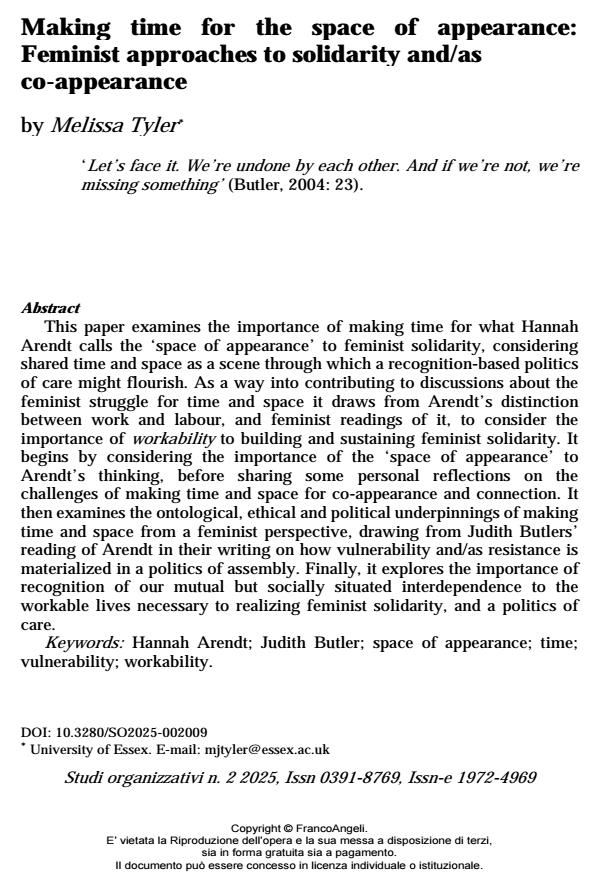
This paper examines the importance of making time for what Hannah Arendt calls the ‘space of appearance’ to feminist solidarity, considering shared time and space as a scene through which a recognition-based politics of care might flourish. As a way into contributing to discussions about the feminist struggle for time and space it draws from Arendt’s distinction between work and labour, and feminist readings of it, to consider the importance of workability to building and sustaining feminist solidarity. It begins by considering the importance of the ‘space of appearance’ to Arendt’s thinking, before sharing some personal reflections on the challenges of making time and space for co-appearance and connection. It then examines the ontological, ethical and political underpinnings of making time and space from a feminist perspective, drawing from Judith Butlers’ reading of Arendt in their writing on how vulnerability and/as resistance is materialized in a politics of assembly. Finally, it explores the importance of recognition of our mutual but socially situated interdependence to the workable lives necessary to realizing feminist solidarity, and a politics of care.
Questo articolo indaga l'importanza di trovare il tempo per quello che Hannah Arendt chiama lo “spazio dell'apparenza” per la solidarietà femminista, considerando il tempo e lo spazio condivisi come un contesto attraverso il quale potrebbe fiorire una politica di cura basata sul riconoscimento. Come contributo alle discussioni sulla lotta femminista per il tempo e lo spazio, questo testo si basa sulla distinzione di Arendt tra work e labour, e sulle letture femministe di questa distinzione, per considerare l'importanza della condizione di workability nel costruire e sostenere la solidarietà femminista. Il contributo inizia considerando l'importanza dello “spazio dell'apparenza” nel pensiero di Arendt, prima di condividere alcune riflessioni personali sulle sfide di creare tempo e spazio per la co-apparizione e la connessione. Si interroga poi sui fondamenti ontologici, etici e politici della creazione di tempo e spazio da una prospettiva femminista, attingendo alla lettura di Judith Butler di Arendt nei loro scritti su come la vulnerabilità e/come resistenza si materializza in una politica di azione collettiva (assembly). Infine, esplora l'importanza del riconoscimento della nostra interdipendenza reciproca, ma socialmente situata, per le vite workable necessarie a realizzare la solidarietà femminista e una politica di cura.
Parole chiave:Hannah Arendt; Judith Butler; spazio dell’apparenza; tempo; vulnerabilità; workability.
- Arendt, H. (1998), First published 1958. The Human Condition, Chicago, Ill: University of Chicago Press.
- Bauman, Z. (2016), Strangers at Our Door, Cambridge, Polity.
- Beauvoir De, S. (2011), First published 1949. The Second Sex, translated by Constance Borde and Sheila Maldvany-Chavallier, New York, Vintage.
- Butler, J. (2004), Undoing Gender, London, Routledge.
- Butler, J. (2015), Notes Toward a Performative Theory of Assembly, Cambridge, MA: Harvard University Press.
- Butler, J. (2020), The Force of Nonviolence: An Ethico-Political Bind, London, Verso.
- Butler, J. (2022), What World is This? A Pandemic Phenomenology, New York, Columbia University Press.
- Care Collective (2020), The Care Manifesto, London, Verso.
- Cavarero, A. (2016), Inclinations: A Critique of Rectitude. translated by A. Minervini and A. Sitze, Stanford, CA: University of Stanford Press.
- Fotaki, M. (2022), “Solidarity in crisis? Community responses to refugees and forced migrants in the Greek islands”, Organization, 29(2): 295-323. DOI: 10.1177/13505084211051048
- Hegel, G.W.F. (1977), first published 1807, Phenomenology of Spirit, Oxford, Oxford University Press.
- Kenny, K. (2024), Regulators of Last Resort: Whistleblowers, the Limits of the Law and the Power of Partnerships, Cambridge, Cambridge University Press.
- Kenny, K. (2025), ‘After months of Trump’s shock tactics, whistleblower groups are pushing back against attached on workers’ rights’, The Conversation. 25th March 2025.
- Lapper, A. (2005), Alison Lapper: My Life in My Hands, London, Simon and Schuster.
- Mandalaki, E. and Fotaki, M. (2020), “The bodies of the commons: Towards a relational embodied ethics of the commons”, Journal of Business Ethics, 166: 745-760.
- Mbembe, A. (2019), Necropolitics, translated by S. Corcoran, London, Duke University Press.
- Pianezzi, D. (2025), Corporeal Ethics for Feminist Work: (Dis)Organized Bodies, Bristol, Bristol University Press.
- Segal, L. (2018), Radical Happiness: Moments of Collective Joy, London, Verso.
- Smolovic Jones, S. (2023), “Gaslighting and dispelling: Experiences of non-governmental organization workers in navigating gendered corruption”, Human Relations, 76(6): 901-925. DOI: 10.1177/00187267221083274
- Smolovic Jones, S., Winchester, N. and Clarke, C. (2021), “Feminist solidarity building as embodied agonism: An ethnographic account of a protest movement”, Gender, Work and Organization, 28(3): 917-934.
- Tronto, J. (2015), Who Cares? How to Reshape a Democratic Politics, New York, Cornell.
- Vachhani, S. (2020), “Envisioning a democratic culture of difference: Feminist ethics and the politics of dissent in social movements”, Journal of Business Ethics, 164: 745-757.
- Wall Kimmerer, R. (2013), Braiding Sweetgrass: Indigenous Wisdom, Scientific Knowledge and the Teachings of Plants, London, Penguin.
- Wall Kimmerer, R. (2024), The Serviceberry: An Economy of Gifts and Abundance, London, Allen Lane.
- Wiskström, A., Lund, R., Meriläinen, S., Øyslebø Sørensen, S., Vachhani, S. and Pullen, A. (2021), “Feminist solidarity: Practices, politics and possibilities”, Gender, Work and Organization, 28(3): 857-863.
Melissa Tyler, Making time for the space of appearance: Feminist approaches to solidarity and/as co-appearance in "STUDI ORGANIZZATIVI " 2/2025, pp 205-216, DOI: 10.3280/SO2025-002009