Disuguaglianze in codice. Un’esplorazione della discriminazione algoritmica come violenza contro le donne
Titolo Rivista SOCIOLOGIA DELLA COMUNICAZIONE
Autori/Curatori Paola Panarese, Vittoria Azzarita, Marta Grasso
Anno di pubblicazione 2026 Fascicolo 2025/70
Lingua Italiano Numero pagine 20 P. 117-136 Dimensione file 658 KB
DOI 10.3280/SC2025-070007
Il DOI è il codice a barre della proprietà intellettuale: per saperne di più
clicca qui
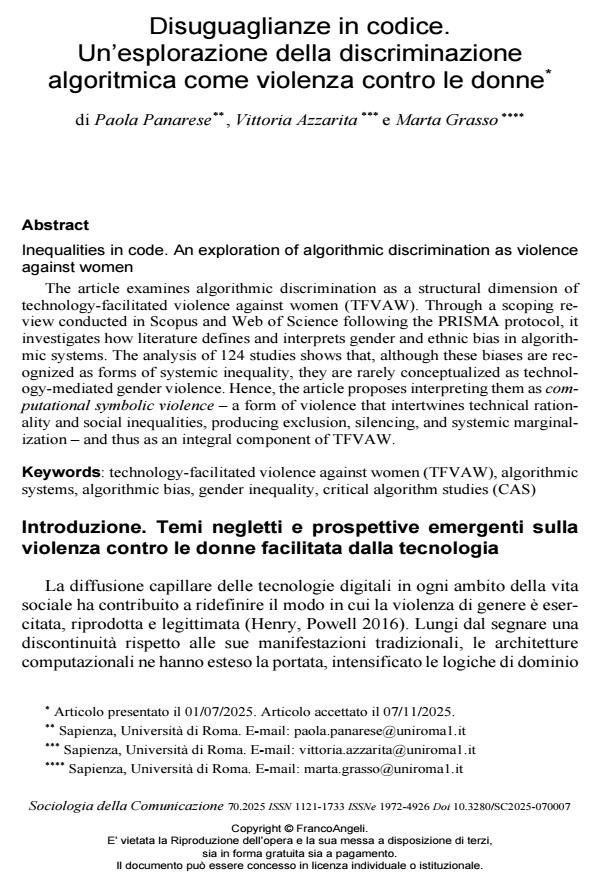
Qui sotto puoi vedere in anteprima la prima pagina di questo articolo.
Se questo articolo ti interessa, lo puoi acquistare (e scaricare in formato pdf) seguendo le facili indicazioni per acquistare il download credit. Acquista Download Credits per scaricare questo Articolo in formato PDF
FrancoAngeli è membro della Publishers International Linking Association, Inc (PILA), associazione indipendente e non profit per facilitare (attraverso i servizi tecnologici implementati da CrossRef.org) l’accesso degli studiosi ai contenuti digitali nelle pubblicazioni professionali e scientifiche.
The article examines algorithmic discrimination as a structural dimension of technology-facilitated violence against women (TFVAW). Through a scoping review conducted in Scopus and Web of Science following the PRISMA protocol, it investigates how literature defines and interprets gender and ethnic bias in algorithmic systems. The analysis of 124 studies shows that, although these biases are recognized as forms of systemic inequality, they are rarely conceptualized as technology-mediated gender violence. Hence, the article proposes interpreting them as computational symbolic violence – a form of violence that intertwines technical rationality and social inequalities, producing exclusion, silencing, and systemic marginalization – and thus as an integral component of TFVAW.
Parole chiave:technology-facilitated violence against women (TFVAW), algorithmic systems, algorithmic bias, gender inequality, critical algorithm studies (CAS)
- Yegenoglu M. (1998), Colonial Fantasies: Towards a Feminist Reading of Orientalism, Cambridge University Press, Cambridge.
- Airoldi M. (2024), Machine Habitus. Sociologia degli algoritmi, Luiss University Press, Roma.
- Amrute S. (2020), Bored techies being casually racist: Race as algorithm, in «Science, Technology, & Human Values», n. 45, 5, pp. 903 - 933. DOI: 10.1177/0162243920912824
- Antonopoulou C. (2023), Algorithmic bias in anthropomorphic artificial intelligence: critical perspectives through the practice of women media artists and designers, in «Technoetic Arts», 21, pp. 157-174.
- Arendt H. (1964), La Banalità del Male. Eichmann a Gerusalemme, Feltrinelli, Milano.
- Asdal K., Reinertsen H. (2021), Doing Document Analysis: A Practice-Oriented Method, Sage Publications, Thousand Oaks.
- Beer D. (2009), Power through the algorithm? Participatory web cultures and the technological unconscious, in «New Media & Society», 11, 6, pp. 985-1002. DOI: 10.1177/1461444809336551.
- Beer D. (2017), The social power of algorithms, in «Information, Communication & Society», 20, 1, pp. 1-13. DOI: 10.1080/1369118X.2016.1216147.
- Benjamin R. (2019), Race after technology: Abolitionist tools for the new Jim code, Polity Press, Cambridge.
- Borau S., Otterbring T., Laporte S., Fosso Wamba S. (2021), The most human bot: Female gendering increases humanness perceptions of bots and acceptance of AI, in «Psychol Mark», 38, pp. 1052-1068.
- Broussard M. (2024), More than a Glitch. Confronting Race, Gender, and Ability Bias in Tech, MIT Press, Cambridge, MA.
- Brown C., Hegarty K. (2018), Digital dating abuse measures: A critical review, in «Aggression and Violent Behavior», 40, pp. 44-59.
- Bucher T. (2018), If… then: Algorithmic power and politics, Oxford University Press, Oxford.
- Buolamwini J., Gebru T. (2018), Gender shades: Intersectional accuracy disparities in commercial gender classification, Conference on fairness, accountability and transparency, pp. 77-91.
- Caliskan A., Bryson J.J., Narayanan A. (2017), Semantics derived automatically from language corpora contain human-like biases, in «Science», 356, pp. 183-186.
- Charlesworth T.E., Yang V., Mann T.C., Kurdi B., Banaji M.R. (2021), Gender stereotypes in natural language: word embeddings show robust consistency across child and adult language corpora of more than 65 million words, in «Psychological Science», 32, pp. 218-240.
- Chowdhury R., Lakshmi D. (2023), “Your opinion doesn’t matter, anyway”. Exposing Technology-Facilitated Gender-Based Violence in an Era of Generative AI, UNESCO, disponible in: https://unesdoc.unesco.org/ark:/48223/pf0000387483 (01 ottobre 2025).
- Citron D.K. (2015), Addressing Cyber Harassment: An Overview of Hate Crime in Cyberspace, in «Journal of Law, Technology & the Internet», 6, (1), pp. 1-12.
- Connell R.W. (2005), Masculinities, University of California Press, Berkeley.
- Costa P. (2018), Conversing with personal digital assistants: On gender and artificial intelligence, in «Journal of Science and Technology of the Arts», 10, 201, pp. 59-72.
- Crawford K. (2021), Atlas of AI: Power, politics, and the planetary costs of artificial intelligence, Yale University Press, New Haven.
- Crenshaw K. (1991), Mapping the Margins: Intersectionality, Identity Politics, and Violence against Women of Color, in «Stanford Law Review», vol. 43, no. 6, pp. 1241.99. JSTOR, DOI: 10.2307/1229039.
- Dastin J. (2018), Amazon Scraps Secret AI Recruiting Tool That Showed Bias against Women, Reuters, https://www.reuters.com/article/world/insight-amazon-scraps-secret-ai-recruiting-tool-that-showed-bias-against-women-idUSKCN1MK0AG/
- de Boise S. (2019), Editorial: is masculinity toxic?, in «International Journal for Masculinity Studies», 14, pp. 147-151. DOI: 10.1080/18902138.2019.1654742
- D’Ignazio C., Klein L.F. (2020), Data feminism, MIT Press, Cambridge, MA.
- Dignum V. (2022), Relational artificial intelligence. arXiv.
- Dragiewicz M., Burgess J., Matamoros-Fernández A., Salter M., Suzor N. P., Woodlock D., Harris B. (2018), Technology facilitated coercive control: domestic violence and the competing roles of digital media platforms, in «Feminist Media Studies», 18, 4, pp. 609-625. DOI: 10.1080/14680777.2018.1447341.
- Eubanks V. (2018), Automating inequality: How high-tech tools profile, police, and punish the poor, Picador, St Martin’s Press, New York.
- European Institute for Gender Equality (2025), EU gender-based violence survey: Key results, Publications Office of the European Union, Bruxelles. DOI: 10.2839/3648756.
- Fairclough, N. (2015). Language and Power (3rd ed.), Routledge, New York.
- Flynn A., Powell A., Hindes S. (2024), An intersectional analysis of technology-facilitated abuse: Prevalence, experiences and impacts of victimization, in «The British Journal of Criminology», 64, 3, pp. 600-619.3/bjc/azad044.
- García-Ull F. J., Melero-Lázaro M. (2023), Gender stereotypes in AI-generated images, in «Profesional de la Información», 32, 5.
- Garg N., Schiebinger L., Jurafsky D., Zou J. (2018), Word embeddings quantify 100 years of gender and ethnic stereotypes, in «Proceedings of the National Academy of Sciences», 115, 16, pp. E3635-E3644.
- Garrido M. (2022), Mapping Online Gender-Based Violence, UPEACE Press, San Josè.
- Gillespie T., Seaver N. (2015), Critical Algorithm Studies: A Reading List, in «Social Media Collective», November 5. https://socialmediacollective.org/reading-lists/critical-algorithm-studies/.
- Gorska A. M., Jemielniak D. (2023), The invisible women: Uncovering gender bias in AI-generated images of professionals, in «Feminist Media Studies», 23, pp. 4370-4375.
- Guo Y., Liu D., Yin X., Xu S. X. (2021), She is not just a computer: Gender role of AI chatbots in debt collection, in Proceedings of the International Conference on Information Systems (ICIS 2020), Association for Information Systems.
- Henry N., Powell A. (2016), Technology-facilitated sexual violence: A literature review of empirical research, in «Trauma, Violence, & Abuse», 19, 2, pp. 195-208. DOI: 10.1177/1524838016650189.
- Hicks M. (2019), Hacking the cis-tem, in «IEEE Annals of the History of Computing», 41, 1, pp. 20-33.
- Jain L.R., Menon V. (2023), AI algorithmic bias: Understanding its causes, ethical and social implications, in «Proceedings of the 2023 IEEE 35th International Conference on Tools with Artificial Intelligence (ICTAI)», IEEE, pp. 460-467.
- Jane E. A. (2017), Misogyny online: A short (and brutish) history, SAGE Publications, London.
- Kelly L. (1987), The Continuum of Sexual Violence, in Hanmer J., Maynard M. (eds.), Women, Violence and Social Control, Palgrave Macmillan, London, pp. 46-60.
- Kim S., Lee J., Oh P. (2024), Questioning artificial intelligence: How racial identity shapes the perceptions of algorithmic bias, in «International Journal of Communication», 18, pp. 677-699.
- Kitchin R. (2017), Thinking critically about and researching algorithms, in «Information, Communication & Society», 20, 1, pp. 14-29. DOI: 10.1080/1369118X.2016.1154087.
- Leavy S., Siapera E., O’Sullivan B. (2021), Ethical data curation for AI: An approach based on feminist epistemology and critical theories of race, in «Proceedings of the 2021 AAAI/ACM Conference on AI, Ethics, and Society», pp. 695-703.
- Lombard N. (ed.) (2018), The Routledge handbook of gender and violence, Routledge, London and New York.
- Noble S.U. (2018), Algorithms of oppression. How search engines reinforce racism, NYU Press, New York.
- O’Neil C. (2016), Weapons of math destruction. How big data increases inequality and threatens democracy, Crown, New York.
- Page M.J., McKenzie J.E., Bossuyt P.M., Boutron I., Hoffmann T.C., Mulrow C.D., et al. (2021), The PRISMA 2020 statement: An updated guideline for reporting systematic reviews, in «BMJ», 372, n71.
- Palacios Barea M.A., Boeren D., Ferreira Goncalves J.F. (2023), At the intersection of humanity and technology: a technofeminist intersectional critical discourse analysis of gender and race biases in the natural language processing model GPT-3, in «AI & Society», 40, pp. 461-479.
- Pan B, Hembrooke H, Joachims T, et al. (2007), In Google we trust: users’ decisions on rank, position, and relevance, in «Journal of Computer Mediated Communication», 12, (3), pp. 801-823.
- Pavan E. (2017), Internet intermediaries and online gender-based violence, in Segrave M., Vitis L. (eds.), Gender, technology and violence, Routledge, London, pp. 62-78. DOI: 10.4324/9781315441160-5.
- Peng Y. (2018), Same candidates, different faces: Uncovering media bias in visual portrayals of presidential candidates with computer vision, in «Journal of Communication», 68, 5, pp. 920-941.
- Powell A. (2021), ‘Intimate intrusions’: Technology facilitated dating and intimate partner violence, in Flynn A., Powell A., Sugiura L. (eds.), The Palgrave handbook of gendered violence and technology, Palgrave Macmillan, Cham, pp. 157-179. DOI: 10.1007/978-3-030-83734-1_9.
- Powell A., Henry N. (2017), Sexual violence in a digital age, Palgrave Macmillan, London.
- Prates M.O.R., Avelar P.H., Lamb L.C. (2020), Assessing gender bias in machine translation: a case study with Google Translate, in «Neural Computing and Application», 32, pp. 6363-6381
- Russell D. (1990), Rape in marriage, Indiana University Press, Bloomington.
- Schaper U., Beljan M., Eitler P., et al. (2020), Sexotic: The interplay between sexualization and exoticization, in «Sexualities», 23, 1-2, pp. 114-126.
- Seaver N. (2017), Algorithms as culture: Some tactics for the ethnography of algorithmic systems, in «Big Data & Society», 4, 2, DOI: 10.1177/2053951717738104.
- - (2019), Captivating algorithms: Recommender systems as traps, in «Journal of Material Culture», 24, 4, pp. 421-436. DOI: 10.1177/1359183518820366.
- Semenzin S., Bainotti L. (2020), The use of Telegram for non-consensual dissemination of intimate images: Gendered affordances and the construction of masculinities, in «Social Media + Society», 6, 4, 2056305120984453.0.1177/2056305120984453.
- Senent R.M., Bueso D. (2022), The Banality of (Automated) Evil: Critical Reflections on the Concept of Forbidden Knowledge in Machine Learning Research, in «Recerca: Revista de Pensament i Anàlisi», 27, 2, pp. 1-26.
- Suchman L. (2007), Human-Machine Reconfigurations: Plans and Situated Actions (2nd ed), Cambridge University Press, Cambridge.
- Sun L., Wei M., Sun Y., Suh Y.J., Shen L., Yang S. (2024), Smiling women pitching down: Auditing representational and presentational gender biases in image-generative AI, in «Journal of Computer-Mediated Communication», 29, 1, zmad045.
- Tipaldo G. (2025), L’analisi del contenuto e i media digitali. Dalla critica delle fonti a ChatGPT, il Mulino, Bologna.
- UN Women (2023), Expert group meeting report: Technology-facilitated violence against women. Towards a common definition, testo disponibile in: https://www.unwomen.org/sites/default/files/2023-03/Expert-Group-Meeting-report-Technology-facilitated-violence-against-women-en.pdf (01 ottobre 2025).
- Urman A., Makhortykh M. (2024), “Foreign beauties want to meet you”: The sexualization of women in Google’s organic and sponsored text search results, in «New Media & Society», 26, 5, pp. 2932-2953. DOI: 10.1177/1461448231159865.
- Wachter-Boettcher S. (2017), Technically wrong. Sexist apps, biased algorithms, and other threats of toxic tech, WW Norton & Company, New York.
- Waelen R., Wieczorek M. (2022), The struggle for AI’s recognition: Understanding the normative implications of gender bias in AI with Honneth’s theory of recognition, in «Philosophy & Technology», 35, 53.
- Wang C., Wang K., Bian A., Islam R., Keya K.N., Foulds J., Pan S. (2022), Do humans prefer debiased AI algorithms? A case study in career recommendation, in Proceedings of the 27th International Conference on Intelligent User Interfaces, pp. 134-147.
- Wellner G., Rothman T. (2020), Feminist AI: Can we expect our AI systems to become feminist?, in «Philosophy and Technology», 33, pp. 191-205.
- Wright P.J., Tokunaga R.S. (2016), Men’s objectifying media consumption, objectification of women, and attitudes supportive of violence against women, in «Archives of Sexual Behavior», 45, 4, 2016, pp. 955-964.
Paola Panarese, Vittoria Azzarita, Marta Grasso, Disuguaglianze in codice. Un’esplorazione della discriminazione algoritmica come violenza contro le donne in "SOCIOLOGIA DELLA COMUNICAZIONE " 70/2025, pp 117-136, DOI: 10.3280/SC2025-070007