Algorithms in Employment Matchmaking: bridging Public and Private Sectors Approaches
Titolo Rivista STUDI ORGANIZZATIVI
Autori/Curatori Gianluca Scarano, Sofia Rigolli
Anno di pubblicazione 2026 Fascicolo 2026/1
Lingua Inglese Numero pagine 25 P. 9-33 Dimensione file 189 KB
DOI 10.3280/SO2026-001001
Il DOI è il codice a barre della proprietà intellettuale: per saperne di più
clicca qui
Qui sotto puoi vedere in anteprima la prima pagina di questo articolo.
Se questo articolo ti interessa, lo puoi acquistare (e scaricare in formato pdf) seguendo le facili indicazioni per acquistare il download credit. Acquista Download Credits per scaricare questo Articolo in formato PDF
FrancoAngeli è membro della Publishers International Linking Association, Inc (PILA), associazione indipendente e non profit per facilitare (attraverso i servizi tecnologici implementati da CrossRef.org) l’accesso degli studiosi ai contenuti digitali nelle pubblicazioni professionali e scientifiche.
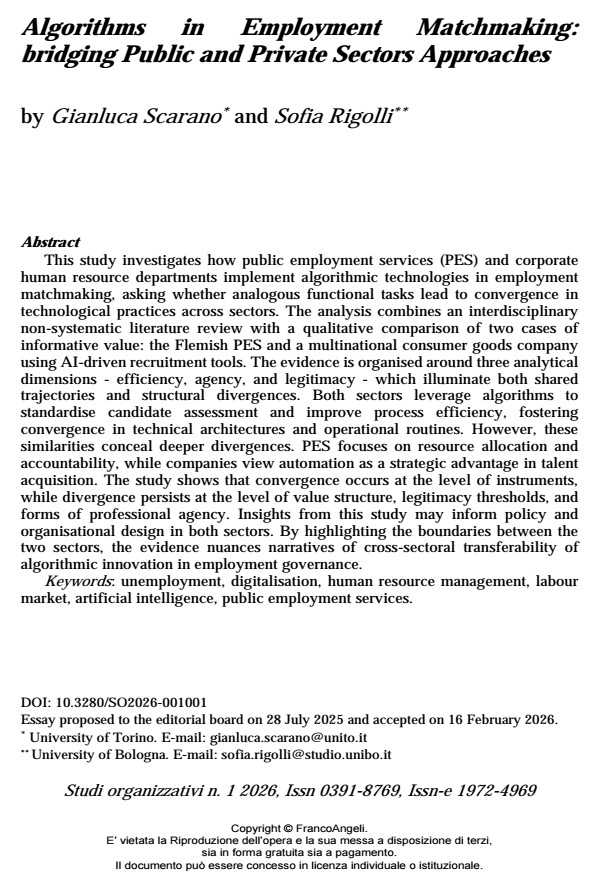
This study investigates how public employment services (PES) and corporate human resource departments implement algorithmic technologies in employment matchmaking, asking whether analogous functional tasks lead to convergence in technological practices across sectors. The analysis combines an interdisciplinary non-systematic literature review with a qualitative comparison of two cases of informative value: the Flemish PES and a multinational consumer goods company using AI-driven recruitment tools. The evidence is organised around three analytical dimensions - efficiency, agency, and legitimacy - which illuminate both shared trajectories and structural divergences. Both sectors leverage algorithms to standardise candidate assessment and improve process efficiency, fostering convergence in technical architectures and operational routines. However, these similarities conceal deeper divergences. PES focuses on resource allocation and accountability, while companies view automation as a strategic advantage in talent acquisition. The study shows that convergence occurs at the level of instruments, while divergence persists at the level of value structure, legitimacy thresholds, and forms of professional agency. Insights from this study may inform policy and organisational design in both sectors. By highlighting the boundaries between the two sectors, the evidence nuances narratives of cross-sectoral transferability of algorithmic innovation in employment governance.
Il contributo si concentra sulle tecnologie algoritmiche per l’incontro tra domanda e offerta di lavoro adottate dai servizi pubblici per l’impiego e dai dipartimenti di risorse umane aziendali, chiedendosi se compiti funzionali analoghi possano condurre a una convergenza tra i due settori. L’analisi combina una revisione interdisciplinare non sistematica della letteratura con un confronto qualitativo tra due casi selezionati per il loro valore informativo: il servizio pubblico per l’impiego delle Fiandre, da un lato, e una multinazionale dei beni di consumo, dall’altro. Le evidenze sono organizzate attorno a tre dimensioni analitiche - efficienza, agenzia e legittimità - che mettono in luce sia traiettorie condivise sia divergenze strutturali. Entrambi i settori utilizzano algoritmi per standardizzare la valutazione dei candidati e migliorare l’efficienza dei processi di selezione, favorendo una convergenza nelle architetture tecniche e nelle routine operative. Tuttavia, mentre le priorità dei servizi pubblici per l’impiego si concentrano principalmente sull’allocazione delle risorse pubbliche e sulla responsabilità istituzionale, le aziende considerano l’automazione come un vantaggio strategico nell’acquisizione dei talenti. Permangono inoltre divergenze più profonde nelle strutture valoriali di riferimento dei due settori, nelle rispettive soglie di legittimità, nonché nei fattori di agenzia relativi alle professionalità coinvolte. Evidenziando i confini tra i due ambiti, i risultati contribuiscono a problematizzare le narrazioni sulla trasferibilità intersettoriale dell’innovazione algoritmica nella governance dell’occupazione.
Parole chiave:disoccupazione, digitalizzazione, gestione delle risorse umane, mercato del lavoro, intelligenza artificiale, servizi pubblici per l’impiego.
- Ahmed, O. (2018), “Artificial Intelligence in HR”, International journal of research and analytical reviews, 5(4):971-978.
- Allhutter, F.C., Fischer, F., Grill, G., Mager, A. (2020), “Algorithmic profiling of job seekers in Austria: how austerity politics are made effective?”, Frontiers in Big Data, 3(5):1-17,
- Arntz, M., Gregory, T., Zierahn, U. (2016), “The risk of automation for jobs in OECD countries: A comparative analysis”, OECD Social, Employment and Migration Working Papers, 189, Paris, OECD Publishing,
- Ayesha J., Juthika K. B. (2020), “The viability of AI-based recruitment process: A systematic literature review”, Thesis in IT Management, Umea University.
- Ball, S., McGann, M., Nguyen, P., Considine, M. (2023), “Emerging modes of digitalisation in the delivery of welfare-to-work: Implications for street-level discretion”, Social Policy & Admnistration, 1-15,
- Bernhard, I. (2013), “E-government and E-governance – Swedish Case Studies with Focus on the Local Level”, Thesis in Planning and Decision Analysis, KTH Stockholm.
- Black, J.S., Van Esch, P. (2020), “AI-enabled recruiting: What is it and how should a manager use it?”, Business Horizons, 63(2):215-226,
- Bogen, M. (2019), “All the ways hiring algorithms can introduce bias”, Harvard Business Review.
- Bogen, M., Rieke, A. (2018), “Help wanted: An examination of hiring algorithms, equity, and bias”, Upturn.
- Boselli, R., Cesarini, M., Mercorio, F., & Mezzanzanica, M. (2018), “Classifying online job advertisements through machine learning”. Future Generation Computer Systems, 86:319–328,
- Breit, E., Egeland, C., Løberg, I.B., Røhnebæk, M. (2020), “Digital coping: How frontline workers cope with digital service encounters”, Social Policy & Administration, 55(5):833–847,
- Brynjolfsson, E., McAfee, A. (2014), The Second Machine Age: Work, Progress, and Prosperity in a Time of Brilliant Technologies, New York, WW Norton & Company.
- Carey, D., Smith, M. (2016), “How companies are using simulations, competitions, and analytics to hire”, Harvard Business Review.
- Chen, Z. (2023), “Ethics and discrimination in artificial intelligence-enabled recruitment practices”, Humanities and Social Sciences Communications, 10(1):1-12,
- Considine, M., McGann, M., Ball, S., Nguyen, P. (2022), “Can Robots Understand Welfare? Exploring Machine Bureaucracies in Welfare-to-Work”, Journal of Social Policy, 51(3):519-534, DOI: 10.1017/S0047279422000174
- Danneels, L., Viaene, S. (2015), “Simple rules strategy to transform government: An ADR approach”, Government Information Quarterly, 32(4):516-525,
- Delecraz, S., Eltarr, L., Becuwe, M., Bouxin, H., Boutin, N., Oullier, O. (2022), “Responsible Artificial Intelligence in Human Resources Technology: An innovative inclusive and fair by design matching algorithm for job recruitment purposes”, Journal of Responsible Technology, 11,
- Delpierre, A., Demazière, D., El Fatihi, H. (2024), “The stealth legitimization of a controversial policy tool: Statistical profiling in French Public Employment Service”, Regulation & Governance, 18(2):499–512,
- Dencik, L. (2022), The Datafied Welfare State: a Perspective from the UK. In A. Hepp, J. Jarke & L. Kramp (Eds.), New perspectives in critical data studies, New York, Springer International Publishing, DOI: 10.1007/978-3-030-96180-0_7
- Desiere, S., Langenbucher, K., Struyven, L. (2019), “Statistical profiling in public employment services: An international comparison”, OECD Social, Employment and Migration Working Papers, 224, Paris, OECD Publishing,
- Desière, S., Struyven, L. (2021), “Using Artificial Intelligence to Classify Jobseekers: The Accuracy-Equity Trade-off”, Journal of Social Policy, 50(2):367-385, DOI: 10.1017/S0047279420000203
- Doherty, R. (2010), “Getting social with recruitment”, Strategic HR Review, 9(6):11–15, DOI: 10.1108/14754391011078063
- Drage, E., Mackereth, K. (2022), “Does AI Debias Recruitment? Race, Gender, and AI’s eradication of difference”, Philosophy & Technology, 35(4),
- Elia, G., Margherita, A. (2015), “Next-generation human resource management: a system for measuring and visualising professional competencies”, International Journal of Human Resources Development and Management, 15(1):1-15, DOI: 10.1504/IJHRDM.2015.069975
- Faliagka, E., Iliadis, L., Karydis, I., Rigou, M., Sioutas, S., Tsakalidis, A., Tzimas, G. (2014), “On-line consistent ranking on e-recruitment: seeking the truth behind a well-formed CV”, Artificial Intelligence Review, 42:515-528,
- Fernández-Martínez, C., Fernández, A. (2020), “AI and recruiting software: Ethical and legal implications”, Paladyn, Journal of Behavioral Robotics, 11(1):199-216,
- Frey, B.C., Osbourne, M.A. (2017), “The future of employment: How susceptible are jobs to computerisation?”, Technological Forecasting and Social Change, 114:254-280,
- Fugate, M., Kinicki, A., Ashforth, B. (2004), “Employability: a psycho-social construct, itsdimensions, and applications”, Journal of Vocational Behavior, 65 (1):14-38,
- Gallagher, P.,Griffin, R. (2023), “(in)Accuracy in Algorithmic Profiling of the Unemployed–An Exploratory Review of Reporting Standards”, Social Policy and Society, DOI: 10.1017/S1474746423000428
- Hakan, B., Utku, K. (2018). "Emotion extraction from facial expressions by using artificial intelligence techniques", BRAIN-Broad Research in Artifical Intelligence and Neuriscience, 9(1):5-16,
- Hamilton, R. H., Davison, H. K. (2018), “The search for skills: Knowledge stars and innovation in the hiring process”, Business Horizons, 6(3):409–419,
- Harwell, D. (2022), “A Face-Scanning Algorithm Increasingly Decides Whether You Deserve the Job”, Ethics of Data and Analytics, Auerbach Publications, 206-211.
- Haug, K. B., Hansen, M. P. (2025), “The politics of algorithmic profiling of unemployed: A framework for analysing legitimation, contestation, and compromises”, Journal of European Social Policy, OnlineFirst, DOI: 10.1177/09589287251345909
- Henman, P. (2020), “Improving public services using artificial intelligence: possibilities, pitfalls, governance”, Asia Pacific Journal of Public Administration, 42(4):209–221, DOI: 10.1080/23276665.2020.1816188
- Hilliard, A., Guenole, N., Leutner, F. (2022), “Robots are judging me: Perceived fairness of algorithmic recruitment tools”, Frontiers in Psychology - Sec. Organizational Psychology, 13,
- Høybye-Mortensen, M. (2015), “Decision-making tools and their influence on caseworkers' room for discretion”, The British Journal of Social Work, 45(2):600-615,
- Hood, C. (1991), “A Public Management for all Seasons?”, Public Administration Review, 69(1): 3-19,
- Hu, Q. (2023), “Unilever’s practice on AI-based recruitment”, Highlights in Business, Economics and Management, 16:256–263,
- Hunkenschroer, A. L., Luetge, C. (2022), “Ethics of AI-enabled recruiting and selection: A review and research agenda”, Journal of Business Ethics, 178(4):977-1007,
- Johansson, J., Herranen, S. (2019), “The Application of Artificial Intelligence (AI) in Human Resource Management: The Current State of AI and Its Impact on the Traditional Recruitment Process”, Thesis in Business Administration, Jonkoping International Business School.
- Joseph, S., Avdic, A. (2016), “Where do the Nordic Nations’ Strategies Take e-Government?”. Electronic Journal of e-Government, 14(1):2-16.
- Joyce, K., Smith-Doerr, L., Alegria, S., Bell, S., Cruz, T., Hoffman, S. G., Noble, S. U., Shestakofsky, B. (2021), "Toward a sociology of artificial intelligence: A call for research on inequalities and structural change", Socius: Sociological Research for a Dynamic World, 7, DOI: 10.1177/2378023121999581
- Kammerer, B. (2022), “Hired by a Robot: The Legal Implications of Artificial Intelligence Video Interviews and Advocating for Greater Protection of Job Applicants”, Iowa Law Review, 107(2).
- Kaur, M. et al. (2022), “Innovative capacity of governments: A systemic framework”, OECD Working Papers on Public Governance, 51, Paris, OECD Publishing,
- Köchling, A., Wehner, M. C., Warkocz, J. (2023), “Can I show my skills? Affective responses to Artificial Intelligence in the recruitment process”, Review of Managerial Science, 17(6):2109–2138,
- Kuncel, N. R., Klieger, D. M., Ones, D. S. (2014), “In Hiring, Algorithms Beat Instinct”, Harvard Business Review, 92(5), 32.
- Lacroux, A., Martin-Lacroux, C. (2022), “Should I trust the artificial intelligence to recruit? Recruiters’ perceptions and behavior when faced with algorithm-based recommendation systems during resume screening”, Frontiers in Psychology, 13,
- Lipsky, M. (1980), Street-level bureaucracy: Dilemmas of the individual in public service, New York, Russell Sage Foundation.
- Lodemel, I., Moreira, A. (2014), Activation or Workfare? Governance and Neo-liberal convergence, Oxford, Oxford University Press,
- Malgieri, G., Comandé, G. (2017), “Why a Right to Legibility of Automated Decision-Making Exists in the General Data Protection Regulation”, International Data Privacy Law, 7(4):243-265,
- Mariani, K., Vega-Lozada, F. (2023), “The Use of AI and Algorithms for Decision-making in Workplace Recruitment Practices”, Journal of Student Research, 12 (1),
- Melanthiou, Y., Pavlou, F., Constantinou, E. (2015), “The use of social network sites as an e-recruitment tool”, Journal of Transnational Management, 20(1):31–49, DOI: 10.1080/15475778.2015.998141.
- Mosley H., Schutz H., and Breyer N. (2001), “Management by objectives in European public employment services”, WZB Discussion Paper N. FS I 01-203, Berlin.
- Nunn, A., Morgan, J. (2020), “The political economy of Public Employment Services: measurement and disempowered empowerment?”, Policy Studies, 41(1):42-62, DOI: 10.1080/01442872.2018.1540777.
- O'Neil, C. (2016), Weapons of Math Destruction: How Big Data Increases Inequality and Threatens Democracy, New York, Crown Publishers,
- Olsen, P.J. (2015), “Democratic order, autonomy, and accountability”, Governance, 28(4):425–440,
- Pollitt, C.,G. Bouckaert (2004), Public Management Reform: A Comparative Analysis, Oxford, Oxford University Press,
- Raso, J. (2017), “Displacement as Regulation:New Regulatory Technologies and Front-Line Decision-Making in Ontario Works”, Canadian Journal of Law & Society, 32(1): 75-95,
- Sacchi, S., Scarano, G. (2023), “Le politiche del lavoro nell'era digitale: indicazioni per l'Italia dall'evidenza comparata”. Politiche Sociali, 10(2):269–292, DOI: 10.7389/108024
- Savage, D. D., Bales, R. (2017), “Video games in job interviews: Using algorithms to minimize discrimination and unconscious bias”, ABA Journal of Labour & Employment Law, 32(2):211-228.
- Sharma, A. (2018), “How the world's largest cosmetic company transformed its hiring practice with AI”, People Matters HR News..
- Sidorova, A., Rafiee, D. (2019), “AI agency risks and their mitigation through business process management: A conceptual framework”, Business Process Management Journal, DOI: 10.24251/HICSS.2019.704
- Sylva, H., Mol, S. T. (2009). “E-recruitment: A study into applicant perceptions of an online application system”, International Journal of Selection and Assessment, 17(3):311–323,
- Van den Broek, E., Sergeeva, A., Huysman, M. (2021), “When the machine meets the expert: An ethnography of developing AI for hiring. MIS Quarterly”, 45(3):1557-1580, DOI: 10.25300/MISQ/2021/16559
- Van den Broek, E., Sergeeva, A., Huysman, M. (2025), “Is There Fairness in AI?”, Journal of Management Studies. Advance online publication,
- Van Esch, P., Black, J. S. (2019), “Factors that influence new generation candidates to engage with and complete digital, AI-enabled recruiting”, Business Horizons, 62(6):729–739,
- Van Esch, P., Mente, M. (2018), “Marketing video-enabled social media as part of your e-recruitment strategy: Stop trying to be trendy”, Journal of Retailing and Consumer Services, 44:266–273,
- Wihlborg, E., Larsson, H. and Hedstrom, K. (2016) “‘The Computer Says No!’ - A Case Study on Automated Decision-Making in Public Authorities”, 49th Hawaii International Conference on System Sciences (HICSS), pp. 2903-2912, DOI: 10.1109/HICSS.2016.364.
- Wijnhoven, M.A., Dusseldorp, E., Guiaux, M., Havinga, H. (2023), “The Work Profiler: Revision and maintenance of a profiling tool for the recently unemployed in the Netherlands”, International Social Security Review , 76:109-134,
- Wijnhoven, M.A., Havinga H. (2014), “The Work Profiler: A digital instrument for selection and diagnosis of the unemployed Local Economy”, Local Economy, 29(6–7):740–749, DOI: 10.1177/0269094214545045
Gianluca Scarano, Sofia Rigolli, Algorithms in Employment Matchmaking: bridging Public and Private Sectors Approaches in "STUDI ORGANIZZATIVI " 1/2026, pp 9-33, DOI: 10.3280/SO2026-001001