Quel che resta del Covid-19: un’analisi retrospettiva sull’uso del budget e sulla figura del controller
Titolo Rivista MANAGEMENT CONTROL
Autori/Curatori Cristiana Cattaneo, Chiara Oppi, Siria Comi
Anno di pubblicazione 2026 Fascicolo 2026/2
Lingua Italiano Numero pagine 24 P. 73-96 Dimensione file 132 KB
DOI 10.3280/MACO2026-002004
Il DOI è il codice a barre della proprietà intellettuale: per saperne di più
clicca qui
Qui sotto puoi vedere in anteprima la prima pagina di questo articolo.
Se questo articolo ti interessa, lo puoi acquistare (e scaricare in formato pdf) seguendo le facili indicazioni per acquistare il download credit. Acquista Download Credits per scaricare questo Articolo in formato PDF
FrancoAngeli è membro della Publishers International Linking Association, Inc (PILA), associazione indipendente e non profit per facilitare (attraverso i servizi tecnologici implementati da CrossRef.org) l’accesso degli studiosi ai contenuti digitali nelle pubblicazioni professionali e scientifiche.
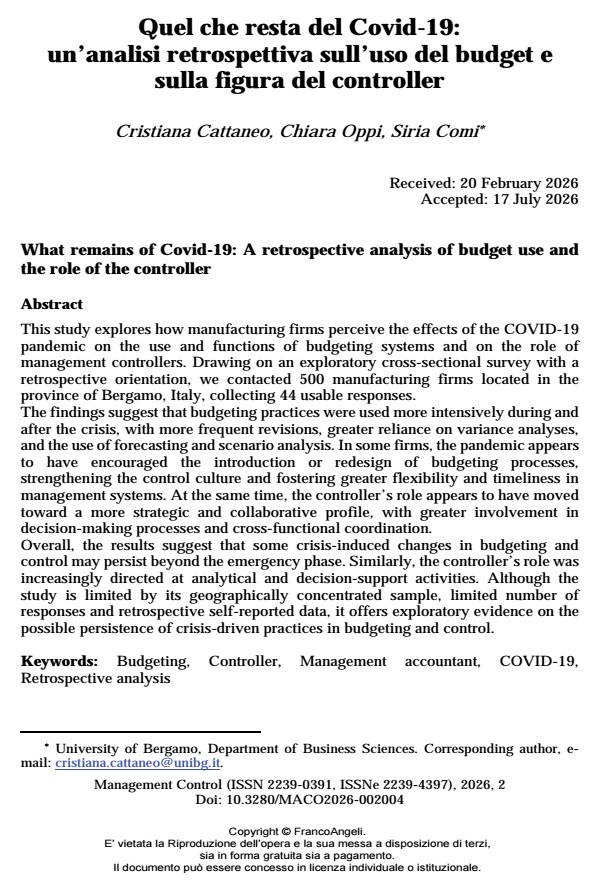
This study explores how manufacturing firms perceive the effects of the COVID-19 pandemic on the use and functions of budgeting systems and on the role of management controllers. Drawing on an exploratory cross-sectional survey with a retrospective orientation, we contacted 500 manufacturing firms located in the province of Bergamo, Italy, collecting 44 usable responses. The findings suggest that budgeting practices were used more intensively during and after the crisis, with more frequent revisions, greater reliance on variance analyses, and the use of forecasting and scenario analysis. In some firms, the pandemic appears to have encouraged the introduction or redesign of budgeting processes, strengthening the control culture and fostering greater flexibility and timeliness in management systems. At the same time, the controller’s role appears to have moved toward a more strategic and collaborative profile, with greater involvement in decision-making processes and cross-functional coordination. Overall, the results suggest that some crisis-induced changes in budgeting and control may persist beyond the emergency phase. Similarly, the controller’s role was increasingly directed at analytical and decision-support activities. Although the study is limited by its geographically concentrated sample, limited number of responses and retrospective self-reported data, it offers exploratory evidence on the possible persistence of crisis-driven practices in budgeting and control.
Parole chiave:Budgeting, Controller, Management accountant, COVID-19, Retrospective analysis
- Adler P.S., Borys B. (1996), Two types of bureaucracy: Enabling and coercive, Administrative Science Quarterly, 41(1), pp.61-89. DOI: 10.2307/2393986
- Ascani I., Chiucchi M.S., Gatti M. (2021), Pandemia e sistema di budgeting: quali effetti sulla figura del controller?, Management Control, 3, pp. 65-86. DOI: 10.3280/MACO2021-003004
- Asel J. A., Posch A., Speckbacher G. (2011), Squeezing or cuddling? The impact of economic crises on management control and stakeholder management, Review of Managerial Science, 5(2), pp. 213-231.
- Badia F., Ranaldo S., Galeone G. (2021), La crisi COVID-19 come “crash-test” per i sistemi di controllo aziendali: il caso di un’azienda di trasporto pubblico locale, Management Control, 1, pp. 57-80. DOI: 10.3280/MACO2021-001004
- Banca d’Italia (2009), Relazione annuale 2009, Banca d’Italia.
- Bassani G., Panizza A., Santella G. (2025), Levers of control in the age of COVID-19, Journal of Management Control, pp. 1-46.
- Becker S.D., Mahlendorf M.D., Schäffer U., Thaten M. (2016), Budgeting in times of economic crisis, Contemporary Accounting Research, 33(4), pp. 1489-1517. DOI: 10.1111/1911-3846.12222
- Becker S.D., Mahlendorf M.D. (2017), The influence of the economic crisis on the tasks and roles of management accountants, In: The Role of the Management Accountant (pp. 292-304), Routledge.
- Burns J., Baldvinsdottir G. (2005), An institutional perspective of accountants’ new roles – the interplay of contradictions and praxis, European Accounting Review, 14(4), pp. 725-757. DOI: 10.1080/09638180500194171
- Burns J., Vaivio J. (2001), Management accounting change, Management Accounting Research, 12(4), pp. 389-402.
- Byrne S., Pierce B. (2018), Exploring management accountants’ role conflicts and ambiguities and how they cope with them, Qualitative Research in Accounting & Management, 15(4), pp. 410-436. DOI: 10.1108/QRAM-11-2016-0083
- Cardoni A. (2018), Le sfide evolutive del Management Control tra relazioni strategiche, innovazione e discontinuità: a knowledge transfer matter?, Management Control, 1, pp. 5-15. DOI: 10.3280/MACO2018-001001
- Cattaneo C. Sonzogni S., (2021), Management control systems package e turnaround: un caso aziendale, Management Control, 1, pp. 151-174. DOI: 10.3280/MACO2021-001008
- Chenhall R.H. (2003), Management control systems design within its organizational context: findings from contingency-based research and directions for the future, Accounting, Organizations and Society, 28(2-3), pp. 127-168. DOI: 10.1016/S0361-3682(01)00027-7
- Chenhall R.H., Moers F. (2015), The role of innovation in the evolution of management accounting and its integration into management control, Accounting, Organizations and Society, 47, pp. 1-13.
- Confindustria Bergamo (2021), Bergamo, il Covid, le imprese, gli imprenditori, Confindustria Bergamo.
- Corsi K. (2021), Il lato umano del controllo per fronteggiare la crisi, Management Control, 1, pp. 5-12. DOI: 10.3280/MACO2021-001001
- Cox J.W., Hassard J. (2007), Ties to the past in organization research: A comparative analysis of retrospective methods, Organization, 14(4), pp. 475-497. DOI: 10.1177/1350508407078049
- Endenich C. (2014), Economic crisis as a driver of management accounting change: Comparative evidence from Germany and Spain, Journal of Applied Accounting Research, 15(1), pp. 123-149. DOI: 10.1108/JAAR-11-2012-0075
- Fowler Jr F.J. (2013), Survey research methods, Sage Publications Ltd.
- Fricker R.D. (2008), Sampling methods for web and e-mail surveys. The SAGE handbook of online research methods, Sage Publications Ltd.
- Friedman A.L., Lyne S.R. (2001), The beancounter stereotype: towards a general model of stereotype generation, Critical Perspectives on Accounting, 12(4), pp. 423-451.
- Goretzki L., Strauss E., Weber J. (2013), An institutional perspective on the changes in management accountants’ professional role, Management Accounting Research, 24(1), pp. 41-63.
- Granlund M., Lukka K. (1998), Towards increasing business orientation: Finnish management accountants in a changing cultural context, Management Accounting Research, 9(2), pp. 185-211.
- Hartmann F.G., Maas V.S. (2011), The effects of uncertainty on the roles of controllers and budgets: An exploratory study, Accounting and Business Research, 41(5), pp. 439-458. DOI: 10.1080/00014788.2011.597656
- Henri J.F. (2006), Management control systems and strategy: A resource-based perspective, Accounting, Organizations and Society, 31(6), pp. 529-558.
- Henttu-Aho T. (2016), Enabling characteristics of new budgeting practice and the role of controller, Qualitative Research in Accounting & Management, 13(1), pp. 31-56. DOI: 10.1108/QRAM-09-2014-0058
- Hyvönen T., Järvinen J., Pellinen J. (2008), A virtual integration - The management control system in a multinational enterprise, Management Accounting Research, 19(1), pp. 45-61.
- Iannone B., Piretti C. (2021), L’approccio integrato al controllo aziendale in un periodo di crisi “eccezionale”. Il caso del Gruppo Farnese, Management Control, 1, pp. 81-104. DOI: 10.3280/MACO2021-001005
- ISTAT, ISS (2020), Impatto dell’epidemia COVID-19 sulla mortalità totale. ISTAT.
- Janke R., Mahlendorf M.D., Weber J. (2014), An exploratory study of the reciprocal relationship between interactive use of management control systems and perception of negative external crisis effects, Management Accounting Research, 25(4), pp. 251-270.
- Järvenpää M. (2007), Making business partners: a case study on how management accounting culture was changed, European Accounting Review, 16(1), pp. 99-142. DOI: 10.1080/09638180701265903
- Kaplan R. S., Mikes A. (2012), Managing risks: A new framework, Harvard Business Review, 90(6), pp. 48-60.
- Kober R., Thambar P.J. (2022), Paradoxical tensions of the COVID-19 pandemic: a paradox theory perspective on the role of management control systems in helping organizations survive crises, Accounting, Auditing & Accountability Journal, 35(1), pp. 108-119. DOI: 10.1108/AAAJ-08-2020-4851
- Leotta A., Rizza C., Ruggieri D. (2025), Il ruolo del budgeting in contesti altamente dinamici: l’invisibile dietro il visibile, Management Control, 3, pp. 185-208, DOI: 10.3280/MACO2025-003009
- Maas V.S., Matejka M. (2009), Balancing the dual responsibilities of business unit controllers: Field and survey evidence. The Accounting Review, 84(4), pp. 1233-1253.
- Mancini D., De Nicola M., Iacoviello G. (2021), L’impatto della crisi pandemica sui sistemi di controllo di gestione: un’analisi empirica, Management Control, 1, pp. 105-127. DOI: 10.3280/MACO2021-001006
- Merchant K.A., Van der Stede W.A. (2007), Management control systems: Performance measurement, evaluation, and incentives (2nd ed.), Pearson.
- Millar M.M., Dillman D.A. (2011), Improving response to web and mixed-mode surveys, Public Opinion Quarterly, 75(2), pp. 249-269.
- Ministero della Salute (2020), COVID-19: Situazione epidemiologica in Italia. Ministero della Salute.
- Mucci D.M., Horton K.E., Braga de Aguiar A., Wanderley C.D.A. (2025), How did the COVID-19 pandemic impact the business partner role and accountants’ decision-making influence?, Journal of Accounting & Organizational Change. DOI: 10.1108/JAOC-10-2024-0333
- O’Cathain A., Thomas K.J. (2004), “Any other comments?” Open questions on questionnaires – a bane or a bonus to research?, BMC Medical Research Methodology, 4(1), 25. DOI: 10.1186/1471-2288-4-25
- Onesti G. (2021), Il ruolo degli aspetti comportamentali e culturali del controllo di gestione: un’analisi comparativa a livello internazionale, Management Control, 1, pp. 33-56. DOI: 10.3280/MACO2021-001003
- Passetti E.E., Battaglia M., Bianchi L., Annesi N. (2021), Coping with the COVID-19 pandemic: the technical, moral and facilitating role of management control, Accounting, Auditing & Accountability Journal, 34(6), pp. 1430-1444. DOI: 10.1108/AAAJ-08-2020-4839
- Rinaldi L. (2023), Accounting and the COVID-19 pandemic two years on: insights, gaps, and an agenda for future research, Accounting Forum, 47(3), pp. 333-364. DOI: 10.1080/01559982.2022.2045418
- Simons R. (1994), Levers of control: How managers use innovative control systems to drive strategic renewal, Harvard Business Press.
- Speklé R. F., Widener, S K. (2018), Challenging issues in survey research: Discussion and suggestions, Journal of Management Accounting Research, 30(2), pp. 3-21.
- Tourangeau R., Rips L. J., Rasinski K. (2000). The Psychology of Survey Response, Cambridge University Press, Cambridge.
- Unioncamere Lombardia (2021), Impatto del Covid-19 sul sistema produttivo lombardo, Unioncamere Lombardia.
- Van der Stede W.A. (2011), Management accounting research in the wake of the crisis: Some reflections, European Accounting Review, 20(4), pp. 605-623. DOI: 10.1080/09638180.2011.627678
- Van der Stede W. A., Young S. M., Chen C. X. (2005). Assessing the quality of evidence in empirical management accounting research: The case of survey studies. Accounting, Organizations and Society, 30(7-8), pp. 655-684.
- Wiegmann L., Petrikowski L., Goretzki L. (2024), Business unit controllers’ credibility and the hardening of local forecasts, Contemporary Accounting Research, 41, pp. 324-354, DOI: 10.1111/1911-3846.12916
- Wouters M., Wilderom C. (2008), Developing performance-measurement systems as enabling formalization: A longitudinal field study of a logistics department, Accounting, Organizations and Society, 33(4-5), pp. 488-516.
- Yazdifar H., Tsamenyi M. (2005), Management accounting change and changing roles of management accountants, Journal of Accounting & Organizational Change, 1(2), pp. 1-20. DOI: 10.1108/18325910510635353
Cristiana Cattaneo, Chiara Oppi, Siria Comi, Quel che resta del Covid-19: un’analisi retrospettiva sull’uso del budget e sulla figura del controller in "MANAGEMENT CONTROL" 2/2026, pp 73-96, DOI: 10.3280/MACO2026-002004