Affrontare l’incertezza del mercato: il ruolo dell’innovazione aperta nello sviluppo dei sistemi informativi
Titolo Rivista MANAGEMENT CONTROL
Autori/Curatori Salvatore Tallarico, Simone Lazzini
Anno di pubblicazione 2026 Fascicolo 2026/2
Lingua Italiano Numero pagine 22 P. 97-118 Dimensione file 331 KB
DOI 10.3280/MACO2026-002005
Il DOI è il codice a barre della proprietà intellettuale: per saperne di più
clicca qui
Qui sotto puoi vedere in anteprima la prima pagina di questo articolo.
Se questo articolo ti interessa, lo puoi acquistare (e scaricare in formato pdf) seguendo le facili indicazioni per acquistare il download credit. Acquista Download Credits per scaricare questo Articolo in formato PDF
FrancoAngeli è membro della Publishers International Linking Association, Inc (PILA), associazione indipendente e non profit per facilitare (attraverso i servizi tecnologici implementati da CrossRef.org) l’accesso degli studiosi ai contenuti digitali nelle pubblicazioni professionali e scientifiche.
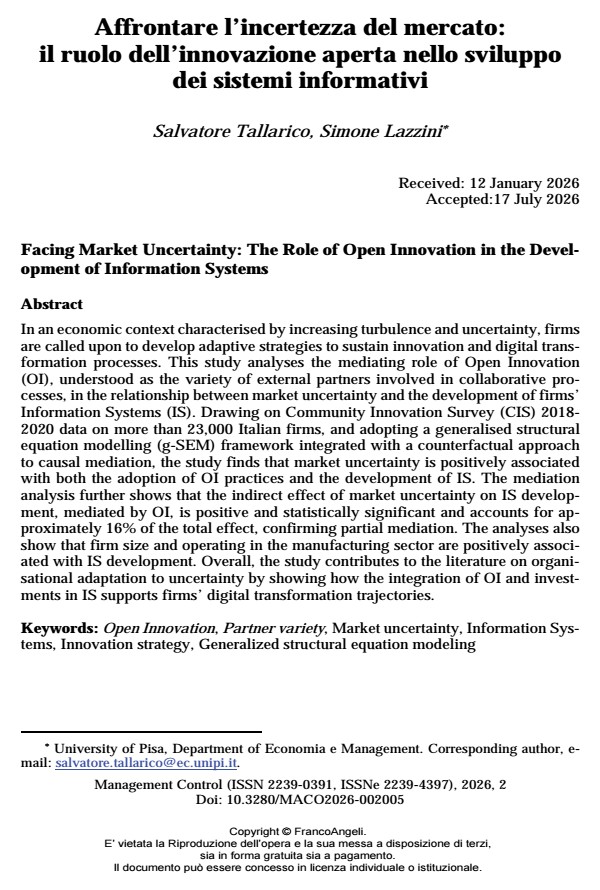
In an economic context characterised by increasing turbulence and uncertainty, firms are called upon to develop adaptive strategies to sustain innovation and digital trans-formation processes. This study analyses the mediating role of Open Innovation (OI), understood as the variety of external partners involved in collaborative pro-cesses, in the relationship between market uncertainty and the development of firms’ Information Systems (IS). Drawing on Community Innovation Survey (CIS) 2018-2020 data on more than 23,000 Italian firms, and adopting a generalised structural equation modelling (g-SEM) framework integrated with a counterfactual approach to causal mediation, the study finds that market uncertainty is positively associated with both the adoption of OI practices and the development of IS. The mediation analysis further shows that the indirect effect of market uncertainty on IS develop-ment, mediated by OI, is positive and statistically significant and accounts for ap-proximately 16% of the total effect, confirming partial mediation. The analyses also show that firm size and operating in the manufacturing sector are positively associ-ated with IS development. Overall, the study contributes to the literature on organi-sational adaptation to uncertainty by showing how the integration of OI and invest-ments in IS supports firms’ digital transformation trajectories.
Parole chiave:Open Innovation, Partner variety, Market uncertainty, Information Systems, Innovation strategy, Generalized structural equation modeling
- Abbas K., De Santis F., Kolbjørnsrud V. (2026), Artificial intelligence in accounting: A comparative analysis of adoption in accounting and non-accounting firms, Journal of Accounting and Public Policy, 57, 107433.
- Abdelhakim M., Abdeldayem M., Aldulaimi S. (2022), Information Technology Adoption Barriers in Public Sector. 2022 ASU International Conference in Emerging Technologies for Sustainability and Intelligent Systems (ICETSIS), pp. 355-360. DOI: 10.1109/ICETSIS55481.2022.9888805
- Alghamdi O., Agag G. (2024), Competitive advantage: A longitudinal analysis of the roles of data-driven innovation capabilities, marketing agility, and market turbulence, Journal of Retailing and Consumer Services, 76, 103547.
- Anthony R. N. (1965), Planning and Control Systems: A Framework for Analysis, Harvard Business School Press, Cambridge.
- Aureli S., Supino E., (2021), Business analytics e sistema informativo aziendale, in Mancini D., D’Onza G., Caserio C. (a cura di), Scritti in onore di Luciano Marchi. Volume II – Sistemi informativi e revisione aziendale, Giappichelli, Torino, pp. 1-11.
- Badia F. (2021), Riflessioni sul concetto di integrazione nei sistemi informativi aziendali in Mancini D., D’Onza G., Caserio C. (a cura di), Scritti in onore di Luciano Marchi. Volume II – Sistemi informativi e revisione aziendale, Giappichelli, Torino, pp. 15-23.
- Barney J. (1991), Firm resources and sustained competitive advantage, Journal of Management, 17(1), pp. 99-120. DOI: 10.1177/014920639101700108
- Baron R. M., Kenny D. A. (1986), The moderator-mediator variable distinction in social psychological research: Conceptual, strategic, and statistical considerations. Journal of Personality and Social Psychology, 51(6), pp. 1173-1182. DOI: 10.1037/0022-3514.51.6.1173
- Bogers M., Chesbrough H., Moedas C. (2018), Open innovation: Research, practices, and policies, California Management Review, 60(2), pp. 5-16. DOI: 10.1177/0008125617745086
- Camussone P. F. (1998), Il sistema informativo aziendale, ETAS Management, Rizzoli, Segrate.
- Caserio C. (2021), I sistemi informativi aziendali per il supporto decisionale: profili evolutivi e prospettive di ricerca, in Mancini D., D’Onza G., Caserio C. (a cura di), Scritti in onore di Luciano Marchi. Volume II – Sistemi informativi e revisione aziendale, Giappichelli, Torino, pp. 65-71.
- Chen D. Q., Mocker M., Preston D. S., Teubner A. (2010), Information systems strategy: Reconceptualization, measurement, and implications, MIS Quarterly, 34(2), pp. 233-259. DOI: 10.2307/20721426
- Chesbrough H. W. (2003), Open innovation: The new imperative for creating and profiting from technology, Harvard Business School Press, Cambridge.
- Chiucchi M. S., Montemari M. (2021). L’osmosi tra sistemi informativi e sistemi di controllo di gestione: un percorso evolutivo, in Mancini D., D’Onza G., Caserio C. (a cura di), Scritti in onore di Luciano Marchi. Volume II – Sistemi informativi e revisione aziendale, Giappichelli, Torino, pp. 75-84
- Christopher M., Holweg M. (2011), Supply Chain 2.0: Managing supply chains in the era of turbulence, International Journal of Physical Distribution & Logistics Management, 41(1), pp. 63-82. DOI: 10.1108/09600031111101439
- Cohen M., Lobel R., Perakis G. (2014), The Impact of Demand Uncertainty on Consumer Subsidies for Green Technology Adoption, Forthcoming in Management Science,
- Cohen W. M., Levinthal D. A. (1990), Absorptive capacity: A new perspective on learning and innovation. Administrative Science Quarterly, 35(1), 128-152. DOI: 10.2307/2393553
- Corrocher N., Fontana R. (2008), Objectives, obstacles and drivers of ICT adoption: What do IT managers perceive?, Information Economics and Policy, 20, pp. 229-242.
- Cui T., Tong Y., Tan C.-H. (2022), Open innovation and information technology use: Towards an operational alignment view. Information Systems Journal, 32(5), pp. 932-972.
- Dahlander L., Gann D. M. (2010), How open is innovation?, Research Policy, 39(6), pp. 699-709.
- De Santis F., Rigolini A. (2021), Digitalizzazione e creazione di valore, in Mancini D., D’Onza G., Caserio C. (a cura di), Scritti in onore di Luciano Marchi. Volume II – Sistemi informativi e revisione aziendale, Giappichelli, Torino, pp. 101-109.
- Dzwigol H. (2021), The Uncertainty Factor in the Market Economic System: The Microeconomic Aspect of Sustainable Development, Virtual Economics, pp. 98-117.
- Enkel E., Gassmann O., Chesbrough H. (2009), Open R&D and open innovation: Exploring the phenomenon, R&D Management, 39(4), pp. 311-316.
- Garzella S. (2000), I confini d’azienda. Un approccio strategico, Giuffrè, Milano.
- Gomber P., Kauffman R. J., Parker C., Weber B. W. (2018), On the fintech revolution: Interpreting the forces of innovation, disruption, and transformation in financial services, Journal of Management Information Systems, 35(1), pp. 220-265. DOI: 10.1080/07421222.2018.1440766
- Gorry G. A., Scott-Morton M. S. (1971), A framework for management information systems, Sloan Management Review, 13(1), pp. 55-70.
- Grant R. M. (1996), Toward a knowledge-based theory of the firm, Strategic Management Journal, 17(S2), pp. 109-122.
- Greco M., Grimaldi M., Cricelli L. (2016), An analysis of the OI effect on firm performance, European Management Journal, 34, pp. 501-516. DOI: 10.1016/J.EMJ.2016.02.008
- Hafeez S., Shahzad K., Helo P., Mubarak M. F. (2025), Knowledge management and SMEs’ digital transformation: A systematic literature review and future research agenda, Journal of Innovation & Knowledge, Advance online publication. 10(3), 100728.
- Han J., Kang R. (2020), Market uncertainty, innovation of firms in alliance and alliance partner characteristics, European Journal of Innovation Management, 24(5), pp. 1883-1905.
- Howells J. (2006), Intermediation and the Role of Intermediaries in Innovation, Research Policy, 35(5), pp. 715-728.
- Huang Y., Mu W. (2025), Strategy adaptation under external uncertainty: examining speed-based competitions, Management Decision, 63(5), pp. 1703-1721.
- Ifinedo P. (2011), Examining the influences of external expertise and in-house computer/IT knowledge on ERP system success, Journal of Systems and Software, 84(12), pp. 2065-2078.
- Karlson K. B., Holm A., Breen R. (2012), Comparing regression coefficients between same-sample nested models using logit and probit: A new method, Sociological Methodology, 42(1), pp. 286-313. DOI: 10.1177/0081175012444861
- Lattanzi N., Marasca S. (a cura di) (2026), Digitalizzazione e tecnologie intelligenti per il governo delle aziende. Il contributo dell’economia aziendale al Sistema Paese, FrancoAngeli, Milano.
- Laudon K. C., Laudon J. P. (2020), Management Information Systems: Managing the Digital Firm (16th ed.), Pearson, Milano.
- Laursen K., Salter A. (2006), Open for innovation: The role of openness in explaining innovation performance among UK manufacturing firms, Strategic Management Journal, 27(2), pp. 131-150.
- Lazzarotti V., Manzini R., Pellegrini L. (2010), Open Innovation models adopted in practice: An extensive study in Italy, Measuring Business Excellence, 14(4), pp. 11-23. DOI: 10.1108/13683041011093721
- Lee M., Roh T. (2023), Digitalization capability and sustainable performance in emerging markets: mediating roles of in/out-bound Open Innovation and coopetition strategy, Management Decision, 63(8), pp. 2796-2824.
- Leiponen A., Helfat C. E. (2010), Innovation objectives, knowledge sources, and the benefits of breadth, Strategic Management Journal, 31(2), pp. 224-236.
- Macher G., Narayan R., Dragicevic N., Leino T., Veledar O. (2023), Open innovation cultures, in Yilmaz M., Clarke P., Riel A., Messnarz R. (a cura di), Systems, software and services process improvement: 30th European Conference, EuroSPI 2023, Grenoble, France, August 30-September 1, 2023, Proceedings, Part II, Communications in Computer and Information Science, Vol. 1891, pp. 275-286, Springer Nature Switzerland. DOI: 10.1007/978-3-031-42310-9_20
- Majchrzak A., Malhotra A. (2013), Towards an Information Systems Perspective and Research Agenda on Crowdsourcing for Innovation, The Journal of Strategic Information Systems, 22(4), pp. 257-268.
- Mancini D., Lavorato D., Piedepalumbo P. (2023), Il contributo di Management Control alla ricerca su tecnologie digitali e sostenibilità, Management Control, 2, pp. 5-18. DOI: 10.3280/MACO2023-002001
- Marchi L. (2003), I Sistemi Informativi aziendali, Giuffrè, Milano.
- McQuitty S., Wolf M. (2013), Structural Equation Modeling: A Practical Introduction, Journal of African Business, 14(1), pp. 58-69. DOI: 10.1080/15228916.2013.765325
- Megaritis A., Vlastakis N., Triantafyllou A. (2021), Stock market volatility and jumps in times of uncertainty, Journal of International Money and Finance, 113, 102355. DOI: 10.1016/J.JIMONFIN.2021.102355
- Mele G., Capaldo G., Secundo G., Corvello V. (2023), Revisiting the idea of knowledge-based dynamic capabilities for digital transformation, Journal of Knowledge Management, 28(2), pp. 532-563. DOI: 10.1108/JKM-02-2023-0121
- Milliken F. J. (1987), Three types of perceived uncertainty about the environment: State, effect, and response uncertainty, Academy of Management Review, 12(1), pp. 133-143.
- Organisation for Economic Co-operation and Development (OECD) (2023), OECD employment outlook 2023: Artificial intelligence and the labour market, OECD Publishing.
- Pearl J. (2001), Direct and indirect effects, in Proceedings of the Seventeenth Conference on Uncertainty in Artificial Intelligence (UAI2001), pp. 411-420, Morgan Kaufmann, Burlington.
- Porter M. E. (1980), Competitive strategy: Techniques for analyzing industries and competitors, Free Press.
- Prahalad C. K., Hamel G. (1990), The core competence of the corporation, Harvard Business Review, 68(3), pp. 79-91.
- Rabe-Hesketh S., Skrondal A. Pickles A (2004), Generalized multilevel structural equation modeling, Psychometrika, 69, pp. 167-190. DOI: 10.1007/BF02295939
- Randhawa K., Wilden R., Hohberger J. (2016), A bibliometric review of Open Innovation: setting a research agenda, Journal of Product Innovation Management, 33, pp. 750-772. DOI: 10.1111/JPIM.12312
- Ravichandran T. (2005), Organizational assimilation of complex technologies: an empirical study of component-based software development, IEEE Transactions on Engineering Management, 52, pp. 249-268. DOI: 10.1109/TEM.2005.844925
- Sá T., Ferreira J., Jayantilal S. (2023). Open Innovation strategy: a systematic literature review, European Journal of Innovation Management, 28(2), pp. 454-510.
- Simon H. A. (1960), The New Science of Management Decision, Harper & Row, New York City.
- Stratopoulos T. C., Wang V. X. (2025), Artificial intelligence and accounting research: A framework and agenda, International Journal of Accounting Information Systems, 56, 100760.
- Tallarico S., Pellegrini L., Lazzarotti V., Lazzini S. (2024), Boosting firms’ absorptive capacity: The digital technologies edge, European Journal of Innovation Management, 28(6), pp. 2558-2580. DOI: 10.1108/EJIM-09-2023-0741
- Tallon P. P., Queiroz M., Coltman T., Sharma R. (2019), Information technology and the search for organizational agility: A systematic review with future research possibilities, The Journal of Strategic Information Systems, 28(2), pp. 218-237.
- Tang T., Zhang S., Peng J. (2021), The value of marketing innovation: Market-driven versus market-driving, Journal of Business Research, 126, pp. 88-98. DOI: 10.1016/J.JBUSRES.2020.12.067
- Tang W., Bu H., Ji Y., Li Z. (2024), Market uncertainty and information content in complex seasonality of prices, Pacific-Basin Finance Journal, 86, 102430.
- Teece D. J. (2007), Explicating dynamic capabilities: The nature and microfoundations of (sustainable) enterprise performance, Strategic Management Journal, 28(13), pp. 1319-1350.
- Teece D. J., Pisano G., Shuen A. (1998), Dynamic capabilities and strategic management, Strategic Management Journal, 18(7), pp. 509-533.
- Thong J. Y. L. (1999), An Integrated Model of Information Systems Adoption in Small Businesses, Journal of Management Information Systems, 15(4), pp. 187-214. DOI: 10.1080/07421222.1999.11518227.
- Thong J. Y., Yap C. S., Raman K. S. (1994), Engagement of external expertise in information systems implementation, Journal of Management Information Systems, 11(2), pp. 209-231. DOI: 10.1080/07421222.1994.11518046
- Torres E. R., Cano C. A. G., Castillo V. S. (2022), Management information systems and their impact on business decision making, Data and Metadata.
- Tushman M. L., Anderson P. (1986), Technological discontinuities and organizational environments, Administrative Science Quarterly, 31(3), pp. 439-465. DOI: 10.2307/2392832
- VanderWeele T. J. (2015), Explanation in causal inference: Methods for mediation and interaction, Oxford University Press, Oxford.
- Wixom B. H., Yen B., Relich M. (2013), Maximizing value from business analytics. MIS Quarterly Executive, 12(2), pp. 111-123.
- Yang L., Ng C., Cheng T., Sun M., Shao X., Li R. (2024), Competition under demand uncertainty: The roles of technology and capacity strategy, European Journal of Operational Research, 317, pp. 185-204.
- Ye F., Paulson N., Khanna M. (2024), Strategic innovation and technology adoption under technological uncertainty, Journal of Economic Dynamics and Control, 165, 104879.
- Zahra S. A., George G. (2002), Absorptive capacity: A review, reconceptualization, and extension, Academy of Management Review, 27(2), pp. 185-203. DOI: 10.2307/4134351
- Zhang X., Chu Z., Ren L., Xing J. (2023), Open innovation and sustainable competitive advantage: The role of organizational learning, Technological Forecasting and Social Change, 186, 122114.
Salvatore Tallarico, Simone Lazzini, Affrontare l’incertezza del mercato: il ruolo dell’innovazione aperta nello sviluppo dei sistemi informativi in "MANAGEMENT CONTROL" 2/2026, pp 97-118, DOI: 10.3280/MACO2026-002005