Enabling factors of carbon accounting disclosure quality: Designing an analytical framework
Titolo Rivista MANAGEMENT CONTROL
Autori/Curatori Alessandro Marelli, Danilo Boffa, Antonio Prencipe
Anno di pubblicazione 2026 Fascicolo 2026/2
Lingua Inglese Numero pagine 24 P. 119-142 Dimensione file 142 KB
DOI 10.3280/MACO2026-002006
Il DOI è il codice a barre della proprietà intellettuale: per saperne di più
clicca qui
Qui sotto puoi vedere in anteprima la prima pagina di questo articolo.
Se questo articolo ti interessa, lo puoi acquistare (e scaricare in formato pdf) seguendo le facili indicazioni per acquistare il download credit. Acquista Download Credits per scaricare questo Articolo in formato PDF
FrancoAngeli è membro della Publishers International Linking Association, Inc (PILA), associazione indipendente e non profit per facilitare (attraverso i servizi tecnologici implementati da CrossRef.org) l’accesso degli studiosi ai contenuti digitali nelle pubblicazioni professionali e scientifiche.
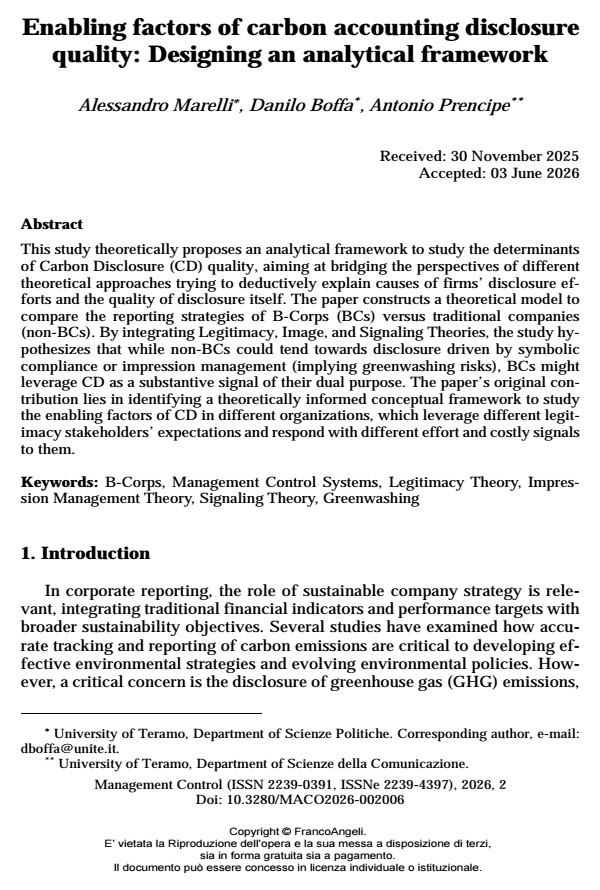
This study theoretically proposes an analytical framework to study the determinants of Carbon Disclosure (CD) quality, aiming at bridging the perspectives of different theoretical approaches trying to deductively explain causes of firms’ disclosure efforts and the quality of disclosure itself. The paper constructs a theoretical model to compare the reporting strategies of B-Corps (BCs) versus traditional companies (non-BCs). By integrating Legitimacy, Image, and Signaling Theories, the study hypothesizes that while non-BCs could tend towards disclosure driven by symbolic compliance or impression management (implying greenwashing risks), BCs might leverage CD as a substantive signal of their dual purpose. The paper’s original contribution lies in identifying a theoretically informed conceptual framework to study the enabling factors of CD in different organizations, which leverage different legitimacy stakeholders’ expectations and respond with different effort and costly signals to them.
Parole chiave:B-Corps, Management Control Systems, Legitimacy Theory, Impression Management Theory, Signaling Theory, Greenwashing
- Gardner W. L., & Martinko M. J. (1988), Impression management in organizations, Journal of management, 14(2), pp. 321-338.
- Alsaifi K., Elnahass M., & Salama A. (2020), Carbon disclosure and financial performance: UK environmental policy, Business Strategy and the Environment, 29(2), pp. 711-726.
- Baboukardos D. (2017), Market valuation of greenhouse gas emissions under a mandatory reporting regime: Evidence from the UK, Accounting Forum, 41(3), pp. 221-233.
- Battilana J., Lee M., Walker J., & Dorsey C. (2012), In Search of the Hybrid Ideal: How Organizations Pursue, Combine, and Balance Multiple Goals, Research in Organizational Behavior, 32, pp. 179-204.
- Bebbington J., & Unerman J. (2020), Advancing research into accounting and the UN Sustainable Development Goals, Accounting, Auditing & Accountability Journal, 33(7), pp. 1213-1225.
- Bebbington J., Larrinaga-Gonzalez C., & Moneva J. M. (2008), Corporate social reporting and reputation risk management, Accounting, Auditing & Accountability Journal, 21(3), pp. 337-361.
- Blanco C. C. (2021), Supply Chain Carbon Footprinting and Climate Change Disclosures of Global Firms, Production and Operations Management, 30(9), pp. 3143-3160.
- Buell R. W., & Kalkanci B. (2021), How transparency into internal and external responsibility initiatives influences consumer choice, Management Science, 67(2), pp. 932-950.
- Cho C. H., & Patten D. M. (2007), The information content of social and environmental disclosures: A market-based analysis, Journal of Business Finance & Accounting, 34(3-4), pp. 518-531.
- Christiansen P., Dienes D., & Jensen J. (2021), Does stakeholder pressure affect the quality of corporate social responsibility reports?, Corporate Social Responsibility and Environmental Management, 28(1), pp. 32-47.
- Clarkson P. M., Li Y., Pinnuck M., & Richardson G. (2019), The market reaction to the quantity and quality of environmental disclosure, Journal of Accounting and Public Policy, 38(2), pp. 127-143.
- Clarkson P. M., Li Y., Pinnuck M., & Richardson G. D. (2015), The valuation relevance of greenhouse gas emissions under the European Union carbon emissions trading scheme, European Accounting Review, 24(3), pp. 551-580.
- Clarkson P. M., Li Y., Richardson G. D., & Vasvari F. P. (2008), Revisiting the relation between environmental performance and environmental disclosure: An empirical analysis, Accounting, Organizations and Society, 33(4-5), pp. 303-327.
- Connelly B. L., Certo S. T., Ireland R. D., & Reutzel C. R. (2011), Signaling theory: A review and assessment, Journal of Management, 37(1), pp. 39-67.
- Coyte L. (2019), Enabling management control systems: A literature review and future research agenda, Journal of Accounting Literature, 43, pp. 1-28.
- De Camillis E., Izzo T., & Mancini D. (2025), Percorsi di decarbonizzazione e sistemi di controllo: un modello di analisi per il settore energetico, Management Control, (2).
- Deegan C. (2002), The legitimising effect of social and environmental disclosures - a true challenge for accounting research, Accounting, Auditing & Accountability Journal, 15(3), pp. 282-301.
- DEFRA (2013), Environmental reporting guidelines: Including mandatory greenhouse gas emissions reporting guidance.
- Demaret J., Molinari M. (2025), How can management accounting and control systems facilitate compliance with sustainability reporting regulations?, Journal of Applied Accounting Research, 26(4), pp. 829-846.
- Di Vaio A., & Ali T. (2025), Carbon Accounting for the Sustainable Transition: Accountability, Compliance, and Climate Change, Routledge.
- Di Vaio A., Chhabra M., Zaffar A. and Balsalobre-Lorente D. (2025), Accounting and Accountability in the Transition to Zero-Carbon Energy for Climate Change: A Systematic Literature Review, Bus Strat Env, 34, pp. 5925-5946.
- Di Vaio A., VanEngelenhoven E., & Palladino S. (2025), Digital Twins nei Sistemi Portuali e il contributo di GHG accounting: Una review della letteratura, Management Control, 1, pp. 211-236.
- Di Vaio A., Van Engelenhoven E., Raimo N. and Garofalo A. (2026), Strategic Carbon Disclosure and Accountable Efficiency: Reporting Shipping Industry Scope 3 Emissions, Business Strategy and the Environment, 35(1), pp. 1003-1021.
- Downar B., Ernstberger J., Reichelstein S., Schwenen S., & Zaklan A. (2021), The impact of carbon disclosure mandates on emissions and financial operating performance, Review of Accounting Studies, 26(3), pp. 1137-1175.
- Duan Y., Hofer C., & Aloysius J. A. (2021), Consumers care and firms should too: On the benefits of disclosing supplier moni- toring activities, Journal of Operations Management, 67(3), pp. 360-381.
- Eccles R. G., & Serafeim G. (2013), The performance and disclosure of ESG, Harvard Business School Working Paper, 13-054.
- Eccles R. G., Serafeim G., & Stroehle C. (2020), The impact of corporate sustainability on organizational processes and performance, Organization & Environment, 33(4), pp. 563-596.
- Fabrizio K. R., & Kim E. H. (2019), Reluctant disclosure and transparency: Evidence from environmental disclosures, Organization Science, 30(6), pp. 1207-1231.
- Gehman J., Soubliere M., & Palmer I. (2017), Hybrid Organizations as Innovation: The Case of B Corps, Journal of Organizational Change Management, 30(2), pp. 273-294.
- Giacalone R. A., & Rosenfeld P. (2013), Impression management in the organization, Psychology Press.
- Gray R., Kouhy R., & Lavers S. (1995), Corporate social and environmental reporting: a review of the literature and a longitudinal study of UK disclosure, Accounting, auditing & accountability journal, 8(2), pp. 47-77.
- Han Y-G., Huang H-W., Liu W-P., & Hsu Y-L. (2022), Firm-value effects of carbon emissions and carbon disclosures: evidence from Taiwan, Accounting Horizons.
- Hooghiemstra R. (2000), Corporate communication and impression management - new perspectives for accounting research, Journal of Business Ethics, 27(1-2), pp. 55-68.
- Hora M., & Subramanian R. (2019), Relationship between positive environmental disclosures and environmental performance: An empirical investigation of the greenwashing sin of the hidden trade-off, Journal of Industrial Ecology, 23(4), pp. 855-868.
- Houqe M. N., & Khan H. Z. (2023), What determines the quality of carbon reporting? A system-oriented theories and corporate governance perspective, Business Strategy and the Environment, 32(6), pp. 3197-3216.
- Houqe M. N., & Khan M. A. (2023), Determinants of carbon disclosure quality: Evidence from developing countries, Journal of Environmental Management, 327, 116867.
- Jacobs B. W. (2014), Shareholder value effects of voluntary emis- sions reduction, Production and Operations Management, 23(11), pp. 1859-1874.
- Jacobs B. W., Singhal V. R., & Subramanian R. (2010), An empirical investigation of environmental performance and the market value of the firm, Journal of Operations Management, 28(5), pp. 430-441.
- Jira C., & Toffel M. W. (2013), Engaging supply chains in climate change, Manufacturing & Service Operations Management, 15(4), pp. 559-577.
- Kim Y., Park M. S., & Wier M. (2012), Is enterprise risk management associated with the quality of accounting earnings?, Journal of Accounting and Public Policy, 31(2), pp. 194-211.
- KPMG (2022). Survey of Sustainability Reporting 2022. -- Retrieved from https://kpmg.com/xx/en/home/insights/2022/10/kpmg-survey-of-sustainability-reporting-2022.html.
- Lys T., Naughton J. P., & Wang C. (2015), Signaling through corporate accountability reporting, Journal of accounting and economics, 60(1), pp. 56-72.
- Luo L., Tang Q., Fan H., & Ayers J. (2023), Corporate carbon assurance and the quality of carbon disclosure, Accounting & Finance, 63(1), pp. 657-690.
- Luo L., Wang L., & Li R. (2023), The impact of environmental regulation on corporate carbon disclosure quality: Evidence from China, Environmental Science and Pollution Research, 30(24), pp. 65203-65217.
- Malmi T., & Brown D. A. (2008), Management control systems as a package - Opportunities, challenges and research directions, Management Accounting Research, 19(4), pp. 287-300.
- Marquis C., Toffel M. W., & Zhou Y. (2016), Scrutiny, norms, and selective disclosure: A global study of greenwashing. Organization Science, 27(2), pp. 483-504.
- Matsumura E. M., Prakash R., & Vera-Munoz S. C. (2014), Firm-value effects of carbon emissions and carbon disclosures, The Accounting Review, 89(2), pp. 695-724.
- Matthews L., Gerged A. M., & Elheddad M. (2024, July), Carbon disclosure, greenhouse gas emissions and market value of FTSE 350 firms-evidence from voluntary carbon disclosers versus non-disclosers, In Accounting forum (pp. 1-25). Routledge.
- Melloni L., Casonato L., & Cameran M. (2017), The quality of non-financial information: An empirical investigation of Italian listed companies, Journal of Management and Governance, 21(3), pp. 639-669.
- Minutiello A., & Tettamanzi P. (2022), Non-Financial Reporting Quality and Its Determinants: A Systematic Literature Review, Sustainability, 14(10), 6140.
- Minutiello V., & Tettamanzi P. (2022), The quality of nonfinancial voluntary disclosure: A systematic literature network analysis on sustainability reporting and integrated reporting, Corporate Social Responsibility and Environmental Management, 29(1), pp. 1-18.
- Ott C., Schiemann F., & Günther T. (2017), Disentangling the determinants of the response and the publication decisions: The case of the carbon disclosure project, Journal of Accounting and Public Policy, 36(1), pp. 14-33.
- Pitrakkos P., & Maroun W. (2020), Evaluating the quality of carbon disclosures, Sustainability Accounting, Management and Policy Journal, 11(3), pp. 553-589.
- Rana T., Rahman M.J., & Öhman P. (Eds.) (2025), Carbon Accounting for Sustainability and Environmental Management: Case Studies from China (1st ed.). Routledge.
- Reid,E. M., & Toffel,M. W. (2009), Responding to public and private politics: Corporate disclosure of climate change strategies, Strategic Management Journal, 30(11), pp. 1157-1178.
- Reverte C. (2009), Determinants of corporate social responsibility disclosure: An application of legitimacy theory, Journal of Business Ethics, 88(2), pp. 351-366.
- Rezaee Z., & Tuo B. (2019), Carbon accounting and carbon assurance: A comprehensive review and future research agenda, Journal of Cleaner Production, 218, pp. 590-602.
- Rezaee Z., & Tuo L. (2019), Are the quantity and quality of sustainability disclosures associated with the innate and discretionary earnings quality?, Journal of business ethics, 155, pp. 763-786.
- Ribeiro C., Cerqueira R., & Brandão F. (2022), Corporate social responsibility disclosure: A reactive or proactive strategy?, Business Strategy and the Environment, 31(6), pp. 3326-3342.
- Rosenfeld P., Edwards J. E., & Thomas M. D. (2015), Impression management, Wiley Encyclopedia of management, 1-2.
- Schaltegger S., Burritt R. L., & Viere T. (2023), Management control for sustainability: Towards a research agenda, Journal of Management Control, 34(1), pp. 1-24.
- Song Y., Yu D., & Ma L. (2024), Can upstream customers’ environmental disclosure affect downstream suppliers’ GHG emissions?, Journal of Environmental Management, 349, 119438.
- Spence A. M. (1973), Job market signaling, The Quarterly Journal of Economics, 87(3), pp. 355-374.
- Stubbs W. (2021), Benefit Corporations: The Emergence of a New Legal Form for Social Enterprise, In Research Handbook on Social Enterprise Law (pp. 37-56). Edward Elgar Publishing.
- Suchman M. C. (1995), Managing legitimacy: Strategic and institutional approaches, The Academy of Management Review, 20(3), pp. 571-610.
- Tan D., Komal B., Ezeani E., Usman M., & Salem R. (2022), Carbon emission disclosures and financial reporting quality: does ownership structure and economic development matter?, Environmental Science & Policy, 137, pp. 109-119.
- Tan Y., Peng L., & Li S. (2022), Determinants of carbon accounting quality: Empirical evidence from Chinese listed companies, Environmental Science and Pollution Research, 29(20), pp. 30424-30438.
- Unerman J., & O’Dwyer B. (2007), The business case for regulation of corporate social responsibility and accountability, Accounting Forum, 31(4), pp. 332-353.
- Villena V. H., & Dhanorkar S. (2020), How institutional pressures and managerial incentives elicit carbon transparency in global supply chains, Journal of Operations Management, 66(6), pp. 697-734.
- Yang L., Muller N. Z., & Liang P. J. (2021), The real effects of mandatory CSR disclosure on emissions: Evidence from the greenhouse gas reporting program (No. w28984), National Bureau of Economic Research.
- Yin J., & Wang S. (2018), The effects of corporate environmental disclosure on environmental innovation from stakeholder perspectives, Applied Economics, 50(8), pp. 905-919.
Alessandro Marelli, Danilo Boffa, Antonio Prencipe, Enabling factors of carbon accounting disclosure quality: Designing an analytical framework in "MANAGEMENT CONTROL" 2/2026, pp 119-142, DOI: 10.3280/MACO2026-002006