Socially Responsible Investors and ESG performance: Does investor origin matter?
Titolo Rivista MANAGEMENT CONTROL
Autori/Curatori Sonia Vitali, Marco Giuliani, Simone Poli
Anno di pubblicazione 2026 Fascicolo 2026/2
Lingua Inglese Numero pagine 26 P. 143-168 Dimensione file 198 KB
DOI 10.3280/MACO2026-002007
Il DOI è il codice a barre della proprietà intellettuale: per saperne di più
clicca qui
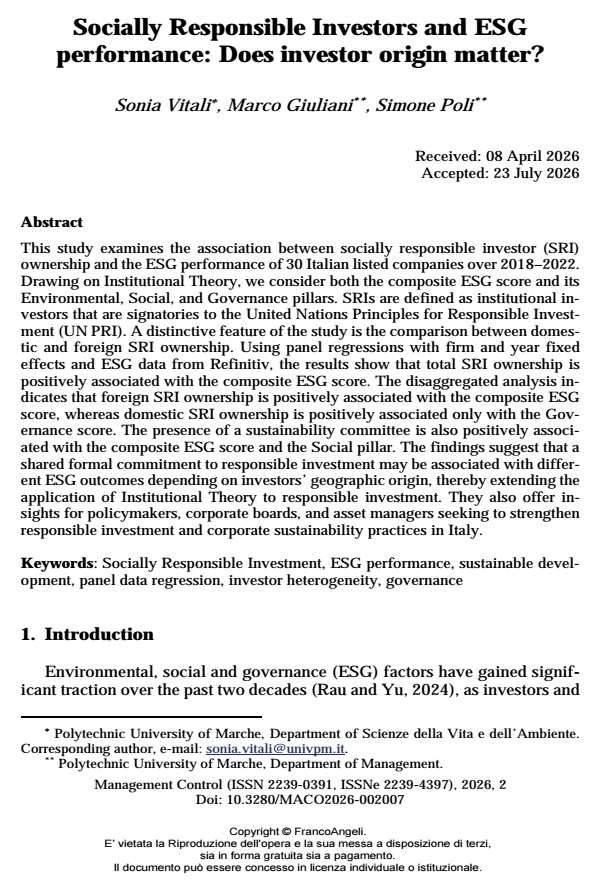
Qui sotto puoi vedere in anteprima la prima pagina di questo articolo.
Se questo articolo ti interessa, lo puoi acquistare (e scaricare in formato pdf) seguendo le facili indicazioni per acquistare il download credit. Acquista Download Credits per scaricare questo Articolo in formato PDF
FrancoAngeli è membro della Publishers International Linking Association, Inc (PILA), associazione indipendente e non profit per facilitare (attraverso i servizi tecnologici implementati da CrossRef.org) l’accesso degli studiosi ai contenuti digitali nelle pubblicazioni professionali e scientifiche.
This study examines the association between socially responsible investor (SRI) ownership and the ESG performance of 30 Italian listed companies over 2018–2022. Drawing on Institutional Theory, we consider both the composite ESG score and its Environmental, Social, and Governance pillars. SRIs are defined as institutional investors that are signatories to the United Nations Principles for Responsible Investment (UN PRI). A distinctive feature of the study is the comparison between domestic and foreign SRI ownership. Using panel regressions with firm and year fixed effects and ESG data from Refinitiv, the results show that total SRI ownership is positively associated with the composite ESG score. The disaggregated analysis indicates that foreign SRI ownership is positively associated with the composite ESG score, whereas domestic SRI ownership is positively associated only with the Governance score. The presence of a sustainability committee is also positively associated with the composite ESG score and the Social pillar. The findings suggest that a shared formal commitment to responsible investment may be associated with different ESG outcomes depending on investors’ geographic origin, thereby extending the application of Institutional Theory to responsible investment. They also offer insights for policymakers, corporate boards, and asset managers seeking to strengthen responsible investment and corporate sustainability practices in Italy.
Parole chiave:Socially Responsible Investment, ESG performance, sustainable development, panel data regression, investor heterogeneity, governance
- Alda M. (2019), Corporate sustainability and institutional shareholders: The pressure of socially responsible pension funds on environmental firm practices, Business Strategy and the Environment, 28(6), pp. 1060-1071.
- Alda M. (2021), The environmental, social, and governance (ESG) dimension of firms in which socially responsible investment (SRI) and conventional pension funds invest: The mainstream SRI and the ESG inclusion, Journal of Cleaner Production, 298, 126812.
- Azar J., Duro M., Kadach I., Ormazabal G. (2021), The Big Three and corporate carbon emissions around the world, Journal of Financial Economics, 142(2), pp. 674-696.
- Bauckloh T., Schaltegger S., Utz S., Zeile S., Zwergel B. (2023), Active first movers vs. late free-riders? An empirical analysis of UN PRI signatories’ commitment, Journal of Business Ethics, 182, pp. 747-781.
- Borglund T., Frostenson M., Helin S., Arbin K. (2023), The professional logic of sustainability managers: Finding underlying dynamics, Journal of Business Ethics, 182(1), pp. 59-76.
- Campanella F., Ferri L., Serino L., Zampella A. (2026), Driving sustainability: How FinTech transforms SDG performance in SMEs, Journal of Global Responsibility, 17(2), pp. 322-342. DOI: 10.1108/JGR-01-2025-0015
- Chen T., Dong H., Lin C. (2020), Institutional shareholders and corporate social responsibility, Journal of Financial Economics, 135(2), pp. 483-504.
- Cohen S., Kadach I., Ormazabal G. (2023), Institutional investors, climate disclosure, and carbon emissions, Journal of Accounting and Economics, 76(2-3), 101640.
- Cremasco C., Boni L. (2024), Is the European Union Sustainable Finance Disclosure Regulation effective in shaping sustainability objectives? An analysis of investment funds’ behaviour, Journal of Sustainable Finance & Investment, 14(4), pp. 1018-1036. DOI: 10.1080/20430795.2022.2124838
- Daugaard D., Ding A. (2022), Global drivers for ESG performance: The body of knowledge, Sustainability, 14(4), 2322.
- DiMaggio P.J., Powell W.W. (1983), The iron cage revisited: Institutional isomorphism and collective rationality in organizational fields, American Sociological Review, 48(2), pp. 147-160. DOI: 10.2307/2095101
- Dimson E., Karakas O., Li X. (2021), Coordinated engagements, ECGI Finance Working Paper No. 721/2021.
- Dyck A., Lins K.V., Roth L., Wagner H.F. (2019), Do institutional investors drive corporate social responsibility? International evidence, Journal of Financial Economics, 131(3), pp. 693-714.
- Ferri L., Spagnuolo F., Troise C., Zampella A. (2025), Strategic innovation: Exploring governance drivers of FinTech investments, Journal of Strategy and Management, 18(3), pp. 521-538. DOI: 10.1108/JSMA-11-2024-0309
- Fiorillo P., Santilli G. (2024), The influence of shareholder ESG performance on corporate sustainability: Exploring the role of ownership structure, Finance Research Letters, 67, 105800.
- Focke M. (2022), Do sustainable institutional investors influence senior executive compensation structures according to their preferences? Empirical evidence from Europe, Corporate Social Responsibility and Environmental Management, 29(5), pp. 1109-1121.
- Gelb J., McCarthy R., Rehm W., Voronin A. (2023), Investors want to hear from companies about the value of sustainability, McKinsey & Company, 15 September, available at: -- https://www.mckinsey.com/capabilities/strategy-and-corporate-finance/our-insights/investors-want-to-hear-from-companies-about-the-value-of-sustainability.
- Gibson Brandon R., Glossner S., Krueger P., Matos P., Steffen T. (2020), Responsible institutional investing around the world, ECGI Finance Working Paper No. 712/2020.
- Gibson Brandon R., Glossner S., Krueger P., Matos P., Steffen T. (2022), Do responsible investors invest responsibly?, Review of Finance, 26(6), pp. 1389-1432.
- Hauke J., Kossowski T. (2011), Comparison of values of Pearson’s and Spearman’s correlation coefficients on the same sets of data, Quaestiones Geographicae, 30(2), pp. 87-93.
- Hoepner A.G.F., Majoch A.A.A., Zhou X.Y. (2021), Does an asset owner’s institutional setting influence its decision to sign the Principles for Responsible Investment?, Journal of Business Ethics, 168(2), pp. 389-414.
- Kim I., Wan H., Wang B., Yang T. (2019), Institutional investors and corporate environmental, social, and governance policies: Evidence from toxics release data, Management Science, 65(10), pp. 4901-4926.
- Kim S., Yoon A. (2023), Analyzing active fund managers’ commitment to ESG: Evidence from the United Nations Principles for Responsible Investment, Management Science, 69(2), pp. 741-758.
- Kordsachia O., Focke M., Velte P. (2022), Do sustainable institutional investors contribute to firms’ environmental performance? Empirical evidence from Europe, Review of Managerial Science, 16(5), pp. 1409-1436.
- Li Z., Wang P., Wu T. (2021), Do foreign institutional investors drive corporate social responsibility? Evidence from listed firms in China, Journal of Business Finance & Accounting, 48(1-2), pp. 338-373.
- Liang H., Renneboog L. (2020), Corporate social responsibility and sustainable finance: A review of the literature, ECGI Finance Working Paper No. 701/2020.
- Martí-Ballester C.P. (2022), Do renewable energy mutual funds advance towards clean energy-related Sustainable Development Goals?, Renewable Energy, 195, pp. 1090-1102.
- Marti E., Fuchs M., DesJardine M.R., Slager R., Gond J.-P. (2024), The impact of sustainable investing: A multidisciplinary review, Journal of Management Studies, 61(5), pp. 2181-2211.
- Martiny A., Taglialatela J., Testa F., Iraldo F. (2024), Determinants of environmental, social and governance performance: A systematic literature review, Journal of Cleaner Production, 456, 142213.
- Meyer J.W., Rowan B. (1977), Institutionalized organizations: Formal structure as myth and ceremony, American Journal of Sociology, 83(2), pp. 340-363. DOI: 10.1086/226550
- Naciti V. (2019), Corporate governance and board of directors: The effect of board composition on firm sustainability performance, Journal of Cleaner Production, 237, 117727.
- Paoloni P., Modaffari G. (2025), Investimenti sostenibili nei fondi pensione italiani: Illusione o buone pratiche di sviluppo?, Management Control, 1, pp. 59-84. DOI: 10.3280/MACO2025-001004
- Peng H., Zhang Z., Goodell J.W., Li M. (2023), Socially responsible investing: Is it for real or just for show?, International Review of Financial Analysis, 86, 102553.
- Rau P.R., Yu T. (2024), A survey on ESG: Investors, institutions and firms, China Finance Review International, 14(1), pp. 3-33. DOI: 10.1108/CFRI-12-2022-0260
- Razali N.M., Wah Y.B. (2011), Power comparisons of Shapiro-Wilk, Kolmogorov-Smirnov, Lilliefors and Anderson-Darling tests, Journal of Statistical Modeling and Analytics, 2(1), pp. 21-33.
- Scott W.R. (2014), Institutions and organizations: Ideas, interests, and identities, 4th ed., Thousand Oaks, CA, Sage.
- Sgrò F., Chamochumbi Diaz G.D., Palazzi F., Ciambotti M. (2025), The effect of corporate governance on SDG performance of Italian listed companies, Management Control, 1, pp. 111-135. DOI: 10.3280/MACO2025-001006
- van Zanten J.A., Rein B. (2023), Who owns (un)sustainable companies? Examining institutional determinants of sustainable investing, Journal of Cleaner Production, 422, 138542.
- Velte P. (2023a), Sustainable institutional investors and corporate biodiversity disclosure: Does sustainable board governance matter?, Corporate Social Responsibility and Environmental Management, 30(6), pp. 3063-3077.
- Velte P. (2023b), Which institutional investors drive corporate sustainability? A systematic literature review, Business Strategy and the Environment, 32(1), pp. 42-71.
- Widyawati L. (2020), A systematic literature review of socially responsible investment and environmental, social and governance metrics, Business Strategy and the Environment, 29(2), pp. 619-637.
- Wooldridge J.M. (2020), Introductory econometrics: A modern approach, 7th ed., Boston, MA, Cengage Learning.
- Wu B., Gu Q., Liu Z., Liu J. (2023), Clustered institutional investors, shared ESG preferences and low-carbon innovation in family firms, Technological Forecasting and Social Change, 194, 122676.
- Yang L. (2023), Firms’ socially responsible activities: The role of the Big Three, Journal of Economics and Finance, 47(4), pp. 859-883.
- Yoo J.W., Chang Y.J. (2024), Domestic vs. foreign institutional investors: Who improves ESG and value of Chinese companies?, Sustainability, 16(18), 8238.
Sonia Vitali, Marco Giuliani, Simone Poli, Socially Responsible Investors and ESG performance: Does investor origin matter? in "MANAGEMENT CONTROL" 2/2026, pp 143-168, DOI: 10.3280/MACO2026-002007