Valuing what’s left. Urban austerity and collaborative management of public real estate in Bologna
Journal title SOCIOLOGIA URBANA E RURALE
Author/s Maurizio Bergamaschi, Maria Grazia Montesano
Publishing Year 2026 Issue 2026/139
Language Italian Pages 23 P. 26-47 File size 253 KB
DOI 10.3280/SUR2026-139002
DOI is like a bar code for intellectual property: to have more infomation
click here
Below, you can see the article first page
If you want to buy this article in PDF format, you can do it, following the instructions to buy download credits
FrancoAngeli is member of Publishers International Linking Association, Inc (PILA), a not-for-profit association which run the CrossRef service enabling links to and from online scholarly content.
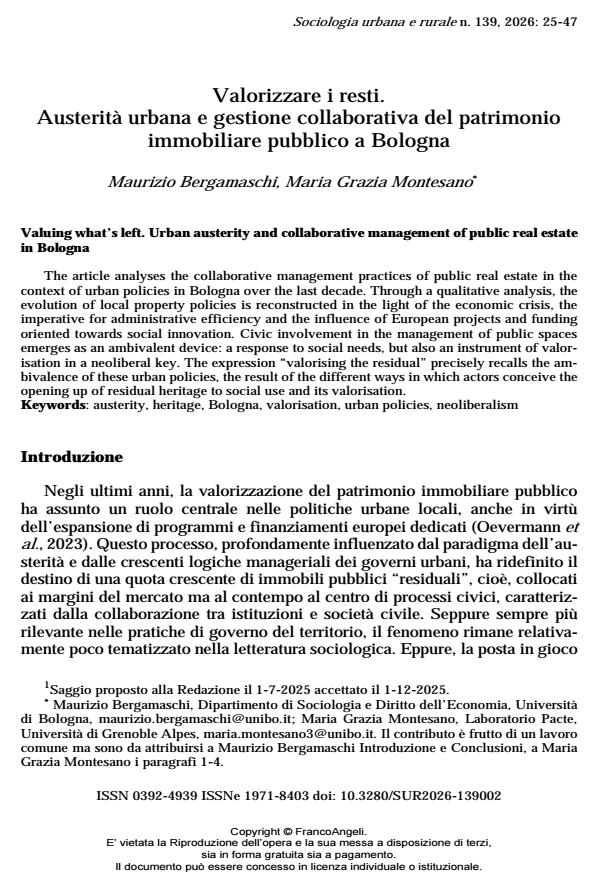
The article analyses the collaborative management practices of public real estate in the context of urban policies in Bologna over the last decade. Through a qualitative analysis, the evolution of local property policies is reconstructed in the light of the economic crisis, the imperative for administrative efficiency and the influence of European projects and funding oriented towards social innovation. Civic involvement in the management of public spaces emerges as an ambivalent device: a response to social needs, but also an instrument of valorisation in a neoliberal key. The expression “valorising the residual” precisely recalls the ambivalence of these urban policies, the result of the different ways in which actors conceive the opening up of residual heritage to social use and its valorisation.
Keywords: austerity, heritage, Bologna, valorisation, urban policies, neoliberalism
- Oevermann H., Polyák L., Szemzö H., Mieg H.A. (2023). Open heritage: Community-driven adaptive reuse in Europe: Best practice. Berlino: De Gruyter.
- Peck J. (2005). Struggling with the Creative Class. International Journal of Urban and Regional Research, 29(4): 740-770.
- Adisson F., Artioli F. (2019). Four types of urban austerity: Public land privatisations in French and Italian cities. Urban Studies, 57(1): 75-92. DOI: 10.1177/0042098019827517
- Allegrini G., Paltrinieri R. (2018). Partecipazione e collaborazione negli interventi di comunità: l’esperienza dei laboratori di quartiere del Comune di Bologna. Sociologia urbana e rurale, 116: 29-44. DOI: 10.3280/SUR2018-116003
- Allegrini G., Spillare S. (2022). Innovazione democratica, social media e co-creazione di senso: il caso del Bilancio Partecipativo del Comune di Bologna. In Paltrinieri R., Spillare S., Tardivo G. (a cura di). Orizzonti Mediterranei. Comunicazione, istituzioni e prospettive mediatiche in un confronto tra Italia e Spagna. Milano: FrancoAngeli.
- Arena G., Bombardelli M. (2022). L’amministrazione condivisa. Trento: Università degli Studi di Trento.
- Artioli F. (2012). Public real estate between administrative reforms and financial constraints. A comparative analysis of the re-use of military assets in Italy and France. Hal open science, hal-01070344.
- Bianchi I. (2018). The post-political meaning of the concept of commons: the regulation of the urban commons in Bologna. Space and Polity, 22(3): 287-306. DOI: 10.1080/13562576.2018.1505492
- Blyth M. (2013). Austerity: The history of a dangerous idea. Oxford: Oxford University Press.
- Boarelli M. (2021). Partecipazione senza Potere. Bologna e l’illusione di contare. Testo disponibile al sito: https://www.dinamopress.it/news/partecipazione-senza-potere-bologna-e-lillusione-di-contare/ (consultato il 22/06/2025).
- Bourdieu P. (2010). Sul concetto di campo in sociologia. Roma: Armando.
- Camerin F., Gastaldi F. (2018). Il ruolo dei fondi di investimento immobiliare nella riconversione del patrimonio immobiliare pubblico in Italia. Urban@it, 2.
- Carlone T. (2022). Non ci resta che partecipare. Una riflessione sulla partecipazione civica a Bologna tra processi istituzionali e istanze dal basso. Tracce Urbane, 8(12): 94-118. DOI: 10.13133/2532-6562/18122
- Ciaffi D., Saporito E. (2022). Il diritto alla cura dei beni comuni come palestra di democrazia. Sociologia urbana e rurale, 127: 39-51. DOI: 10.3280/SUR2022-127004
- Crivello S. (2012). Città e cultura. Roma: Carocci.
- DeVerteuil J. (2016). Resilience in the post-welfare inner city. Bristol: Policy Press.
- Florida R. (2003). L’ascesa della nuova Classe Creativa. Milano: Mondadori.
- Foucault M. (1972). L’ordine del discorso. Torino: Einaudi.
- Gatta F., Montesano M.G. (2024). Experimenting with austerity urbanism through public asset management. The case of Grenoble and Bologna. Métropoles, 35.
- Harvey D. (1989). From Managerialism to Entrepreneurialism: The Transformation in Urban Governance in Late Capitalism. Geografiska Annaler, 71(1): 3-17. DOI: 10.2307/490503
- Kennett P., Jones G., Meegan R., Croft J. (2015). Recession, Austerity and the ‘Great Risk Shift’: Local Government and Household Impacts and Responses in Bristol and Liverpool. Local Government Studies, 41(4): 622-644. DOI: 10.1080/03003930.2015.1036986
- Kitson M., Martin R., Tyler P. (2011). The Geographies of Austerity. Cambridge Journal of Regions, Economy and Society, 4(3): 289-302.
- Laino G. (2018). Community hub a Napoli fra creatività e divari. Territorio, 84(1): 98-104.
- Livolsi C. (2025). Il bilancio partecipativo: laboratorio di democrazia. L’esperienza del Comune di Bologna. Nuove Autonomie, 1: 481-501.
- Lofranco Z.T. (2022). La finanziarizzazione della città e la lotta per il parco Hastahana a Sarajevo. Meridiana, 103: 9-34.
- Lowndes W., Gardner A. (2016). Local Governance under the Conservatives: Super-Austerity, Devolution and the ‘Smarter State’. Local Government Studies, 42 (3): 357-375. DOI: 10.1080/03003930.2016.1150837
- Mattei U. (2012). Beni comuni: un manifesto. Roma-Bari: Laterza.
- Mouton M., Guelton S., Poinsot P. (2023). Leveraging Land-Value Capture in Contexts of Urban Austerity: Evidence from the Grand Paris Express (France). European Planning Studies, 32(1): p. 45-48. DOI: 10.1080/09654313.2023.2240843
- Muller P. (1990). Référentiel. In Boussaguet L., Jacquot S., Ravinet P. (dir.). Dictionnaire des politiques publiques. Paris: Presses de Sciences Po.
- Peck J. (2012). Austerity urbanism. City, 16(6): 626-655. DOI: 10.1080/13604813.2012.734071
- Pierson P. (1998). Irresistible forces, immovable objects: post-industrial welfare states confront permanent austerity. Journal of European Public Policy, 5(4): 539-560. DOI: 10.1080/13501769880000011
- Piganiol M. (2022). The contested commodification of state-owned land. French Politics, 20: 226-243.
- Polizzi E., Vitale T. (2017). Riforma del terzo settore: verso quale approdo? Aggiornamenti sociali, 68(2): 102-112.
- Powers T., Rakopoulos, T. (2019). The anthropology of austerity: An introduction. Focaal, 2019(83): 1-12.
- Schön D.A. (2017). The reflective practitioner: How professionals think in action. Londra: Routledge.
- Theodore N. (2020). Governing through Austerity: (Il)logics of Neoliberal Urbanism after the Global Financial Crisis. Journal of Urban Affairs, 42(1): 1-17. DOI: 10.1080/07352166.2019.1623683
- Tulumello S., Saija L., Inch A. (2020). Planning Amid Crisis and Austerity: In, Against and Beyond the contemporary Conjuncture. International Planning Studies, 25(1): 1-8. DOI: 10.1080/13563475.2019.1704404
- Turnbull N. (2023). Austerity’s Afterlives? The Case of Community Asset Transfer in the UK. Geographical Journal, 1-10.
- Vesentini I. (2024). Bologna, la città italiana più attraente per gli investimenti esteri nel settore industriale. Testo disponibile al sito: https://www.ilsole24ore.com/art/bologna-prima-italia-sprint-investimenti-esteri-AFR83sUC (consultato il 20/06/2025).
- Vitale T. (2015). Austerità e tagli alle politiche socio-assistenziali, esplodono le critiche alla programmazione sociale di zona. Hal open science, hal-02189314f.
- Zielyk I.V. (1966). On Ambiguity and Ambivalence. Pacific Sociological Review, 9(1): 57-64. DOI: 10.2307/1388307
Maurizio Bergamaschi, Maria Grazia Montesano, Valorizzare i resti. Austerità urbana e gestione collaborativa del patrimonio immobiliare pubblico a Bologna in "SOCIOLOGIA URBANA E RURALE" 139/2026, pp 26-47, DOI: 10.3280/SUR2026-139002