The Digital Infrastructuring of Welfare: Informative Configurations and the Governance of Public Knowledge
Journal title WELFARE E ERGONOMIA
Author/s Eleonora Costantini, Paolo Borghi, Matteo Rinaldini
Publishing Year 2026 Issue 2026/1
Language Italian Pages 14 P. 27-40 File size 97 KB
DOI 10.3280/WE2026-0001003
DOI is like a bar code for intellectual property: to have more infomation
click here
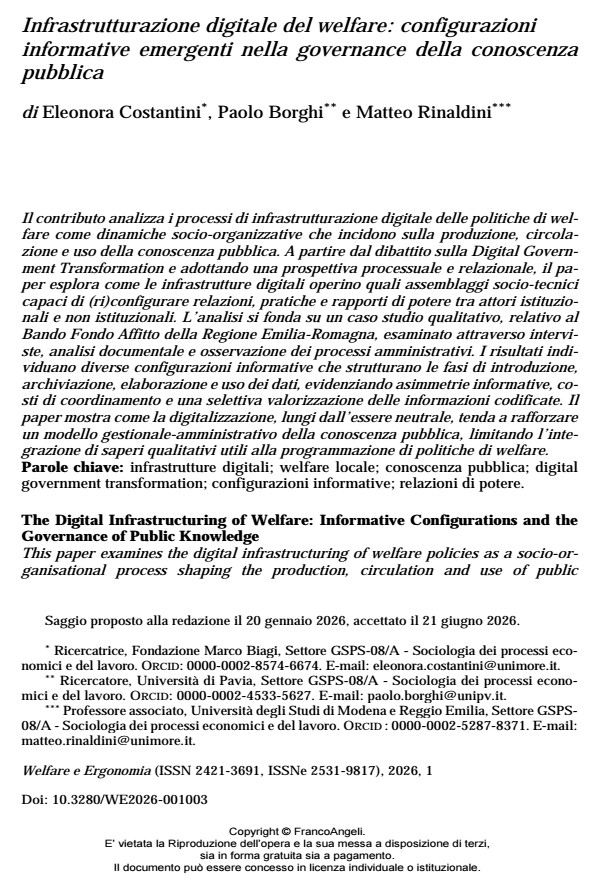
Below, you can see the article first page
If you want to buy this article in PDF format, you can do it, following the instructions to buy download credits
FrancoAngeli is member of Publishers International Linking Association, Inc (PILA), a not-for-profit association which run the CrossRef service enabling links to and from online scholarly content.
This paper examines the digital infrastructuring of welfare policies as a socio-organisational process shaping the production, circulation and use of public knowledge. Drawing on the Digital Government Transformation literature and adopting a relational and processual perspective, digital infrastructures are conceptualised as socio-technical assemblages that reconfigure interactions, practices and power relations among institutional and non-institutional actors. The analysis is based on a qualitative case study of the Emilia-Romagna Regional Housing Allowance Scheme, drawing on interviews, document analysis and observation of administrative processes. The findings identify a set of informational configurations structuring the phases of data input, storage, analysis and public use, revealing informational asymmetries, coordination costs and a selective valorisation of standardised data. The paper argues that digitalisation is not neutral: it tends to reinforce a managerial-administrative model of public knowledge governance, privileging evaluative and allocative functions while marginalising qualitative forms of knowledge that are essential for ensuring welfare policies remain responsive to complex social needs.
Keywords: digital infrastructure; local welfare; public knowledge; digital government transformation; informational configurations; power relations.
- Abdelnour S., Hasselbladh H. and Kallinikos J. (2017). Agency and institutions in organization studies. Organization Studies, 38(12): 1775-1792. DOI: 10.1177/0170840617708007
- Bertot J.C. and Jaeger P.T. (2008). The e-government paradox: Better customer service doesn’t necessarily cost less. Government Information Quarterly, 25(2): 149-154.
- Bolgherini S. (2007). The technology trap and the role of political and cultural variables: A critical analysis of the e-government policies. Review of Policy Research, 24(3): 259-275.
- Bonson E., Torres L., Royo S. and Flores F. (2012). Local e-government 2.0: Social Media and corporate transparency in municipalities. Government Information Quarterly, 29(2): 123-132.
- Borghi V. e Giullari B. (2015). Trasformazioni delle basi informative e immaginazione sociologica. Rassegna Italiana di Sociologia, 56(3-4): 379-404. DOI: 10.1423/81797
- Borghi V. e Leonardi E., a cura di (2024). Il sociale messo in forma. Le infrastrutture come cose, processi e logiche della vita collettiva. Napoli: Orthotes Editrice.
- Costantini E., Manzini N. e Fabbri T. (2024). Tecnologia e digitalizzazione in ambito socio-sanitario: vincoli e opportunità di contesto per le organizzazioni di Terzo Settore. Studi Organizzativi, 1: 9-43. DOI: 10.3280/SO2024-001001
- Cvajner M. (2025). Studiare l’interazione tra umani e macchine. Bologna: Il Mulino.
- Czarniawska B. (2009). How institutions are inscribed in technical objects and what it may mean in the case of the Internet. In: Contini F. and Lanzara G., a cura di, ICT and innovation in the public sector: European studies in the making of e-government. London: Palgrave Macmillan UK.
- De Angelis C.T. (2013). Models of governance and the importance of KM for public administration. Journal of Knowledge Management Practice, 14(2): 1-19.
- de Wit F., Lourenço A., Moreira H. and Vala F. (2022, September). Towards knowledge governance in public administration. In: Proceedings of the 23rd European conference on knowledge management, Naples, Academic Conferences International.
- Di Giulio M. and Vecchi G. (2023). Implementing digitalization in the public sector. Technologies, agency, and governance. Public Policy and Administration, 38(2): 133-158. DOI: 10.1177/09520767211023283
- Elias N. (1982). La civiltà delle buone maniere. Le trasformazioni dei costumi nel mondo aristocratico occidentale. Bologna: il Mulino.
- Febiri F., Gariba M.I., Hub M. and Provaznikova R. (2024). The synergy between human factors, public digitalization and public administration in the European context. Journal of Open Innovation: Technology, Market, and Complexity, 10(4): 1-14.
- Flyvbjerg B. (2006). Five Misunderstandings About Case-Study Research. Qualitative Inquiry, 12(2): 219-245. DOI: 10.1177/1077800405284363
- Grimmelikhuijsen S.G. and Meijer A.J. (2015). Does Twitter increase perceived police legitimacy? Public Administration Review, 75(4): 598-607.
- Hur J.Y., Cho W., Lee G. and Bickerton S.H. (2019). The “smart work” myth: how bureaucratic inertia and workplace culture stymied digital transformation in the relocation of South Korea’s capital. Asian Studies Review, 43(4): 691-709. DOI: 10.1080/10357823.2019.1663786
- Larkin B. (2013). The politics and poetics of infrastructure. Annual Review of Anthropology, 42: 327-343.
- Latupeirissa J.J.P., Dewi N.L.Y., Prayana I.K.R., Srikandi M.B., Ramadiansyah S.A. and Pramana I.B.G.A.Y. (2024). Transforming public service delivery: A comprehensive review of digitization initiatives. Sustainability, 16(7).
- Liva G., Codagnone C., Misuraca G., Gineikyte V. and Barcevicius E. (2020, September). Exploring digital government transformation: a literature review. In: Proceedings of the 13th International Conference on Theory and Practice of Electronic Governance. DOI: 10.1145/3428502.3428578
- Marciano C. (2022). Ma le imprese sociali sognano un welfare digitale?. IMPRESA SOCIALE, 4: 45-50. DOI: 10.7425/IS.2022.04.04
- Mauss M. (2002). Saggio sul dono. Forma e motivo dello scambio nelle società arcaiche. Torino: Einaudi.
- Misuraca G., Barcevicius E. and Codagnone C. (2019). Exploring digital government transformation in the EU. Analysis of the State of the Art and Review of Literature. Luxembourg: Publications Office of the EU.
- Mostowlansky T. and Rota A. (2020). Emic and etic. In: Felix Stein (edited by). The Open Encyclopedia of Anthropology. Facsimile of the first edition in The Cambridge Encyclopedia of Anthropology. Online:
- Wihlborg E. (2014, January). Legitimate E-Government - Public E-Services as a facilitator of political legitimacy. In: 2014 47th Hawaii International Conference on System Sciences. DOI: 10.1109/HICSS.2014.271
Eleonora Costantini, Paolo Borghi, Matteo Rinaldini, Infrastrutturazione digitale del welfare: configurazioni informative emergenti nella governance della conoscenza pubblica in "WELFARE E ERGONOMIA" 1/2026, pp 27-40, DOI: 10.3280/WE2026-0001003