Nuovi paradigmi aziendali emergono dal caos informativo e dalle vane certezze che investono le comunità socio-economiche
Titolo Rivista MANAGEMENT CONTROL
Autori/Curatori Giuseppe Catturi
Anno di pubblicazione 2026 Fascicolo 2026/2
Lingua Italiano Numero pagine 19 P. 25-43 Dimensione file 92 KB
DOI 10.3280/MACO2026-002002
Il DOI è il codice a barre della proprietà intellettuale: per saperne di più
clicca qui
Qui sotto puoi vedere in anteprima la prima pagina di questo articolo.
Se questo articolo ti interessa, lo puoi acquistare (e scaricare in formato pdf) seguendo le facili indicazioni per acquistare il download credit. Acquista Download Credits per scaricare questo Articolo in formato PDF
FrancoAngeli è membro della Publishers International Linking Association, Inc (PILA), associazione indipendente e non profit per facilitare (attraverso i servizi tecnologici implementati da CrossRef.org) l’accesso degli studiosi ai contenuti digitali nelle pubblicazioni professionali e scientifiche.
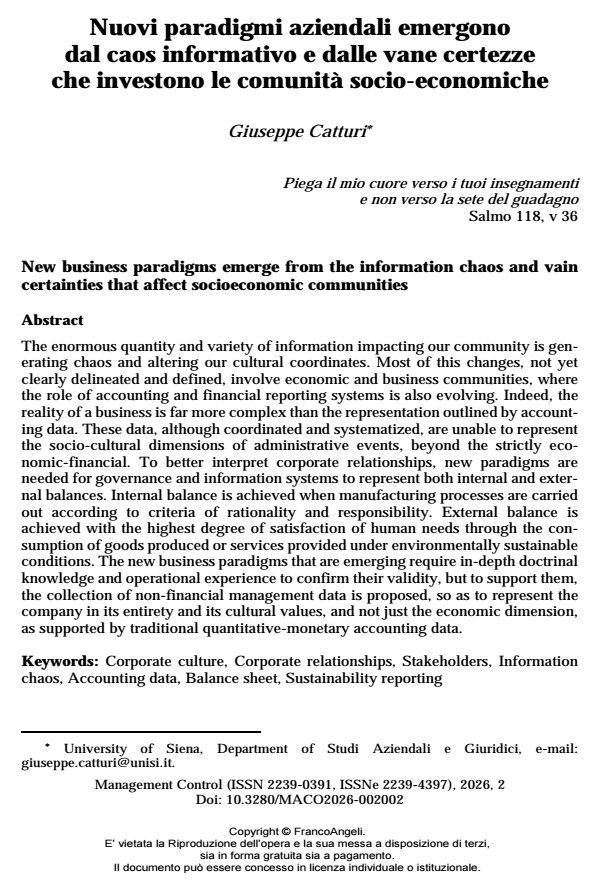
The enormous quantity and variety of information impacting our community is generating chaos and altering our cultural coordinates. Most of this changes, not yet clearly delineated and defined, involve economic and business communities, where the role of accounting and financial reporting systems is also evolving. Indeed, the reality of a business is far more complex than the representation outlined by accounting data. These data, although coordinated and systematized, are unable to represent the socio-cultural dimensions of administrative events, beyond the strictly economic-financial. To better interpret corporate relationships, new paradigms are needed for governance and information systems to represent both internal and external balances. Internal balance is achieved when manufacturing processes are carried out according to criteria of rationality and responsibility. External balance is achieved with the highest degree of satisfaction of human needs through the consumption of goods produced or services provided under environmentally sustainable conditions. The new business paradigms that are emerging require in-depth doctrinal knowledge and operational experience to confirm their validity, but to support them, the collection of non-financial management data is proposed, so as to represent the company in its entirety and its cultural values, and not just the economic dimension, as supported by traditional quantitative-monetary accounting data.
Parole chiave:Corporate culture, Corporate relationships, Stakeholders, Information chaos, Accounting data, Balance sheet, Sustainability reporting
Giuseppe Catturi, Nuovi paradigmi aziendali emergono dal caos informativo e dalle vane certezze che investono le comunità socio-economiche in "MANAGEMENT CONTROL" 2/2026, pp 25-43, DOI: 10.3280/MACO2026-002002