Times and rhythms of the retail shift work: two European case studies. Immediate gratification and deregulation of shop opening hours

Journal title SOCIOLOGIA DEL LAVORO
Author/s Annalisa Dordoni
Publishing Year 2017 Issue 2017/146
Language English Pages 16 P. 156-171 File size 108 KB
DOI 10.3280/SL2017-146010
DOI is like a bar code for intellectual property: to have more infomation click here

Below, you can see the article first page

If you want to buy this article in PDF format, you can do it, following the instructions to buy download credits
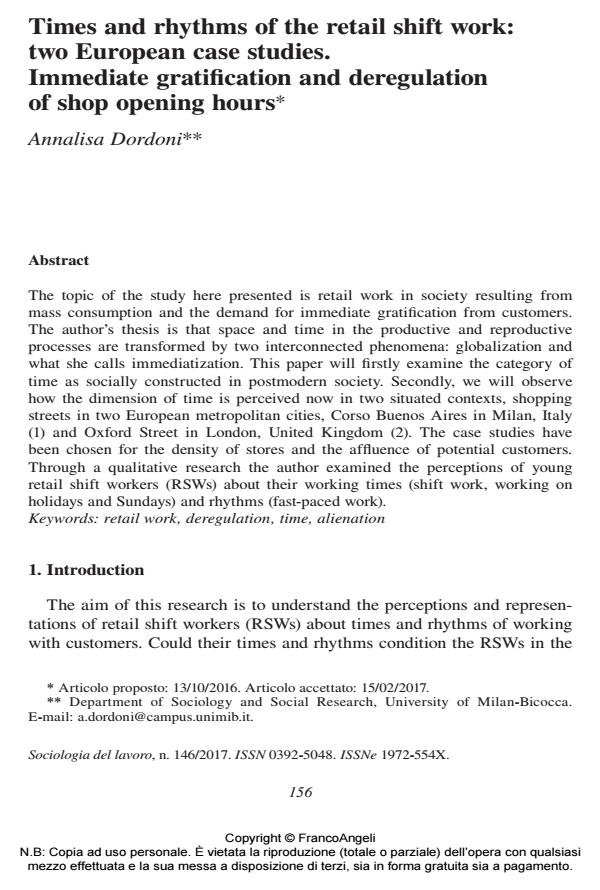
Article preview

FrancoAngeli is member of Publishers International Linking Association, Inc (PILA), a not-for-profit association which run the CrossRef service enabling links to and from online scholarly content.

The topic of the study here presented is retail work in society resulting from mass consumption and the demand for immediate gratification from customers. The author’s thesis is that space and time in the productive and reproductive processes are transformed by two interconnected phenomena: globalization and what she calls immediatization. This paper will firstly examine the category of time as socially constructed in postmodern society. Secondly, we will observe how the dimension of time is perceived now in two situated contexts, shopping streets in two European metropolitan cities, Corso Buenos Aires in Milan, Italy (1) and Oxford Street in London, United Kingdom (2). The case studies have been chosen for the density of stores and the affluence of potential customers. Through a qualitative research the author examined the perceptions of young retail shift workers (RSWs) about their working times (shift work, working on holidays and Sundays) and rhythms (fast-paced work).

Keywords: Retail work, deregulation, time, alienation

  1. Goffman E. (1959). The Presentation of Self in Everyday Life. New York: Random House.
  2. Gould A.M. (2010). Working at McDonalds: some redeeming features of McJobs. Work, Employment and Society, 24(4): 780-802. DOI: 10.1177/0950017010380644
  3. Hammersley M., Atkinson P. (2007). Ethnography: principles in practice. London: Routledge.
  4. Harvey D. (1990). The condition of Postmodernity. An enquiry into the origins of cultural change. Oxford: Blackwell.
  5. Harvey D. (1999). Time-Space Compression and the Postmodern Condition. In: Waters M., Modernity: Critical Concepts 4. New York: Routledge.
  6. Hochschild A.R. (1983). The Managed Heart: Commercialization of Human Feeling. Berkeley: University of California Press.
  7. Jenkins S., Delbridge R., Roberts A. (2010). Emotional management in a mass customised call centre: examining skill and knowledgeability in interactive service work. Work, Employment and Society, 24(3): 546-564. DOI: 10.1177/0950017010371665
  8. Korczynski M., Shire K., Frenkel S., Tam M. (2000). Service work in consumer capitalism: customers, control and contradictions. Work, Employment and Society, 14(4): 669-687. DOI: 10.1177/09500170022118671
  9. Korczynski M. (2009). The Mystery Customer: Continuing Absence in the Sociology of Service Work. Sociology, n. 43(5): 952-967. DOI: 10.1177/0038038509340725
  10. Langman L. (1991). Alienation and everyday life: Goffman meets Marx at the shopping mall. International Journal of Sociology and Social Policy, 11(6/7/8): 107-124.
  11. Leccardi C. (2004). Resisting “Acceleration Society”. Constellations. An International Journal of Critical and Democratic Theory, 10(1): 34-42. DOI: 10.1111/1467-8675.00310
  12. Leccardi C. (2005). Facing uncertainty. Temporality and biographies in the new century. Young, 13(2): 123-146. DOI: 10.1177/1103308805051317
  13. Leccardi C. (2009). Sociologie del tempo. Soggetti e tempo nella società dell’accelerazione. Roma-Bari: Laterza.
  14. Leccardi C. (2014). Time of Society and Time of Experience: Multiple Times and Social Change. KronoScope, 14(1): 10-24. DOI: 10.1163/15685241-12341288
  15. Leidner R. (1993). Fast Food, Fast Talk. Berkeley: University of California Press.
  16. Lopez S.H. (2010). Workers, Managers, and Customers: Triangles of Power in Work Communities. Work and Occupations, 37(3): 251-271. DOI: 10.1177/0730888410375683
  17. Mead G.H. (1934). Mind, self and society. Chicago: University of Chicago Press.
  18. Nowotny H. (1987). Eigenzeit. Entstehung und Strukturierung eines Zeitgefühls. Frankfurt: Suhrkamp.
  19. Osterhammel J., Petersson N.P. (2003). Geschichte der Globalisierung. Dimensionen, Prozesse, Epochen. Munchen: C.H. Beck.
  20. Paolucci G. (1993). Tempi Postmoderni. Per una sociologia del tempo nelle società tardo-industriali. Milano: FrancoAngeli.
  21. Paolucci G. (1996). The changing dynamics of working time. Time & Society, 5(2): 145-167. DOI: 10.1177/0961463X96005002002
  22. Paolucci G. (2001). The city’s continuous cycle of consumption: towards a new definition of the power over time? Antipode, 33(4): 647-659. DOI: 10.1111/1467-8330.00204
  23. Possenti I. (2012). Flessibilità: retoriche e politiche di una condizione contemporanea. Verona: Ombre Corte.
  24. Rosa H. (2003). Social Acceleration: Ethical and Political Consequences of a Desynchronized High-Speed Society. Constellations, 10(1): 3-33. DOI: 10.1111/1467-8675.00309
  25. Rosa H. (2010). Alienation and Acceleration: Towards a Critical Theory of Late-Modern Temporality. Stockholm: Nordic Summer University Press.
  26. Scherman R. (2011). Beyond interaction: customer influence on housekeeping and room service work in hotels. Work, Employment and Society, 25(1): 19-33. DOI: 10.1177/0950017010389240
  27. Sennett R. (1998). The Corrosion of Character: The Personal Consequences of Work in the New Capitalism. New York: W.W. Norton.
  28. Stake R.E. (1994) Case Studies. In: Denzin N.K., Lincoln Y.S., Handbook of Qualitative Research. Thousand Oaks: Sage.
  29. Sturdy A. (1998). Customer care in a consumer society: smiling and sometimes meaning it? Organization, 5(1): 27-53. DOI: 10.1177/135050849851003
  30. Tomlinson J. (2007). The culture of speed. The coming of immediacy. London: Sage.
  31. Wajcman J. (2015). Pressed for Time. The acceleration of life in digital capitalism. Chicago: University of Chicago Press.
  32. Adam B.E. (1990). Time and social theory. Cambridge: Polity Press.
  33. Bauman Z. (1998). Work, Consumerism and the New Poor. Buckingham: Open University Press.
  34. Bauman Z. (2000). Liquid modernity. Cambridge: Polity Press.
  35. Bauman Z. (2009). Vite di corsa, come salvarsi dalla tirannia dell’effimero. Bologna: il Mulino.
  36. Beers T.M. (2000). Flexible Schedules and Shift Work: Replacing the “9-to-5” Workday? Monthly Labor Review, 123(6): 33-40. DOI: 10.2307/41845205
  37. Berger P.L., Luckmann T. (1966). The Social Construction of Reality. New York: Random House.
  38. Blossfeld H.P., Klijzing E., Mills M., Kurz K. (2006). Globalization, uncertainty and youth in society: The losers in a globalizing world. London and New York: Routledge.
  39. Bolton S. (2005). Emotion Management in the Workplace. London: Palgrave.
  40. Bosch G., Lehndorff S. (2005). Working in the Service Society: A Tale from Different Worlds. London and New York: Routledge.
  41. Cameron R., Neal L. (1991). Economic History of the World. New York: Oxford University Press.
  42. Carmo R.M., Cantante F., De Almeida Alves N. (2014). Time projections: Youth and precarious employment. Time & Society, 23(3): 337-357. DOI: 10.1177/0961463X14549505
  43. Cerruti G.C. (2010). Lavorare al tempo del cliente nel post-fordismo. Cambiamenti degli orari di lavoro in un ipermercato. Milano: FrancoAngeli.
  44. Codeluppi V. (2010). Dalla produzione al consumo: processi di cambiamento delle società contemporanee. Milano: FrancoAngeli.
  45. Codeluppi V. (2014). Metropoli e luoghi del consumo. Milano-Udine: Mimesis.
  46. Crespi F. (2005). Tempo vola. Bologna: il Mulino.
  47. Del Colle E. (2013). Tra flessibilità e precarietà. Cambiamenti nelle forme del lavoro e della sicurezza. Roma: Carocci.
  48. Denzin N.K., Lincoln Y.S. (2000). Qualitative research. In: Denzin N.K., Lincoln Y.S., Handbook of qualitative research. Thousand Oaks: Sage.
  49. Di Nallo E., Fabris G. (2004). L’esperienza del tempo di consumo, tra pratiche e fruizione sociale. Milano: FrancoAngeli. Eurofound, European Foundation for the Improvement of Living and Working
  50. Conditions (2012). Working conditions in the retail sector. Executive summary.
  51. Fullin G. (2002). Instabilità del lavoro e vulnerabilità: dimensioni, punti di equilibrio ed elementi di fragilità. Rassegna Italiana di Sociologia, 4: 553-586. DOI: 10.1423/8192
  52. Fullin G. (2004). Vivere l’instabilità del lavoro. Bologna: il Mulino.
  53. Gallino L. (2005). Il costo umano della flessibilità. Roma-Bari: Laterza.
  54. Giddens A. (1979). Central Problems in Social Theory: Action, Structure, and Contradiction in Social Analysis. Berkeley: University of California Press.
  55. Giddens A. (1984). The Constitution of Society: Outline of the Theory of Structuration. Berkeley: University of California Press.

  • Organizational behaviour and firm performance: A study of Italian retail industry Riccardo Savio, in Risk Governance and Control: Financial Markets and Institutions /2021 pp.49
    DOI: 10.22495/rgcv11i1p4
  • Temporal Patterns in Management: Integrating Perspectives on Rhythms of Work and Organizing Omid Omidvar, Demetris Hadjimichael, Gary T. Burke, Igor Pyrko, Robert Chia, in Academy of Management Annals /2025 pp.861
    DOI: 10.5465/annals.2024.0081

Annalisa Dordoni, Times and rhythms of the retail shift work: two European case studies. Immediate gratification and deregulation of shop opening hours in "SOCIOLOGIA DEL LAVORO " 146/2017, pp 156-171, DOI: 10.3280/SL2017-146010