Mediafobia. Quando le tecnologie della comunicazione fanno paura
Journal title SOCIOLOGIA DELLA COMUNICAZIONE
Author/s Federico Boni
Publishing Year 2018 Issue 2017/54
Language Italian Pages 16 P. 64-79 File size 75 KB
DOI 10.3280/SC2017-054005
DOI is like a bar code for intellectual property: to have more infomation
click here
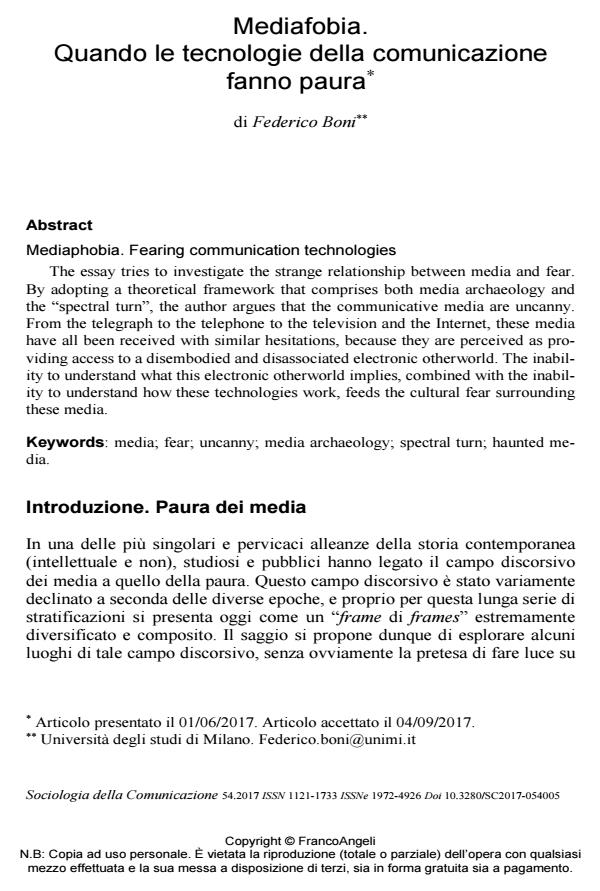
Below, you can see the article first page
If you want to buy this article in PDF format, you can do it, following the instructions to buy download credits
FrancoAngeli is member of Publishers International Linking Association, Inc (PILA), a not-for-profit association which run the CrossRef service enabling links to and from online scholarly content.
- Pinotti A., Somaini A. (2016), Cultura visuale. Immagini sguardi media dispositivi, Einaudi, Torino.
- Abruzzese A. (2003), Mostro, in id. (a cura di), Lessico della comunicazione, Meltemi, Roma, pp. 385-388.
- Alexander J.C. (2013), The Dark Side of Modernity, Sage, London-New York. Blanco M., Peeren E. (eds.) (2013), The Spectralities Reader. Ghosts and Haunting in Contemporary Cultural Theory, Bloomsbury, London-New York.
- Boluk S., Lenz W. (2011), Introduction: Generation Z, the Age of Apocalypse, in iid. (eds.), Generation Zombie. Essays on the Living Dead in Modern Culture, McFarland & Company, Jefferson (NC), pp. 1-17.
- Bottomore S. (1999), The Panicking Audience?: early cinema and the “train effect”, in «Historical Journal of Film, Radio and Television», 19, 2, pp. 177-216. DOI: 10.1080/01439689910027
- Cirucci A.M. (2013), The Social Dead: How Our Zombie Baggage Threatens to Drag Us into the Crypts of Our Past, in Balaji M. (ed.), Thinking Dead: What the Zombie Apocalypse Means, Lexington Books, Lanham (MD), pp. 17-28.
- Codeluppi V. (2013), Perché i mostri, in id. (a cura di), Mostri. Dracula, King Kong, Alien, Twilight e altre figure dell’immaginario, FrancoAngeli, Milano.
- Codeluppi V. (2016), Il mago Orson Welles e le menzogne mediatiche, in id. (a cura di), È tutto vero. Marziani, astronavi e beffe mediatiche, FrancoAngeli, Milano.
- Cristante S. (2002), Il rumore del silenzio, introduzione a Noelle-Neumann E., La spirale del silenzio, Meltemi, Roma.
- DeFleur M.L., Ball-Rokeach S.J. (1989), Theories of Mass Communication, Longman, New York; trad. it. (1995) Teorie delle comunicazioni di massa, il Mulino, Bologna.
- Delumeau J. (1978), La Peur en Occident, Fayard, Paris; trad. it (1979) La paura in occidente, Società Editrice Internazionale, Torino.
- Derrida J. (1993), Spectres de Marx, Galilée, Paris; trad. it. (1994) Spettri di Marx, Cortina, Milano.
- Foucault M. (1969), L’archéologie du savoir, Gallimard, Paris; trad. it (1980) L’archeologia del sapere, Rizzoli, Milano.
- Hertz G., Parikka J. (2012), Zombie Media: Circuit Bending Media Archaeology into an Art Method, in «Leonardo», 45, 5.
- Levina M., Bui D.-M. (2013), Introduction: Toward a comprehensive monster theory in the 21st century, in iid. (eds.), Monster Culture in the 21st Century. A Reader, Bloomsbury, New York-London.
- Loiperdinger M. (2004), Lumière’s Arrival of the Train: Cinema’s Founding Myth, in «The Moving Image: The Journal of the Association of Moving Image Archivists», 4, 1.
- McLuhan M. (1964) Understanding Media, McGraw-Hill, New York; trad. it. (1990) Gli strumenti del comunicare, Il Saggiatore, Milano.
- McQuail D. (1983), Mass Communication Theory. An Introduction, Sage, London; trad. it.
- (2006) Sociologia dei media, il Mulino, Bologna.
- Meyrowitz J. (1985), No Sense of Place. The Impact of Electronic Media on Social Behavior, Oxford University Press, Oxford-New York; trad. it. (1993) Oltre il senso del luogo. L’impatto dei media elettronici sul comportamento sociale, Baskerville, Bologna.
- Natale S. (2012), Fantasie mediali. La storia dei media e la sfida dell’immaginario, in «Studi Culturali», 9, 2. DOI: 10.1405/3807
- Neocleous M. (2008), Il mostro e la morte. Funzione politica della mostruosità, DeriveApprodi, Roma.
- Parikka J. (2007), Digital Contagions. A Media Archaeology of Computer Viruses, Peter Lang, New York.
- Parikka J. (2012), What is Media Archaeology?, Polity, Cambridge.
- Peters J.D. (1999), Speaking into the Air. A History of the Idea of Communication, University of Chicago Press, Chicago.
- Sconce J. (2000), Haunted Media. Electronic Presence from Telegraphy to Television, Duke University Press, Durham (NC)-London.
- Scott N. (2007), Introduction, in id. (a cura di), Monsters and the Monstrous. Myths and Metaphors of Enduring Evil, Rodopi, Amsterdam-New York.
- Warner M. (2006), Phantasmagoria. Spirit Visions, Metaphors, and Media into the Twentyfirst Century, Oxford University Press, Oxford, New York.
- Wolf M. (1985), Teorie delle comunicazioni di massa, Bompiani, Milano.
- Wolf M. (1990) Nota a Welles O., La Guerra dei Mondi, Baskerville, Bologna.
- Wolf M. (1992), Gli effetti sociali dei media, Bompiani, Milano.
Federico Boni, Mediafobia. Quando le tecnologie della comunicazione fanno paura in "SOCIOLOGIA DELLA COMUNICAZIONE " 54/2017, pp 64-79, DOI: 10.3280/SC2017-054005