A hundred steps from the warehouse. The anti-union partnership between business and organized crime. An extreme case study in the logistics sector.

Journal title STUDI ORGANIZZATIVI
Author/s Tea Maistro, Anna Mori, Marco Guerci
Publishing Year 2025 Issue 2025/1
Language Italian Pages 29 P. 67-95 File size 225 KB
DOI 10.3280/SO2025-001003
DOI is like a bar code for intellectual property: to have more infomation click here

Below, you can see the article first page

If you want to buy this article in PDF format, you can do it, following the instructions to buy download credits
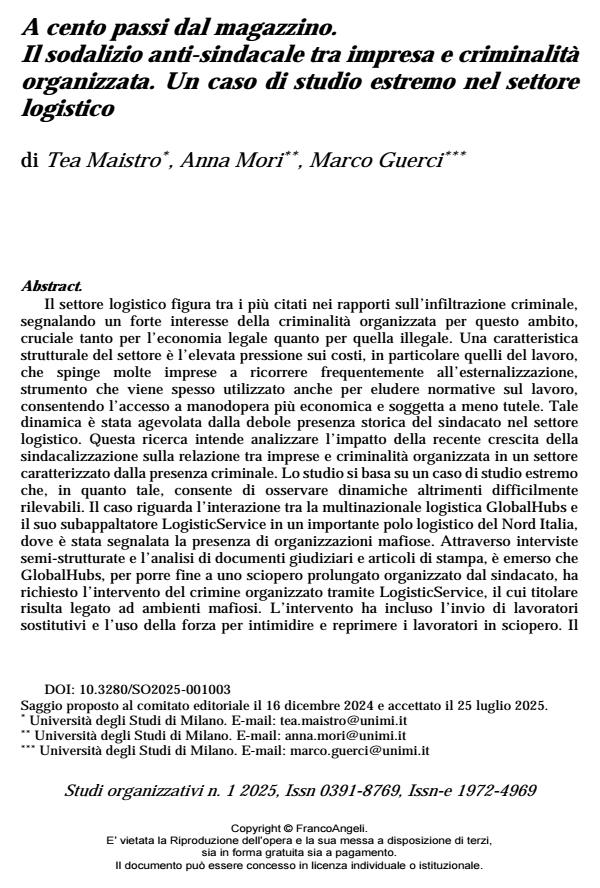
Article preview

FrancoAngeli is member of Publishers International Linking Association, Inc (PILA), a not-for-profit association which run the CrossRef service enabling links to and from online scholarly content.

Organized crime is strongly interested in the logistics sector because it allows for the movement of illegal products. To complement, trade unions’ presence, traditionally associated with legality, is recent in this sector, partly because logistics companies frequently exploit outsourcing to circumvent institutional and regulatory constraints in workforce governance, excluding unions from workplaces. Against this backdrop, this research aims to investigate what impact the recent and growing unionization of the logistic sector - characterized by a strong presence of organized crime - has had on the relationships between companies and organized crime. Empirically, this study is based on an extreme case study regarding the interaction between a logistics multinational – GlobalHubs – and its subcontractor – Logisticservice – in one of the most important logistics hubs in Northern Italy, where the presence of the mafia has been reported. This study integrates multiple sources including semi-structured interviews, analysis of judicial documents and examination of newspaper articles. It emerges that, to end an intense strike, GlobalHubs searched for help from the head of Logisticservice to leverage his connections with a mafia criminal group, which violently repress the strike. From these events, a new representation of the firm emerges, which increasingly appears as a conscious and active partner of organized crime that may become a key player in the logistics sector.

Keywords: organized crime; unionization; silencing workers; union repression; logistics; extreme case study

  1. Benassi, C., Doellgast, V., e Sarmiento-Mirwaldt, K. (2016) “Institutions and Inequality in Liberalizing Markets: Explaining Different Trajectories of Institutional Change in Social Europe”, Politics e Society, 44(1): 117–142.
  2. Benvegnú, C., Haidinger, B., e Sacchetto, D. (2018) Restructuring Labour Relations and Employment in the European Logistics Sector, in Doellgast, V., Lillie, N., Pulignano, V. (eds), Reconstructing Solidarity: Labour Unions, Precarious Work, and the Politics of Institutional Change in Europe Oxford University Press.
  3. Bottalico, A. (2016) “Logistica del trasporto merci e sindacalizzazione dal basso”, Meridiana, 86: 125–146.
  4. Bottalico, A. (2018). “Lavoro e conflitti nella catena logistica del trasporto”, Sociologia del Lavoro, 149: 185–200.
  5. Bottalico, A. (2024) “Logistica del trasporto merci e sindacalizzazione dal basso”, Studi Organizzativi, 2: 45–68.
  6. Campolieti M, Gomez R, Gunderson M (2013) “Does Non-Union Employee Representation Act as a Complement or Substitute to Union Voice? Evidence from Canada and the United States”, Industrial Relations: A Journal of Economy and Society 52(1): 378-396.
  7. Catino, M. (2018) “Colletti bianchi e mafie. Le relazioni pericolose nell’economia del Nord Italia”, Stato e mercato, 1: 149–188.
  8. Catino, M. (2020) “Italian Organized Crime since 1950”, Crime and Justice, 49: 69–140.
  9. Catino, M. (2024) “Normal organizational wrongdoing? Grandi imprese e devianza organizzativa”, Sistema Penale
  10. Cuppini, N., e Pallavicini, C. (2015) “Le lotte nella logistica nella valle del Po”, Sociologia del lavoro, 138: 210–224.
  11. Dalla Chiesa, N. (2014) Manifesto dell’Antimafia, Giulio Einaudi editore.
  12. Dalla Chiesa, N., e Cabras, F. (2022) “Il fenomeno mafioso nelle Regioni del Nord Italia: nuove tendenze e prospettive”, Istituzioni del federalismo: rivista di studi giuridici e politici, XLIII(1): 99–115.
  13. Doellgast, V. L., Lillie, N., e Pulignano, V. (Eds.). (2018). Reconstructing solidarity: Labour unions, precarious work, and the politics of institutional change in Europe, Oxford, Oxford University Press.
  14. Donaldson, J. A., Ching, J. M. R., e Tan, A. T. M. (2013) “Going Extreme: Systematically Selecting Extreme Cases for Study through Qualitative Methods”, American Political Science Association Annual Meeting, 2013: 1–20.
  15. Dorigatti, L., e Mori, A. (2020) “Condizioni di lavoro e relazioni industriali nelle catene del valore della logistica”, Rivista giuridica del lavoro e della previdenza sociale, 71: 388-407.
  16. Faleri, C. (2021) “«Non basta la repressione». A proposito di caporalato e sfruttamento del lavoro in agricoltura”. Lavoro e diritto, 2: 257–279
  17. Giuliani, A. (2015) I reati in materia di caporalato, intermediazione illecita e sfruttamento del lavoro, Padova University Press
  18. Gond, J.-P., Palazzo, G., e Basu, K. (2009) “Reconsidering Instrumental Corporate Social Responsibility through the Mafia Metaphor”, Business Ethics Quarterly, 19(1): 57–85.
  19. Gumbrell-McCormick, R., e Hyman, R. (2019) “Democracy in trade unions, democracy through trade unions?”, Economic and Industrial Democracy, 40(1): 91–110.
  20. Harding, N., Tassabehji, R., e Lee, H. (2024) “Organizations, Neoconservativism, and New Chauvinism: Organizational receptivity to right-wing political strategies”, Organization Studies, 45(4): 567–590.
  21. Iborra M. e Riera M. (2023) “Corporate social irresponsibility: What we know and what we need to know”, Corporate Social Responsibility and Environmental Management, vol. 30(3): pp. 1421–1439.
  22. Jaehrling, K., Méhaut, P. (2013) “Varieties of institutional avoidance: employers' strategies in low-waged service sector occupations in France and Germany”, Socio-Economic Review, 11(4): 687-710.
  23. Johnson, S., Kaufmann, D., McMillan, J., e Woodruff, C. (2000). “Why do firms hide? Bribes and unofficial activity after communism” Journal of Public Economics, 76(3), 495–520.
  24. Kaufman, B. E. (2016) “Experience with Company Unions and their Treatment under the Wagner Act: A Four Frames of Reference Analysis”, Industrial Relations: A Journal of Economy and Society, 55(1): 3–39.
  25. La Rosa, F., Paternostro, S., e Picciotto, L. (2018) “Exploring the determinants of anti-mafia entrepreneurial behaviour: An empirical study on southern Italian SMEs", Entrepreneurship e Regional Development, 30(1–2): 81–117.
  26. Montalbano, G. (2012) “La repressione del movimento contadino in Sicilia (1944-1950)”, Diacronie, 12,4
  27. Richnák, e Porubanová, K. (2017) Business logistics in the conditions of globalization
  28. Paoli L (2014) The Oxford Handbook of Organized Crime, Oxford, Oxford Handbooks.
  29. Palmisano, L. (2017) Mafia Caporale, Frosinone, Fandango
  30. Pellegrini, S. (2018) L’impresa grigia: Le infiltrazioni mafiose nell’economia legale: un’analisi sociologico-giuridica, Roma, Ediesse.
  31. Pinotti, P. (2015) “The Economic Costs of Organised Crime: Evidence from Southern Italy”, The Economic Journal, 125(586): 203-232
  32. Pulignano, V., Thompson, P., e Doerflinger, N. (2022) “When accumulation pressures meet regulatory institutions: A comparison in logistics”, European Journal of Industrial Relations, 28(3): 273–294.
  33. Ravenda, D., Valencia-Silva, M. M., Argiles-Bosch, J. M., e García-Blandón, J. (2019) “Money laundering through the strategic management of accounting transactions”, Critical Perspectives on Accounting, 60: 65–85.
  34. Romeo, I. (2023) “Il sindacato in guerra con la mafia”, Collettiva CGIL
  35. Scaglione, A. (2023) “L’impatto dell’analisi di rete sullo studio dei fenomeni di criminalità organizzata: Evidenze e criticità”, Studi Organizzaztivi, 1: 60–83.
  36. Sciarrone, R. (2002) “Le mafie dalla società locale all’economia globale”, Meridiana, 43: 49–82.
  37. Sciarrone, R. (2014) Mafie del Nord: Strategie criminali e contesti locali. Roma, Donzelli.
  38. Sciarrone, R., e Storti, L. (2016) “Complicità trasversali fra mafia ed economia. Servizi, garanzie, regolazione”, Stato e Mercato, 3: 353–390.
  39. Sciarrone, R., e Storti, L. (2019) Le mafie nell’economia legale: Scambi, collusioni, azioni di contrasto. Bologna, Il Mulino.
  40. Seawright, J., e Gerring, J. (2008) “Case Selection Techniques in Case Study Research: A Menu of Qualitative and Quantitative Options”, Political Research Quarterly, 61(2): 294–308.
  41. Sergi, A. (2020) The Port-Crime Interface: A Report on Organised Crime e Corruption in Seaports, Colchester, University of Essex.
  42. Taschini, L. (2022) “Caporalato e sfruttamento lavorativo in agricoltura”, Rivista del Diritto della Sicurezza Sociale, 4: 613–651
  43. Wagner, L., e De Lugo, L. B. R. B. (2022) Organized Crime and the Haulage Sector, in Zabyelina, Y. e Thachuk K. L. The Private Sector and Organized Crime, Oxon, Routledge.
  44. Yin, R. K. (1989) Case study research: Design and methods (Rev. ed), Beverly Hills, Sage Publications.
  45. Zabyelina, Y., e Thachuk, K. L. (2023) The private sector and organized crime: Criminal entrepreneurship, illicit profits, and private sector security governance (1st Edition), Oxon, Routledge.

Tea Maistro, Anna Mori, Marco Guerci, A cento passi dal magazzino. Il sodalizio anti-sindacale tra impresa e criminalità organizzata. Un caso di studio estremo nel settore logistico in "STUDI ORGANIZZATIVI " 1/2025, pp 67-95, DOI: 10.3280/SO2025-001003