Rural tourism and social innovation in the belluno dolomites unesco
Journal title ECONOMIA E SOCIETÀ REGIONALE
Author/s Olga Tzatzadaki
Publishing Year 2025 Issue 2025/2
Language Italian Pages 23 P. 125-147 File size 352 KB
DOI 10.3280/ES2025-002009
DOI is like a bar code for intellectual property: to have more infomation
click here
Below, you can see the article first page
If you want to buy this article in PDF format, you can do it, following the instructions to buy download credits
FrancoAngeli is member of Publishers International Linking Association, Inc (PILA), a not-for-profit association which run the CrossRef service enabling links to and from online scholarly content.
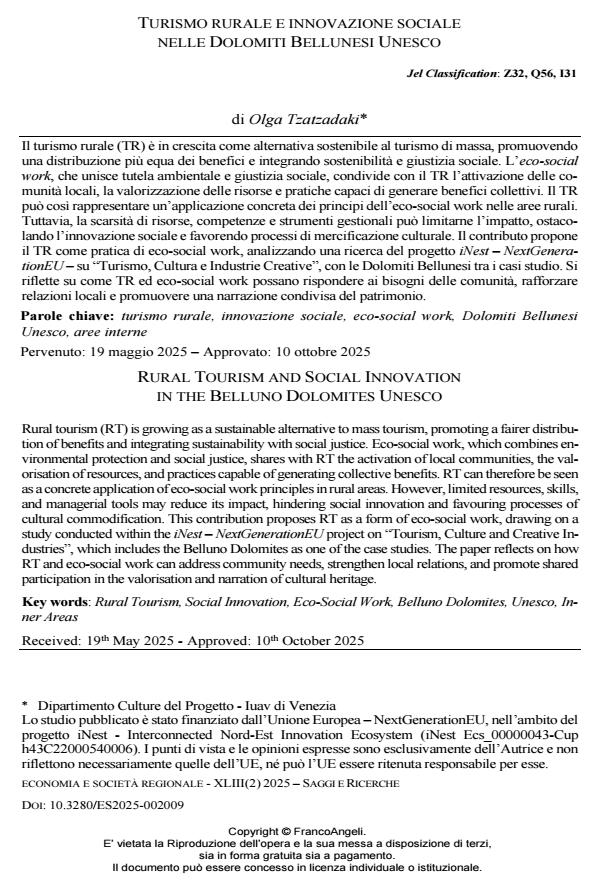
Rural tourism (RT) is growing as a sustainable alternative to mass tourism, promoting a fairer distribution of benefits and integrating sustainability with social justice. Ecosocial work, which combines environmental protection and social justice, shares with RT the activation of local communities, the valorisation of resources, and practices capable of generating collective benefits. RT can therefore be seen as a concrete application of ecosocial work principles in rural areas. However, limited resources, skills, and managerial tools may reduce its impact, hindering social innovation and favouring processes of cultural commodification. This contribution proposes RT as a form of ecosocial work, drawing on a study conducted within the iNest – NextGenerationEU project on “Tourism, Culture and Creative Industries”, which includes the Belluno Dolomites as one of the case studies. The paper reflects on how RT and ecosocial work can address community needs, strengthen local relations, and promote shared participation in the valorisation and narration of cultural heritage.
Keywords: Rural Tourism, Social Innovation, EcoSocial Work, Belluno Dolomites, Unesco, Inner Areas
Jel codes: Z32, Q56, I31
- Seerangan C., Ravi R.V. (2014). A Study on InterGenerational Knowledge Transfer and Its Impact on Sustainable WellBeing. Studies in Indian Sociology, 1(1): 2336.
- Alier J.M. (2004). El ecologismo de los pobres. Conflictos ambientales y lenguajes de valoración. Barcellona: Icaria.
- Alston M., Besthorn F. (2012). Environment and Sustainability. In Lyons K., Hokenstad T., Pawar M., Huegler N., Hall N., Eds. The Sage Handbook of International Social Work, 3: 5669. DOI: 10.4135/9781446247594
- Ammirato S., Felicetti A.M., Raso C., Pansera B.A., Violi A. (2020). Agritourism and sustainability: What we can learn from a systematic literature review. Sustainability, 12(22), 9575.
- Arboleda Jaramillo C.A., Arias Arciniegas C.M., Pérez E.O., Correa P. (2020). Social innovation as a strategy to strengthen community rural tourism. Revista Venezolana de Gerencia, 25(89): 92104.
- Arman M., Ali M., Qadir A. (2023). An assessment of the epistemological progress in rural tourism: A systematic literature review. African Journal of Hospitality, Tourism and Leisure, 12(2): 702716.
- Belliggiano A., Bindi L., Ievoli C. (2021). Walking along the sheeptrack… rural tourism, ecomuseums, and biocultural heritage. Sustainability, 13(16): 8870.
- Berger R.E., Kelly J. (1993). Social work in the ecological crisis. Social Work, 38(5): 521526.
- Besthorn F.H. (2002). Radical environmentalism and the ecological self: Rethinking the concept of selfidentity for social work practice. Journal of Progressive Human Services, 13(1): 5372.
- Blackstock K. (2005). A critical look at communitybased tourism. Community Development Journal, 40(1): 3949.
- Blaikie P., Cannon T., Davis I., Wisner B. (1994). At risk. Natural hazards, people’s vulnerability and disasters. Londra, UK: Routledge.
- Bock B.B. (2016). Rural marginalisation and the role of social innovation; a turn towards nexogenous development and rural reconnection. Sociologia ruralis, 56(4): 552573.
- Boetto H. (2017). A transformative ecosocial model: Challenging modernist assumptions in social work. The British Journal of Social Work, 47(1): 4867.
- CáceresFeria R., HernándezRamírez M., RuizBallesteros E. (2021). Depopulation, communitybased tourism, and community resilience in southwest Spain. Journal of Rural Studies, 88:108116.
- Calbucci R., Deiedda M., De Santi M., Di Rosa R.T., Fiorentini A., Giuliano E., Gui L., Mordeglia S., Pelosio S., Sartori F., Ticchiati R., Zannoni A. (2016), Servizio sociale e calamità naturali. Interventi di servizio sociale. Roma: Eiss.
- Cciaa Camera di Commercio TrevisoBelluno (2017). Dinamiche dei flussi turistici in Provincia di Belluno nell’anno 2016. In: Giornate dell’Economia 2017 (Sandi M., Ufficio Statistica, studi e prezzi) <https://www.tb. camcom.gov.it/uploads/CCIAA/Bisogni/Pubblicazi/Studi/Rapporto/2016/FOC USTurismoBL2016.pdf>.
- CeballosLascura´in H. (1996). Tourism, ecotourism, and protected areas: The state of naturebased tourism around the world and guidelines for its development. International Union for Conservation of Nature and Natural Resources. Cambridge: Gland.
- Chiodo E., Adriani H.L., Navarro F.P., Salvatore R. (2019). Collaborative processes and collective impact in tourist rural villages – insights from a comparative analysis between Argentinian and Italian cases. Sustainability, 11(2): 432.
- Coates J. (2004). Ecology and social work: Toward a new paradigm. Halifax: Fernwood Publishing.
- Coates J., Gray M., Hetherington T. (2006). An ‘ecospiritual’ perspective: Finally, a place for indigenous approaches. The British Journal of Social Work, 36(3): 381399.
- Defourny J., Nyssens M. (2010). Conceptions of social enterprise and social entrepreneurship in Europe and the United States: Convergences and divergences. Journal of Social Entrepreneurship, 1(1): 3253. DOI: 10.1080/19420670903442053
- Della Lucia M., Trunfio M. (2012). Embedded governance, knowledge management e capitale sociale per la sostenibilità delle destinazioni. Il caso delle destinazioni montane emergenti. Modelli e best practice per la competitività e la sostenibilità delle destinazioni italiane. Napoli: Enzo Albano Editore.
- Dik B.J., Duffy R.D. (2009). Calling and vocation at work: Definitions and prospects for research and practice. The counseling psychologist, 37(3), 424450. DOI: 10.1177/0011000008316430
- Dominelli L. (2012). Green Social Work: From Environmental Crises to Environmental Justice. Cambridge: Polity Press.
- Dominelli L. (2013). Environmental justice at the heart of social work practice: Greening the profession. International Journal of Social Welfare, 22(4): 431439.
- Erickson C.L. (2012). Environmental degradation and preservation. In: Healy L.M. e Link R.J., Eds. The handbook of international social work: Human rights, development and the global profession. New YorkOxford: Oup.
- Eurac Research. (2017, novembre). Piano di marketing territoriale per la Provincia di Belluno <https://bia.unibz.it/esploro/outputs/report/PianodiMarketingTerritorialeperla/991005773446701241>.
- Feder G. (1967). Agricultural development and economic growth. Chicago: University of Chicago Press.
- Figueiredo E., Forte T., Eusébio C. (2021). Rural territories and food tourism – exploring the virtuous bonds through a systematic literature review. European Countryside, 13(3): 622643.
- Flora C.B., Flora J.L. (2013). Rural Communities: Legacy and Change, 4th edn. Boulder: Westview Press.
- Franz H.W., Hochgerner J., Howaldt J., Eds. (2012). Challenge social innovation: Potentials for business, social entrepreneurship, welfare, and civil society. Berlin: Springer.
- Ghaderi Z., Henderson J.C. (2012). Sustainable rural tourism in Iran: A perspective from Hawraman village. Tourism Management Perspectives, 23: 4754.
- Gray M., Coates J., Hetherington T., Eds. (2013). Environmental social work. New York: Routledge.
- Guan J., Gao J., Zhang C. (2019). Food heritagization and sustainable rural tourism destination: The case of China’s Yuanjia Village. Sustainability, 11(10), 2858.
- Hall C.M. (2004). Small firms and wine and food tourism in New Zealand: Issues of collaboration, clusters and lifestyles. In: Thomas R., Eds. Small firms in tourism: International perspectives. Amsterdam: Elsevier.
- Hall C.M., Sharples L. (2003). The consumption of experiences or the experience of consumption? An introduction to the tourism of taste. In: Hall C.M., Sharples L., Mitchell R., Macionis N., Cambourne B., Eds. Food Tourism Around the World: Development, Management and Markets. Oxford: ButterworthHeinemann.
- Hawkins C.A. (2010). Sustainability, human rights, and environmental justice: Critical connections for contemporary social work. Critical Social Work, 11(3): 6881.
- Healy L.M. (2008). Exploring the history of social work as a human rights profession. International social work, 51(6): 735748. Hospitality, 6(1), 29.
- Janjua Z.U.A., Krishnapillai G., Rahman M. (2021). A systematic literature review of rural homestays and sustainability in tourism. Sage Open, 11(2). DOI: 10.1177/2158244021100711
- Kastenholz E., Carneiro M.J., Marques C.P., Lima J. (2012). Understanding and managing the rural tourism experience – The case of a historical village in Portugal. Tourism management perspectives, 4: 207214.
- Lane B. (1994). What is rural tourism? Journal of Sustainable Tourism, 2(12): 7 21. DOI: 10.1080/09669589409510680
- LaPan C., Barbieri C. (2014). The role of agritourism in heritage preservation. Current Issues in Tourism, 17(8): 666673. DOI: 10.1080/13683500.2013.849667
- Lipton M. (1980). Migration from rural areas of poor countries: The impact on rural productivity and income distribution. World Development, 8(1): 124. DOI: 10.1016/0305750X(80)900479
- Liu J., Qu H., Huang D., Chen G., Yue X., Zhao X., Liang Z. (2014). The role of social capital in encouraging residents’ proenvironmental behaviors in communitybased ecotourism. Tourism Management, 41: 190201.
- López A., Ramos, D. (2015). Innovation in services: The case of rural tourism in Argentina. Emerging Markets Finance and Trade, 51(3): 635646. DOI: 10.1080/1540496X.2015.1026700
- LópezSanz J.M., PenelasLeguía A., GutiérrezRodríguez P., CuestaValiño P. (2021). Sustainable development and rural tourism in depopulated areas. Land, 10(9): 985.
- Lynch D., Forde C. (2015). Social work and community development. London: Palgrave Macmillan.
- Madanaguli A., Dhir A., Joseph R.P., Albishri N.A., Srivastava S. (2023). Environmental sustainability practices and strategies in the rural tourism and hospitality sector: A systematic literature review and suggestions for future research. Scandinavian Journal of Hospitality and Tourism, 23(1): 128. DOI: 10.1080/15022250.2023.2174179
- Madanaguli A., Kaur P., Mazzoleni A., Dhir A. (2022). The innovation ecosystem in rural tourism and hospitality – A systematic review of innovation in rural tourism. Journal of Knowledge Management, 26(7): 17321762. DOI: 10.1108/JKM0120210050
- Mahmoodi M., Roman M., Prus P. (2022). Features and Challenges of Agritourism: Evidence from Iran and Poland. Sustainability, 14(8): 4555.
- Marlow C., van Rooyen A. (2001). How green is the environment in social work. International Social Work, 44(2): 241254. DOI: 10.1177/00208728010440020
- Maslow A.H. (1943). A theory of human motivation. Psychological Review, 50(4): 370396.
- Matthies A.L., Närhi K. (2017). The ecosocial transition of societies: The contribution of Social Work and Social Policy. London: Routledge.
- Matthies A.L., Stamm I., Hirvilammi T., Närhi K. (2019). Ecosocial innovations and their capacity to integrate ecological, economic and social sustainability transition. Sustainability, 11(7), 2107.
- Matutini E. (2024). Potenzialità e ostacoli per lo sviluppo di pratiche di lavoro ecosociali in Italia. Riflessioni a partire da un caso studio. Studi e ricerche di Lavoro Sociale, 1(1): 3752.
- Matutini E., Busacca M., Da Roit B. (2023). Ready, Steady, Go? Obstacles to the Spread of EcoSocial Work Approaches: An Italian Case Study. Sustainability, 15(4), 3050.
- Mitchell J., Ashley C. (2019). Tourism and Poverty Reduction: Pathways to Prosperity. Londra: Routledge. DOI: 10.4324/9781849774635
- Moscardo G. (2008). Building community capacity for tourism development. EU: CABI Digital Library.
- Mulyaningsih T. (2023). A Systematic Literature Review of Development Rural Tourism. QualityAccess to Success, 24(194). DOI: 10.47750/QAS/24.194.05
- Murray R., CaulierGrice J., Mulgan G. (2010). The open book of social innovation. Nesta and The Young Foundation <https://media.nesta.org.uk/ documents/the_open_book_of_social_innovation.pdf>.
- Oppermann M. (1996). Rural tourism in southern Germany. Annals of Tourism Research, 23(1): 86102. DOI: 10.1016/01607383(95)000216
- Parra Ramajo B., Prat Bau N. (2024). The Responsibilities of Social Work for Ecosocial Justice. Social Sciences, 13(11): 589.
- Putnam R.D. (2000). Bowling alone: The collapse and revival of American community. New York: Simon and Schuster.
- Qiu S., Cai L., Lehto X., Huang Z., Joy Gordon, S., Gartner W. (2019). Reliving selfpresentational concerns in rural tourism. Annals of Tourism Research, 74: 5667.
- Rambaree K., Powers M.C., Smith R.J. (2019). Ecosocial work and social change in community practice. Ecosocial work in community practice 27(1): 18. London: Routledge.
- Ramsay S., Boddy J. (2017). Environmental social work: A concept analysis. British Journal of Social Work, 47(1): 6886.
- Richards G. (2011). Creativity and tourism: The state of the art. Annals of Tourism Research, 38(4): 12251253.
- Rodrigues Ferreira D.I., Sánchez Martín J.M. (2020). La agricultura como producto turístico en áreas rurales: Un debate abierto en la literatura. Investigaciones Turísticas (20): 97123. DOI: 10.14198/INTURI2020.20.05
- Rosalina P.D., Dupre K., Wang Y. (2021). Rural tourism: A systematic literature review on definitions and challenges. Journal of Hospitality and Tourism Management, 47: 134149.
- RuizReal J.L., UribeToril J., de Pablo Valenciano J., GázquezAbad J.C. (2022). Rural tourism and development: Evolution in scientific literature and trends. Journal of Hospitality & Tourism Research, 46(7): 13221346. DOI: 10.1177/1096348020926538
- Sabatier P.A. (1986). Topdown and bottomup approaches to implementation research: a critical analysis and suggested synthesis. Journal of public policy, 6(1): 2148. DOI: 10.1017/S0143814X00003846
- San Martín H., Herrero Á. (2012). Influence of the user’s psychological factors on the online purchase intention in rural tourism: Integrating innovativeness to the UTAUT framework. Tourism Management, 33(2): 341350.
- Saxena G., Clark G., Oliver T., Ilbery B. (2007). Conceptualizing Integrated Rural Tourism. Tourism Geographies, 9(4): 347370. DOI: 10.1080/14616680701647527
- Scheyvens R. (1999). Ecotourism and the empowerment of local communities. Tourism management, 20(2): 245249. DOI: 10.1016/S02615177(98)000697
- Siddiqui S.A., Parahoo S., Sadi M.A.N., Afzal M.N.I. (2021). Rural Tourism as a Transformative Service of Community WellBeing: A Systematic Literature Review. International Journal of Sustainable Development and Planning, 16(6): 10811090.
- Smit B. (2002). Atlas.ti for qualitative data analysis. Perspectives in education, 20(3): 6575.
- Smith R.J. (2010). Social Work, Risk, Power. Sociological Research Online, 15(1): 3746.
- Sørensen E., Torfing J. (2011). Collaborative innovation in the public sector. Basingstoke UK: Palgrave Macmillan.
- Telfer D.J., Sharpley R. (2008). Tourism and development in the developing world. London: Routledge.
- Tosun C. (2000). Limits to community participation in the tourism development process in developing countries. Tourism Management, 21(6): 613633. DOI: 10.1016/S02615177(00)000091
- Ungar M. (2002). A deeper, more social ecological social work practice. Social Service Review, 76(3): 480497. DOI: 10.1086/341185
- Unwto United Nations World Tourism Organization (2017). International Rural Tourism Development: An AsiaPacific Perspective.
- Utami D.D., Dhewanto W., Lestari Y.D. (2023). Rural Tourism Entrepreneurship: A Systematic Literature Review on Resources and Challenges. African Journal of Hospitality Tourism and Leisure, 12(4): 13221344.
- Valderrama E.L., Polanco J.A. (2024). Understanding how collaborative governance mediates rural tourism and sustainable territory development: a systematic literature review. Tourism Recreation Research, 49(4): 888904. DOI: 10.1080/02508281.2022.2072653
- Weaver D.B. (2001). Ecotourism as mass tourism: Contradiction or reality? Cornell Hotel and Restaurant Administration Quarterly, 42(2): 104112. DOI: 10.1016/S00108804(01)800227
- White B. (2012). Agriculture and the generation problem: Rural youth, employment and the future of farming. IDS Bulletin, 43(6): 919. ment in host communities. GeoJournal of Tourism and Geosites, 46(1): 336 345.
- Wrzesniewski A., McCauley C., Rozin P., Schwartz B. (1997). Jobs, careers, and callings: People’s relations to their work. Journal of research in personality, 31(1): 2133.
- Wu H., Greig M., Bryan C. (2022). Promoting environmental justice and sustainability in social work practice in rural community: A systematic review. Social Sciences, 11(8): 336.
- Yanan L., Ismail M.A., Aminuddin A. (2024). How has rural tourism influenced the sustainable development of traditional villages? A systematic literature review. Heliyon, 10(4).
- Zapf M.K. (2005). The spiritual dimension of person and environment: Perspectives from social work and traditional knowledge. International Social Work, 48(5): 633642. DOI: 10.1177/0020872805055328
- Zhao Y., Liu Z., Wang Y. (2025). The Effects of Rural Tourism on Rural Collective Action: A SocioEcological Systems Perspective. Systems, 13(7), 566.
- Neve a tutti i costi? Bacini per l'innevamento artificiale, cambiamento climatico e modelli di sviluppo nelle Dolomiti Venete Alberto Lanzavecchia, Alice Ravanelli, in ECONOMIA E SOCIETÀ REGIONALE 2/2026 pp.73
DOI: 10.3280/ES2026-002006
Olga Tzatzadaki, Turismo rurale e innovazione sociale nelle dolomiti bellunesi unesco in "ECONOMIA E SOCIETÀ REGIONALE " 2/2025, pp 125-147, DOI: 10.3280/ES2025-002009