Sacco Valley's “Ever-Changing Present”: Illustrated Actions and Evocations
Journal title CRIOS
Author/s Clara Maseda Juan
Publishing Year 2025 Issue 2023/26
Language Italian Pages 6 P. 56-61 File size 533 KB
DOI 10.3280/CRIOS2023-026009
DOI is like a bar code for intellectual property: to have more infomation
click here
Below, you can see the article first page
If you want to buy this article in PDF format, you can do it, following the instructions to buy download credits
FrancoAngeli is member of Publishers International Linking Association, Inc (PILA), a not-for-profit association which run the CrossRef service enabling links to and from online scholarly content.
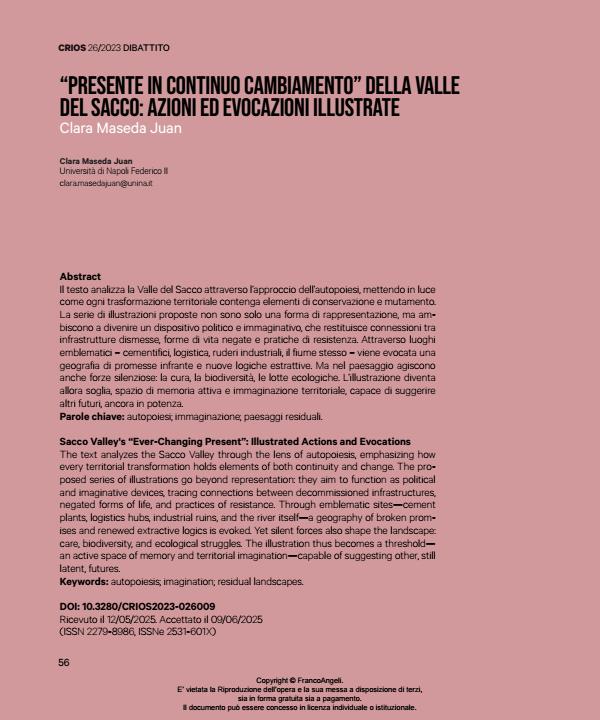
The text analyzes the Sacco Valley through the lens of autopoiesis, emphasizing how every territorial transformation holds elements of both continuity and change. The proposed series of illustrations go beyond representation: they aim to function as political and imaginative devices, tracing connections between decommissioned infrastructures, negated forms of life, and practices of resistance. Through emblematic sites—cement plants, logistics hubs, industrial ruins, and the river itself—a geography of broken promises and renewed extractive logics is evoked. Yet silent forces also shape the landscape: care, biodiversity, and ecological struggles. The illustration thus becomes a threshold—an active space of memory and territorial imagination—capable of suggesting other, still latent, futures.
Keywords: autopoiesis; imagination; residual landscapes.
- Adorno S., & Neri Sernieri S. (2009). Per una storia ambientale delle aree industriali in Italia. In: S. Adorno & S. Neri Sernieri (a cura di), Industria, ambiente e territorio: Per una storia ambientale delle aree industriali in Italia. Bologna: il Mulino.
- Adorno S. (2015). Le Aree di sviluppo industriale nella costruzione degli spazi regionali del Mezzogiorno. In: M. Salvati & L. Sciolla (a cura di), L'Italia e le sue regioni: L'età repubblicana. Roma: Istituto della Enciclopedia Treccani.
- Armiero M. (2021). L'era degli scarti: Cronache dal Wasteocene, la discarica globale. Einaudi.
- ARPA Lazio (2018). Rapporto sullo stato dell'ambiente nella Valle del Sacco. Roma: Regione Lazio.
- Barbera F., Cersosimo D., De Rossi A. (2022). Contro i borghi. Il Belpaese che dimentica i paesi. Roma: Donzelli.
- Barca S. (2020). Forces of reproduction: Notes for a counterhegemonic anthropocene. Cambridge University Press.
- Bast D. C., Carr K., Madron, AM., Syrus (2022). Four reasons why data centers matter, five implications of their social spatial distribution, one graphic to visualize them, Environment and Planning A: Economy and Space, 54(3), p. 441445., 2022, p.1–5. DOI: 10.1177/0308518X211069139
- Barua M. (2021). Infrastructure and nonhuman life: A wider ontology. Progress in Human Geography, 45(6), 1467–1489.
- Berque A., Conan M., Donadieu P., Lassus B., & Roger A. (1999). Mouvance: Cinquante mots pour le paysage. Paris: Éditions de la Villette.
- Bianchetti C. (2011). Il novecento è davvero finito. Considerazioni sull'urbanistica. Roma: Donzelli.
- Bianchetti C. (2012). Un cattivo Darwin. In: M. Agnoletto & M. Guerzoni (a cura di), La campagna necessaria: Un'agenda d'intervento dopo l'esplosione urbana (pp. 9094). Macerata: Quodlibet.
- Brenner N. (2009). Restructuring, rescaling and the urban question. Critical Planning, 16(4), 6179.
- Brenner N. (2014). Introduction: Urban Theory Without an Outside. In: N. Brenner (a cura di), Implosions/Explosions: Towards a study of planetary urbanization (pp. 1431). Berlin: Jovis.
- Brenner N., & Schmid C. (2011). Planetary urbanisation. In: M. Gandy (a cura di), Urban Constellations (pp. 1013). Berlin: Jovis.
- Brighenti A. M. (2008). Visuale, visibile, etnografico. Etnografia e ricerca qualitativa, 1(1), 91114.
- Butler J. (2004). Precarious Life: The Powers of Mourning and Violence. London: Verso.
- Calvillo N. (2023). Aeropolis: Queering air in toxicpolluted worlds. New York: Columbia Books on Architecture and the City.
- di Campli A., Nifosì C., Salvador A. J., Rondot, C. (2023). Ecologie rurali.
- Pratiche e forme di corsistenza. Siracusa: LetteraVentidue Capone N. (2020). Lo spazio e la norma: Per una ecologia politica del diritto. Verona: Ombre corte.
- Centemeri L. (2006). Ritorno a Seveso: Il danno ambientale, il suo riconoscimento, la sua riparazione. Milano: Bruno Mondadori.
- de Certeau M. (1990). L'invenzione del quotidiano. Roma: Edizioni Lavoro.
- Chakrabarty D. (2000). Provincializing Europe: Postcolonial Thought and Historical Difference. Princeton: Princeton University Press.
- Clément G. (2005). Manifesto del terzo paesaggio. Macerata: Quodlibet.
- Consiglio d'Europa (2000), Convenzione europea del paesaggio.
- Curci, F., Kercuku, A., Lanzani, A., & Zanfi, F. (2023). Italia di mezzo: The emerging marginality of intermediate territories between metropolises and inner areas. REGION, 10(1), 89112.
- Debord, G. (1958). Théorie de la dérive. Internationale Situationniste, 2, 1923.
- Debbane N., & Keil R. (2004). Multiple disconnections: Environmental justice and urban water politics in the global north. Urban Studies, 41(13), 23712390.
- Deleuze G., Guattari F. (1980). Mille plateaux. Capitalisme et schizophrénie. Paris: Les Éditions de Minuit.
- Dematteis G. (2001). I territori intermedi: una scommessa per lo sviluppo locale. Torino: Bollati Boringhieri.
- Derek G., Johnston R., Pratt G., Watts, M., & Whatmore S. (2009). The Dictionary of Human Geography (5th ed.). Oxford: Blackwell Publishers Ltd.
- Escobar A. (2018). Designs for the Pluriverse: Radical Interdependence, Autonomy, and the Making of Worlds. Durham/London: Duke University Press.
- Esposito R. (1998). Communitas: Origine e destino della comunità. Torino: Einaudi.
- Formato E., (2020). La città ipercontestuale. In: CRIOS, 1920 (2020), pp. 47.
- Formato E. (2022). Abitare al margine. In: MECHANE, 4 (2022), pp. 13 30.
- Formato E., Tournilhac C., (2020). Lo spatial fix nella costruzione della città moderna, tra adattamento e dislocazione multipolare. In: Belli, A. (a cura di), Pensare lo spazio urbano (pp. 1751). Milano: FrancoAngeli.
- Gandy M. (2017). Negative Luminescence. Annals of the American Association of Geographers, 107(5), 10901107.
- Ghirri L. (1984). Viaggio in Italia. Torino: Il Quadrante.
- Gioffrè V. (2017). Latent Landscape. Siracusa: Letteraventidue Edizioni. Gioffrè V. (2024). Rigenerare Naturale. Siracusa: Letteraventidue Edizioni.
- Glissant E. (1990). Poétique de la Relation. Paris: Gallimard.
- Haraway D. (1988). Situated Knowledges: The Science Question in Feminism and the Privilege of Partial Perspective. Feminist Studies, 14(3), 575599.
- Haraway D. (2015). Anthropocene, Capitalocene, Plantationocene, Chthulucene: Making Kin. Environmental Humanities, 6(1), 159165.
- Harvey D. (1973). Social Justice and the City. London: Edward Arnold. Harvey D. (2003). The New Imperialism. Oxford: Oxford University Press.
- Ingold T. (2011). Being Alive: Essays on Movement, Knowledge and Description. London/New York: Routledge.
- Istituto Superiore di Sanità. (2019). Progetto SENTIERI – Studio epidemiologico nazionale dei territori e degli insediamenti esposti a rischio da inquinamento (Rapporti ISTISAN 19/11). Roma: ISS.
- Lanzani A. (2003). I paesaggi italiani. Roma: Meltemi.
- Lanzani A., a cura di, (2024). Italia di Mezzo. Prospettive per la provincia in transizione. Roma: Donzelli.
- Lanzani A., & Pasqui G. (2011). L'Italia al futuro. Città e paesaggi, economie e società. Milano: Franco Angeli.
- Latour B. (2005). Reassembling the Social: An Introduction to ActorNetworkTheory. Oxford: Oxford University Press.
- Lefebvre H. (1974). La production de l'espace. Paris: Anthropos. (Trad. it. La produzione dello spazio. Milano: Moizzi, 1976).
- Lefebvre H. (2003). The urban revolution. Minneapolis: University of Minnesota Press.
- Lem S. (1961). Solaris. Warszawa: Wydawnictwo Ministerstwa Obrony Narodowej. (Trad. it. Solaris. Milano: Mondadori, 1973).
- Magnaghi A. (2010). Il progetto locale. Verso la coscienza di luogo. Torino: Bollati Boringhieri.
- Mariani A., Iafrate P., & Pompeo F. (2021). Realtà identitarie smarrite: & F. Curci (a cura di), Ripensare la questione urbana. Regionalizzazione dell'urbano in Italia e scenari di innovazione (pp. 2352). Milano: Guerini Associati.
- Perrone C. (2022). Critical Planning and Design: Roots, Pathways, and Frames. Cham: Springer Publishing.
- Perulli P. (2020). Regionalismo e Urbanesimo. Regional Studies and Local Development, 1(1), 717.
- Rudolph D. (2023). The question of 'sustainable' technology: From socioecological fixes to transformations. Human Geography, 16(1), 8186.
- Mattiucci C. (2025). Un tetto a New York. Tre storie indiziarie sulla questione abitativa nella città neoliberale. Napoli: FedOAFederico II University Press.
- Approach of ETH Studio Basel. In: R. Diener, L. Gunnarsson, M. Gunz, V. Jovanovic, M. Meili, C. Müller Inderbitzin, & C. Schmid (a cura di), Territory: On the Development of Landscape and City (pp. 2249). Zurich: Park Books.
- Maturana R. H., & Varela G. F. (2009). El árbol del conocimiento: Las Scott J. C. (1985). Weapons of the Weak: Everyday Forms of Peasant
- bases biológicas del entendimiento humano (19ª ed.). Santiago Resistance. New Haven/London: Yale University Press.
- de Chile: Editorial Universitaria. Secchi B. (2000). Prima lezione di urbanistica. RomaBari: Laterza.
- McFarlane C. (2011). The city as assemblage: Dwelling and urban Secchi B. (2005). La città del ventunesimo secolo. RomaBari: Laterza. space. Environment and Planning D: society and space, 29(4), Sendra P., & Sennett R. (2022). Progettare il disordine: Idee per la città del XXI secolo. Roma: Treccani.
- Morizo, B. (2020). Raviver les braises du vivant: Un front commun. Ar Simmel G. (1998). Sociologia. Milano: Edizioni di Comunità.
- les: Actes Sud Wildproject. Stefanelli R. (1975). Lotte Agrarie e modello di sviluppo 19471967. Bari: Mountz A., Bonds A., Mansfield B., Loyd J., Hyndman J., WaltonRoberts De Donato.
- M., Basu R., Whitson R., Hawkins R., Hamilton T., & Curran W. Swyngedouw E. (2022). Climate change consensus: A depoliticized dea
- 2015). For Slow Scholarship: A Feminist Politics of Resistance through Collective Action in the Neoliberal University. ACME: An International EJournal for Critical Geographies, 14(4), 1235–1259.
- Murray Schafer R. (1977). The Tuning of the World. Toronto: McClelland and Stewart.
- Nixon R. (2011). Slow violence and the environmentalism of the poor. Cambridge, MA: Harvard University Press.
- Nunnari F. (2012). Il "nucleo di industrializzazione Valle del Sacco": Un rischioso tentativo di sviluppo. In: P. P. Poggio & M. Ruzzenenti
- L. Pellizzoni, E. Leonardi, & V. Asara (a cura di), Handbook of critical environmental politics(pp. 443455). Cheltenham: Edward Elgar Publishing.
- de Toledo C. (2022). Il fiume che voleva scrivere (A. Folin, Trad.). Vicenza: Neri Pozza.
- Till K. E. (2005). The New Berlin: Memory, Politics, Place. Minneapolis: University of Minnesota Press.
- Tsing A. L., Bubandt N., Gan E., & Swanson H. A. (a cura di). (2017). Arts of living on a damaged planet. Minneapolis: University of Minnesota Press.
- (a cura di), Il caso italiano: Industria chimica e ambiente (pp. Viganò P. (2023). Il giardino biopolitico: Spazi, vite e transizione. Roma: 157178). Milano: Jaca Book. Donzelli editore.
- Ostrom E. (1990). Governing the Commons: The Evolution of Institutions for Collective Action. Cambridge: Cambridge University Press.
- Paladini S. (2009). Gli archivi e le risorse delle terre civiche: un passato Retuvasa (2023). Il fotovoltaico a terra sui suoli agricoli del SIN 'Baci
- Palestino M. F. (2022). La forma dell'invisibile: Per un'ecologia politica dei territori fragili. Napoli: CLEAN Edizioni.
- Paquot, T. (2021). Écologie des territoires: Transition & biorégions. Paris: Riferimenti cinematografici Éditions Terre urbaine.
- Il Divo (2008), di Paolo Sorrentino.
- Perrone C., Paba G., & Perulli P. (2017). Postmetropoli — tra dotazioni e Dostoevskij (2024), dei fratelli Damiano e Fabio D'Innocenzo. flussi, luoghi e corridoi, fixity and motion. In: A. Balducci, V. Fedeli,
Clara Maseda Juan, “Presente in continuo cambiamento” della Valle del Sacco: azioni ed evocazioni illustrate in "CRIOS" 26/2023, pp 56-61, DOI: 10.3280/CRIOS2023-026009