Digital remote work and changes in managerial control
Journal title STUDI ORGANIZZATIVI
Author/s Roberto Albano, Ylenia Curzi
Publishing Year 2025 Issue 2025/2
Language English Pages 26 P. 33-58 File size 282 KB
DOI 10.3280/SO2025-002002
DOI is like a bar code for intellectual property: to have more infomation
click here
Below, you can see the article first page
If you want to buy this article in PDF format, you can do it, following the instructions to buy download credits
FrancoAngeli is member of Publishers International Linking Association, Inc (PILA), a not-for-profit association which run the CrossRef service enabling links to and from online scholarly content.
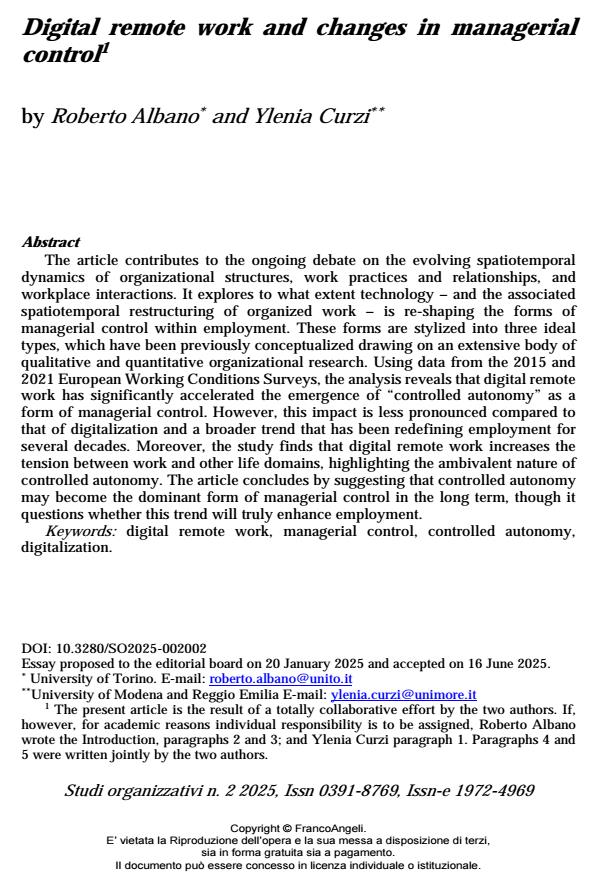
The article contributes to the ongoing debate on the evolving spatiotemporal dynamics of organizational structures, work practices and relationships, and workplace interactions. It explores to what extent technology – and the associated spatiotemporal restructuring of organized work – is re-shaping the forms of managerial control within employment. These forms are stylized into three ideal types, which have been previously conceptualized drawing on an extensive body of qualitative and quantitative organizational research. Using data from the 2015 and 2021 European Working Conditions Surveys, the analysis reveals that digital remote work has significantly accelerated the emergence of “controlled autonomy” as a form of managerial control. However, this impact is less pronounced compared to that of digitalization and a broader trend that has been redefining employment for several decades. Moreover, the study finds that digital remote work increases the tension between work and other life domains, highlighting the ambivalent nature of controlled autonomy. The article concludes by suggesting that controlled autonomy may become the dominant form of managerial control in the long term, though it questions whether this trend will truly enhance employment.
Keywords: digital remote work, managerial control, controlled autonomy, digitalization.
- Albano, R., Curzi, Y. (2024), “Digitalizzazione del lavoro e cambiamenti del controllo manageriale”, Impresa Progetto - Electronic Journal of Management, 1: 1-25, DOI: 10.15167/1824-3576/IPEJM2024.1.1599.
- Albano, R., Curzi, Y., Fabbri, T. (2018), “Work autonomy, control and discretion in Industry 4.0”, in Cantoni, F., Mangia, G. (eds.), Human Resource Management and Digitalization, New York / Torino, Routledge / Giappichelli: 95-113.
- Albano, R., Curzi, Y., Parisi, T. (2021), “Does control change nature in industrial digital work? A secondary analysis of the 1991-2015 European Working Conditions Surveys”, in Addabbo, T., Ales, E., Curzi, Y., Fabbri, T., Rymkevich, O., Senatori, I. (eds.), The Collective Dimensions of Employment Relations, Interdisciplinary Perspectives on Workers’ Voices and Changing Workplace Patterns, Cham, Palgrave Macmillan: 81-116, DOI: 10.1007/978-3-030-75532-4_6
- Albano, R., Curzi, Y., Parisi, T., Tirabeni, L. (2018), “Perceived autonomy and discretion of mobile workers”, Studi organizzativi, 2: 31-61, DOI: 10.3280/SO2018-002002.
- Angelici, M., Profeta, P. (2024), “Smart working: work flexibility without constraints”, Management Science, 70(3): 1680-1705,
- Appay, B. (2007), “Dualismes et paradoxes au travail. L’autonomie controlée”, Sociologia del lavoro, 105: 19-34.
- Bailey, C., Suddaby, R. (2023), “When time falls apart: Re-centring human time in organisations through the lived experience of waiting”, Organization Studies, 44(7): 1033-1053, DOI: 10.1177/01708406231166807
- Bathini, D.R., Kandathil, G.M. (2019), “An orchestrated negotiated exchange: Trading homebased telework for intensified work”, Journal of Business Ethics, 154: 411-423,
- Ben-Ner, A., Urtasun, A., Taska, B. (2023), “Effects of New Technologies on Work: The Case of Additive Manufacturing”, ILR Review, 76(2): 255-289, DOI: 10.1177/00197939221134271
- Berdicchia, D., Masino, G. (2023), La sfida del Job crafting, Bologna, Tao Digital Library,
- Bertolini, S., Fullin, G., Pacetti, V. (2022), “Il lavoro da remoto tra terziarizzazione, digitalizzazione e trasformazioni delle relazioni di impiego”, Meridiana, 104: 9-28, DOI: 10.23744/4748
- Bertolini, S., Vercelli, M. (2024), “Remote work and the hybridisation of work relations: blurring the boundaries between subordination and self-employment?”, Rassegna Italiana di Sociologia, 1: 127-152, DOI: 10.1423/109017
- Bisht, N.S., Trusson, C., Siwale, J., Ravishankar, M.N. (2023), “Enhanced job satisfaction under tighter technological control: The paradoxical outcomes of digitalisation”, New Technology, Work and Employment, 38(2): 162-184,
- Butera, F. (2020), “Le condizioni organizzative e professionali dello smart working dopo l’emergenza: progettare il lavoro ubiquo fatto di ruoli aperti e di professioni a larga banda”, Studi Organizzativi, 1: 141-165, DOI: 10.3280/SO2020-001006
- Cardinal, L.B., Sitkin, S.B., Long, C.P. (2010), “A configurational theory of control”, in Sitkin, S.B., Cardinal, L.B., Bijlsma-Frankema, K.M. (eds.), Organizational control, Cambridge, University Press: 51-79, DOI: 10.1017/CBO9780511777899.004
- Carreri, A., Gosetti, G., Masiero, N. (2023), “Digitalization of relational space in the service triangle: The case study of retail banking”, Frontiers in Sociology, 8: 1141879,
- Carreri, A., Gosetti, G., Poggio, B., Zanoni, P. (2020), “Lavoro e digitalizzazione: soggettività, controllo e qualità del lavoro nella quarta rivoluzione industriale”, Sociologia del lavoro, 158: 51-73, DOI: 10.3280/SL2020-158003
- de Vaujany, F.X., Leclercq-Vandelannoitte, A., Munro, I., Nama, Y., Holt, R. (2021), “Control and surveillance in work practice: Cultivating paradox in ‘new’ modes of organizing”, Organization Studies, 42(5): 675-695, DOI: 10.1177/01708406211010988
- Delfanti, A. (2021), “Machinic dispossession and augmented despotism: Digital work in an Amazon warehouse”, New Media & Society, 23(1): 39-55, DOI: 10.1177/1461444819891613
- Elliott, A. (2019), The Culture of AI: Everyday Life and the Digital Revolution, Abingdon/New York, Routledge.
- Errichiello, L., Pianese, T. (2016), “Organizational control in the context of remote work arrangements: a conceptual framework”, in Widener, S., Epstein, M., Verbeeten, F. (eds.), Performance measurement and management control: contemporary issues, Series Studies in Managerial and Financial Accounting, Vol. 31, Bingley (UK), Emerald: 273-305, DOI: 10.1108/S1479-351220160000031009
- Feldman, E., Reid, E. M., Mazmanian, M. (2020), “Signs of our time: Time-use as dedication, performance, identity, and power in contemporary workplaces”, Academy of Management Annals, 14(2): 598-626,
- Frigotto, M. L., Gabbriellini, S., Solari, L., Tomaselli, A. (2021), “Lo smart working nel panorama italiano: un'analisi della letteratura”, Studi organizzativi, 2: 9-37, DOI: 10.3280/SO2021-002001
- Fullin, G., Pacetti, V., Recchi, S. (2024), “Progettare il lavoro ibrido: lo spazio come strumento organizzativo nella fase post-emergenziale”, Cambio. Rivista sulle trasformazioni sociali, 14(27):15-32,
- Goglio, V., Pacetti, V. (2022), “Tecnologia e controllo nel lavoro da remoto”, Meridiana, 104: 47-73, DOI: 10.23744/4750
- Gregg, M., Kneese, T. (2019), “Clock as a mediating technology of organization”, Media Studies, 35, https://repository.usfca.edu/ms/35,
- Guazzo, C., Gandini, A., Garavaglia, E. (2024), “Indietro non si torna. Un’analisi longitudinale delle esperienze di lavoro da remoto tra i knowledge worker in Italia durante e dopo la pandemia”, Rassegna Italiana di Sociologia, 65(1): 153-176, DOI: 10.1423/112994
- Hafermalz, E. (2021), “Out of the Panopticon and into Exile: Visibility and control in distributed new culture organizations”, Organization Studies, 42(5): 697-717, DOI: 10.1177/0170840620909962
- Hassard, J., Morris, J. (2022), “The extensification of managerial work in the digital age: Middle managers, spatio-temporal boundaries and control”, Human Relations, 75(9): 1647-1678, DOI: 10.1177/00187267211003123
- Hughes, K.D., Silver, W.A. (2020), “Beyond time-binds: Rethinking work–family dynamics for a mobile world”, Human Relations, 73(7): 924-952, DOI: 10.1177/0018726719846264
- Kaldor, N. (1961/1968), “Capital Accumulation and Economic Growth”, in Lutz, F.A., Hague, D.C. (eds.), The Theory of Capital, London, Macmillan, DOI: 10.1007/978-1-349-08452-4_10
- Kelliher, C., Anderson, D. (2010), “Doing more with less? Flexible working practices and the intensification of work”, Human Relations, 63(1): 83-106, DOI: 10.1177/0018726709349199
- Leclercq-Vandelannoitte, A. (2021), “‘Seeing to be seen’: The manager’s political economy of visibility in new ways of working”, European Management Journal, 39(5): 605-616,
- Leclercq-Vandelannoitte, A., Isaac, H., Kalika, M. (2014), “Mobile information systems and organizational control: beyond the panopticon metaphor?”, European Journal of Information Systems, 23(5): 543-557,
- Maggi, B. (2016), De l’agir organisationnel. Un point de vue sur le travail, le bien-être, l’apprentissage. Livre II - Régulation du travail et bien-être, Bologna, TAO Digital Library,
- Marini, D. (2018), Fuori classe. Dal movimento operaio ai lavoratori imprenditivi della Quarta rivoluzione industriale, Bologna, Il Mulino.
- Moro, A., Rinaldini, M., Staccioli, J., Virgillito, M.E (2019), “Control in the era of surveillance capitalism: an empirical investigation of Italian Industry 4.0 factories”, Journal of Industrial and Business Economics, 46: 347-360,
- Pianese, T., Errichiello, L., da Cunha, J.V. (2023), “Organizational control in the context of remote working: A synthesis of empirical findings and a research agenda”, European Management Review, 20(2): 326-345,
- Piro, V. (2024), “From homework to remote work. Reflecting on the porosity of spaces, times and social relationships at home and in workplaces”, Rassegna Italiana di Sociologia, 65(1): 91-100, DOI: 10.1423/112993
- Ponzellini, A.M. (2023), Lavoro, tecnologia e libertà. Tempo e spazio del lavoro nell’era dell’Intelligenza Artificiale, Milano, Guerini next.
- Romens, A. I. (2024), “The hybridisation of employees’ status through remote overwork: the unions’ perspective”, Rassegna Italiana di Sociologia, 1: 101-126, DOI: 10.1423/108612
- Simon, H. A. (1947), Administrative Behavior: A Study of Decision-making Processes in Administrative Organization, New York, Macmillan 19572.
- Sitkin, S.B., Long, C.P., Cardinal, L.B. (2020), “Assessing the control literature: Looking back and looking forward”, Annual Review Of Organizational Psychology And Organizational Behavior, 7: 339-368,
- Sorrentino, M., Tirabeni, L., Toraldo, M.L. (2022), “Reintroducing technology to the coworking debate: prospects and problematics”, Studi organizzativi, 2: 70-94, DOI: 10.3280/SO2022-002003
- Stark, D., Pais, I. (2020), “Algorithmic Management in the Platform Economy”, Sociologica, 14(3): 47-72,
- Strengers, Y. (2015), “Meeting in the Global Workplace: Air Travel, Telepresence and the Body”, Mobilities, 10(4): 592-608, DOI: 10.1080/17450101.2014.902655
- Terssac, G. de (1992), Autonomie dans le travail, Paris, PUF.
- Tirabeni, L., Miele, F. (2020), “Tecnologie digitali e potere nelle organizzazioni: dinamiche di controllo ed effetto” contraccolpo”“, Studi organizzativi, 1: 9-37, DOI: 10.3280/SO2020-001001.
- Thompson, J.D. (1967), Organizations in Action, New York, McGraw Hill, Routledge 2003, DOI: 10.4324/9781315125930
- Zanoni, P., Miszczynski, M. (2023), “Post-Diversity, Precarious Work for All: Unmaking borders to govern labour in the Amazon warehouse”, Organization Studies, 45(7): 987-1008, DOI: 10.1177/01708406231191336
Roberto Albano, Ylenia Curzi, Digital remote work and changes in managerial control in "STUDI ORGANIZZATIVI " 2/2025, pp 33-58, DOI: 10.3280/SO2025-002002