Scroll the world: When our fingers become the horsemen of the apocalypse
Journal title STUDI ORGANIZZATIVI
Author/s François-Xavier de Vaujany
Publishing Year 2025 Issue 2025/2
Language English Pages 9 P. 171-179 File size 167 KB
DOI 10.3280/SO2025-002007
DOI is like a bar code for intellectual property: to have more infomation
click here
Below, you can see the article first page
If you want to buy this article in PDF format, you can do it, following the instructions to buy download credits
FrancoAngeli is member of Publishers International Linking Association, Inc (PILA), a not-for-profit association which run the CrossRef service enabling links to and from online scholarly content.
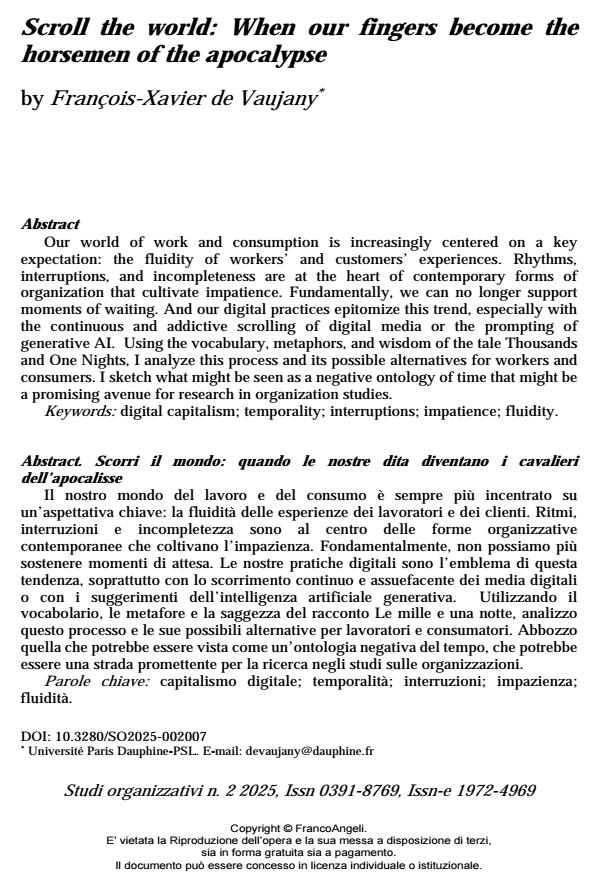
Our world of work and consumption is increasingly centered on a key expectation: the fluidity of workers’ and customers’ experiences. Rhythms, interruptions, and incompleteness are at the heart of contemporary forms of organization that cultivate impatience. Fundamentally, we can no longer support moments of waiting. And our digital practices epitomize this trend, especially with the continuous and addictive scrolling of digital media or the prompting of generative AI. Using the vocabulary, metaphors, and wisdom of the tale Thousands and One Nights, I analyze this process and its possible alternatives for workers and consumers. I sketch what might be seen as a negative ontology of time that might be a promising avenue for research in organization studies.
Keywords: digital capitalism; temporality; interruptions; impatience; fluidity.
- Ciborra, C. (2006), “Imbrication of representations: Risk and digital technologies”, Journal of Management Studies, 43(6): 1339-1356.
- Abalrasul, A. S. H. R. (2020), “When the East Meets the West: Literary Interference and Cultural Transfer”, Journal of Humanistic & Social Studies, 11(1): 9.
- Abbott, N. (1949), “A Ninth-Century Fragment of the" Thousand Nights" New Light on the Early History of the Arabian Nights”, Journal of Near Eastern Studies, 8(3): 129-164. DOI: 10.1086/370926.
- Allen, S. L. (2010), Narrative, authority and the voices of morality: An internextual journey of key themes in “The Thousand Nights and One Night” and Islamic Mirror for Princes. Pacifica Graduate Institute.
- Ciborra, C. (1998), “Crisis and foundations: an inquiry into the nature and limits of models and methods in the information systems discipline”, The Journal of Strategic Information Systems, 7(1): 5-16. DOI: 10.1016/S0963-8687(98)00020-
- Deleuze, G. and Guattari, F. (1980, 2004), A thousand plateaus, London: Continuum.
- de Vaujany, F.X. (2024a), “When the God Ka acts for us: digital management as twinning our selves”, Journal of Organization Design, 13: 113–121.
- de Vaujany, F. X. (2024b), The rise of digital management: from industrial mobilization to platform capitalism. NY: Routledge.
- de Vaujany, F. X. (2025), “What’s next?(Un) learning nothingness and non-events in management education”, Management Learning, 56(1): 63-74. DOI: 10.1177/13505076241284347
- Galland, A. (1840), Les mille et une nuits: contes arabes. Paris: Bourdin.
- Gutas, D. (1981), “Classical Arabic wisdom literature: Nature and scope”, Journal of the American Oriental Society, 101(1): 49-86. DOI: 10.2307/602164.
- Jónsson, Einar Már (2006), “Les «miroirs aux princes» sont-ils un genre littéraire?.” Médiévales. Langues, Textes, Histoire, 51: 153-166.
- Jweid, A. N. A. A. (2021), “The reception of The Arabian Nights in world literature”, Studies in Literature and Language, 22(1): 10-15. DOI: 10.3968/12025.
- Macdonald, D. B. (1924), “The earlier history of the Arabian Nights”, Journal of the Royal Asiatic Society, 56(3): 353-397. DOI: 10.1017/S0035869X00064819.
- Nance, S. (2009), How the Arabian Nights Inspired the American Dream, 1790-1935. University of North Carolina Press.
- Pinault, D. (1992), Story-telling techniques in the Arabian nights (Vol. 15). Brill.
- Pingeot, M. (2024), Vivre sans. Paris: Climats.
- Schumpeter, J. A. (1942, 2013), Capitalism, socialism and democracy. London: Routledge.
- Spinuzzi, C. (2012), “Working alone together: Coworking as emergent collaborative activity”, Journal of business and technical communication, 26(4): 399-441. DOI: 10.1177/1050651912444070.
François-Xavier de Vaujany, Scroll the world: When our fingers become the horsemen of the apocalypse in "STUDI ORGANIZZATIVI " 2/2025, pp 171-179, DOI: 10.3280/SO2025-002007