Tea-cher Professional Development in Impact Evaluation Research: a focus on the inquiry-based paradigm

Journal title CADMO
Author/s Alessandra Boscolo, Elena Nardiello, Laura Landi, Sofia Bosatelli
Publishing Year 2026 Issue 2025/2
Language English Pages 24 P. 69-92 File size 230 KB
DOI 10.3280/CAD2025-002005
DOI is like a bar code for intellectual property: to have more infomation click here

Below, you can see the article first page

If you want to buy this article in PDF format, you can do it, following the instructions to buy download credits
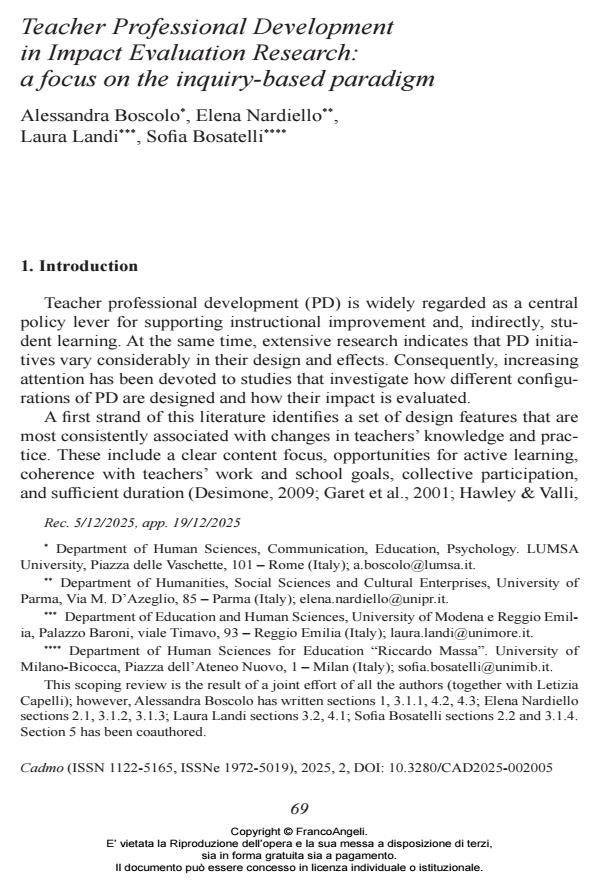
Article preview

FrancoAngeli is member of Publishers International Linking Association, Inc (PILA), a not-for-profit association which run the CrossRef service enabling links to and from online scholarly content.

The article presents a scoping review of impact-evaluation studies on pro-fessional development (PD) for in-service teachers, describing how PD ini-tiatives are characterised in this research field and examining their alignment with inquiry-based approaches, taking the Ricerca-Formazione (R-F) para-digm as a reference. The review identified 861 studies published between 2014 and 2023; after applying exclusion criteria, 159 articles were analysed following PRISMA guidelines. Findings reveal substantial variability and frequent gaps in how PD initiatives are described, which hampers efforts to investigate the quality of PD relating impact evaluation to the specific cha-racteristics of the programmes. When mapped against the R-F paradigm key principles, most PD initiatives display only limited alignment. Contextual analysis and documentation-supported reflection emerge as the most fre-quently represented, whereas negotiated goals and structured teacher–rese-archer collaboration are seldom described.

Keywords: research-based, ricerca-formazione, impact evaluation, in-servi-ce teacher, professional development.

  1. Altet, M. (2002), “Une démarche de recherche sur la pratique enseignante: l’analyse plurielle”, Revue française de pédagogie, 138, pp. 85-93.
  2. Altet, M., Charlier, E., Paquay, L., Perrenoud, P. (a cura di) (2006), Formare gli insegnanti professionisti. Roma: Armando.
  3. Altet, M. (1994), “Comment interagissent enseignant et élèves en classe”, Revue française de pédagogie, 107 (2), pp. 123-139.
  4. Altet, M. (1999), Analyse plurielle d’une séquence d’enseignement-apprentissage, Les cahiers du CREN. Nantes: CRDP Pays-de-la-Loire.
  5. Arksey, H., O’Malley, L. (2005), “Scoping studies: Towards a methodological fra-mework”, International Journal of Social Research Methodology, 8 (1), pp. 19-32, DOI: 10.1080/1364557032000119616
  6. Asquini, G. (Ed.) (2018), La ricerca-formazione. Temi, esperienze, prospettive. Milano: FrancoAngeli.
  7. Bosatelli, S., Boscolo, A., Capelli, L., Landi, L., Nardiello, E. (2026), “Evaluating the Impact of In-Service Teacher Training: A Scoping Review”, manuscript sub-mitted for publication.
  8. Byford, J. M., Shilling, P., Milam, A. (2025), “Burden or benefit: The use of profes-sional development in the middle grades history classroom”, History Education Research Journal, 22 (1), art. 12, DOI: 10.14324/HERJ.22.1.12
  9. Carr, W. (1995), For education: Towards critical educational inquiry. Buckingham: Open University Press.
  10. Carr, W. (2004), “Philosophy and education”, Journal of Philosophy of Education, 38 (1), pp. 55-73.
  11. Cochran-Smith, M., Lytle, S. L. (1999), “Relationships of knowledge and practice: Teacher learning in communities”, Review of Research in Education, 24 (1), pp. 249-305.
  12. Cochran-Smith, M., Lytle, S. L. (2009), Teacher research as stance. The Sage Hand-book of Educational Action Research. London: Sage, pp. 39-49.
  13. Darling-Hammond, L., Hyler, M. E., Gardner, M. (2017), Effective teacher profes-sional development. Palo Alto: Learning Policy Institute.
  14. Desgagné, S. (1997), “Le concept de recherche collaborative: l’idée d’un rapproche-ment entre chercheurs universitaires et praticiens enseignants”, Revue des Sci-ences de l’Éducation, 23 (2), pp. 371-393.
  15. Desgagné, S., Bednarz, N., Lebuis, P., Poirier, L., Couture, C. (2001), “L’approche collaborative de recherche en éducation: un rapport nouveau à établir entre re-cherche et formation”, Revue des Sciences de l’Éducation, 27 (1), pp. 33-64.
  16. Desgagné, S., Bednarz, N. (2005), “Médiation entre recherche et pratique en éduca-tion: faire de la recherche ‘avec’ plutôt que ‘sur’ les praticiens”, Revue des Sci-ences de l’Éducation, 31 (2), pp. 245-258.
  17. Desimone, L. M. (2009), “Improving impact studies of teachers’ professional de-velopment: Toward better conceptualizations and measures”, Educational Re-searcher, 38 (3), pp. 181-199, DOI: 10.3102/0013189X08331140
  18. Desimone, L. M., Garet, M. S. (2015), “Best practices in teachers’ professional de-velopment in the United States”, Psychology, Society & Education, 7 (3), pp. 252-263,
  19. Elliott, J. (1991), Action research for educational change. Buckingham: Open Uni-versity Press.
  20. Garet, M. S., Porter, A. C., Desimone, L., Birman, B. F., Yoon, K. S. (2001), “What makes professional development effective? Results from a national sample of teachers”, American Educational Research Journal, 38 (4), pp. 915-945, DOI: 10.3102/00028312038004915
  21. Gertler, P. J., Martinez, S., Premand, P., Rawlings, L. B., Vermeersch, C. M. J. (2016), Impact evaluation in practice. World Bank, 2nd ed., DOI: 10.1596/978-1-4648-0779-4
  22. Guskey, T. R. (2003), The characteristics of effective professional development: A synthesis of lists, Paper presented at the Annual Meeting of the American Educa-tional Research Association. Chicago, IL, April 21-25.
  23. Hawley, W. D., Valli, L. (1999), The essentials of effective professional develop-ment: A new consensus. In Darling-Hammond, L., Sykes, G. (Eds), Teaching as the learning profession: Handbook of policy and practice. San Francisco: Jossey-Bass, pp. 127-150.
  24. Jaworski, B. (2006), “Theory and practice in mathematics teaching development: Crit-ical inquiry as a mode of learning in teaching”, Journal of Mathematics Teacher Education, 9 (2), pp. 187-211,
  25. Kemmis, S., McTaggart, R. (2005), Participatory action research: Communicative action and the public sphere. In Denzin, N. K., Lincoln, Y. S. (Eds), The Sage Handbook of Qualitative Research. Thousand Oaks: Sage, 3rd ed., pp. 559-604.
  26. Kennedy, M. M. (2016), “How does professional development improve teach-ing?”, Review of Educational Research, 86 (4), pp. 945-980, DOI: 10.3102/0034654315626800
  27. King, F. (2014), “Evaluating the impact of teacher professional development: An evidence-based framework”, Professional Development in Education, 40 (1), pp. 89-111, DOI: 10.1080/19415257.2013.823099
  28. Kreber, C., Brook, P., Policy, E. (2001), “Impact evaluation of educational develop-ment programmes”, International Journal for Academic Development, 6 (2), pp. 96-108, DOI: 10.1080/13601440110090749
  29. Lafortune, L. (2006), “Accompagnement-recherche-formation d’un changement en éducation: un processus exigeant une démarche de pratique reflexive”, Revue des HEP de Suisse romande et du Tessin: Formation et pratiques d’enseignement en questions, 5, pp. 187-202.
  30. Landi, L., Capelli, L., Nardiello, E., Bosatelli, S., Boscolo, A. (2025), Formazione in servizio, modelli di valutazione d’impatto e Ricerca-Formazione: riflessioni a partire da una scoping review. In Dodman, M., Cardarello, R., Damiani, V., Ciani, A., La Ricerca-Formazione: impatti, strumenti, fattori. Milano: Fran-coAngeli, pp. 51-115.
  31. Levac, D., Colquhoun, H., O’Brien, K. K. (2010), “Scoping studies: Advancing the methodology”, Implementation Science, 5, art. 69, DOI: 10.1186/1748-5908-5-69
  32. Lewis, C. (2006), “How should research contribute to instructional improvement? The case of lesson study”, Educational Researcher, 35 (3), pp. 3-14, DOI: 10.3102/0013189X035003003
  33. Schön, D. A. (1983), The reflective practitioner: How professionals think in action. New York: Basic Books, Reprinted in 1995.
  34. Sims, S., Fletcher-Wood, H., O’Mara-Eves, A., Cottingham, S., Stansfield, C., Van Herwegen, J., Anders, J. (2021), What are the characteristics of teacher profes-sional development that increase pupil achievement? A systematic review and meta-analysis. London: Education Endowment Foundation.
  35. Ventista, O. M., Brown, C. (2023), “Teachers’ professional learning and its impact on students’ learning outcomes: Findings from a systematic review”, Social Scienc-es & Humanities Open, 8, 100565,
  36. Zeichner, K. M. (2003), “Teacher research as professional development for P-12 ed-ucators in the USA”, Educational Action Research, 11 (2), pp. 301-326, DOI: 10.1080/09650790300200211
  37. Yoon, K. S., Duncan, T., Lee, S. W.-Y., Scarloss, B., Shapley, K. (2007), Reviewing the evidence on how teacher professional development affects student achieve-ment (Issues & Answers Report REL 2007–No. 033). U.S. Department of Educa-tion, Institute of Education Sciences, National Center for Education Evaluation and Regional Assistance.

Alessandra Boscolo, Elena Nardiello, Laura Landi, Sofia Bosatelli, Teacher Professional Development in Impact Evaluation Research: a focus on the inquiry-based paradigm in "CADMO" 2/2025, pp 69-92, DOI: 10.3280/CAD2025-002005