From minimal building to value-added logistics facilities: how warehouses create territorial value
Journal title TERRITORIO
Author/s Martina Baglio, Martina Farioli, Andrea Venegoni, Fabrizio Dallari
Publishing Year 2026 Issue 2024/111
Language Italian Pages 10 P. 36-45 File size 334 KB
DOI 10.3280/TR2024-111005
DOI is like a bar code for intellectual property: to have more infomation
click here
Below, you can see the article first page
If you want to buy this article in PDF format, you can do it, following the instructions to buy download credits
FrancoAngeli is member of Publishers International Linking Association, Inc (PILA), a not-for-profit association which run the CrossRef service enabling links to and from online scholarly content.
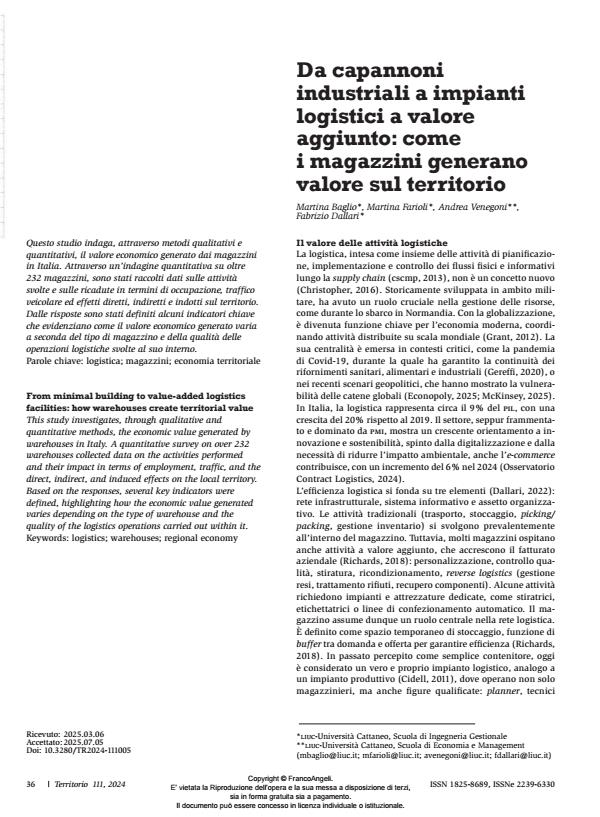
This study investigates, through qualitative and quantitative methods, the economic value generated by warehouses in Italy. A quantitative survey on over 232 warehouses collected data on the activities performed and their impact in terms of employment, traffic, and the direct, indirect, and induced effects on the local territory. Based on the responses, several key indicators were defined, highlighting how the economic value generated varies depending on the type of warehouse and the quality of the logistics operations carried out within it.
Keywords: logistics; warehouses; regional economy
- Aljohani K., Thompson R.G., 2016, «Impacts of Logistics Sprawl on the Urban Environment and Logistics: Taxonomy and Review of Litera-ture». Journal of Transport Geography, 57: 255-263.
- Baglio M., Perotti S., Dallari F., Garagiola E.R., 2020, «Benchmarking Logistics Facilities: A Rating Model to Assess Building Quality and Functionality». Benchmarking: An International Journal, 27, 3: 1239-1260. DOI: 10.1108/BIJ-01-2019-0029
- Baglio M., Dallari F., 2024, «Mappatura dei nodi logistici in Lombardia». Atti della Conferenza Infrastrutture e logistica elementi chiave per la competitività, Milano, 13 marzo 2024. www.unioncamerelombardia. it/fileadmin/dati file_report_trimestrali/Infrastrutture/Mappatu-ra_nodi_logistici.pdf (accesso: 2025.01.13).
- Ballou R.H., 2004, Business Logistics/Supply Chain Management: Plan-ning, Organizing, and Controlling the Supply Chain. Upper Saddle River, nj: Pearson/Prentice Hall.
- Buldeo Rai H., 2023, «Urban Warehouses as Good Neighbors: Findings from a New York City Case Study». Transportation Research Interdis-ciplinary Perspectives, 19: 100823.
- CCNL Logistica, trasporto merci e spedizione, 2024, Contratto nazionale rinnovato il 6 dicembre 2024. https://generaltrasporti.eu/rinno-vo-ccnl-trasporto-merci-e-logistica-2024-novita-e-tabelle/ (accesso: 2025.06.12).
- Christopher M., 2016, Logistics and Supply Chain Management: Logistics & Supply Chain Management. Harlow: Pearson.
- Cidell J., 2011, «Distribution Centers among the Rooftops: the Global Logistics Network Meets the Suburban Spatial Imaginary». Interna-tional Journal of Urban and Regional Research, 35, 4: 832-851.
- Clouse C., Thorvaldson J., Jolley G.J., 2023, «Impact Factors: Methodolo-gical Standards for Applied Input-Output Analysis». Journal of Regional Analysis and Policy, 53, 2: 1-14.
- Corò G., 2000, «La logistica come infrastruttura organizzativa della global economy». In: Micelli S., Di Maria E. (a cura di), Distretti industriali e tecnologie di rete: progettare la convergenza. Milano: FrancoAngeli.
- Corò G., D’Agostino Z., 2001, a cura di, Dal sistema dei trasporti all’orga-nizzazione logistica: spazi di iniziativa strategica per le reti produttive dell’economia mantovana. Mantova: Camera di Commercio.
- CSCMP, 2013, «SCM Definitions and Glossary of Terms». https://cscmp. org/CSCMP/cscmp/educate/scm_definitions_and_glossary_of_terms. aspx (accesso: 2025.01.13).
- Dablanc L., Ross C., 2012, «Atlanta: A Mega logistics Center in the Pied-mont Atlantic Megaregion (pam)». Journal of Transport Geography, 24: 432-442.
- Dallari F., 2022, Corso di logistica e trasporti (2ª ed.). Milano: Hoepli. deSouza P.N., Ballare S., Niemeier D.A., 2022, «The Environmental and
- Traffic Impacts of Warehouses in Southern California». Journal of Transport Geography, 104: 103440.
- Eisenhardt K.M., 1989, «Building Theories from Case Study Research». Academy of Management Review, 14, 4: 532-550.
- Forte_Siviero_SIET_2009.pdf (accesso: 2025.06.14).
- Fried T., Goodchild A., 2023, «E-Commerce and Logistics Sprawl: A Spa-tial Exploration of Last-Mile Logistics Platforms». Journal of Transport Geography, 112: 103692.
- Gereffi G., 2020, «What Does the covid-19 Pandemic Teach Us About Global Value Chains? The Case of Medical Supplies». Journal of Interna-tional Business Policy, 3, 3: 287-301.
- Grant D.B., 2012, Logistics Management (1° ed.). London: Pearson. Grant D.B., Shaw S., Sweeney E., Bahr W., Chaisurayakarn S., Evange-
- lista P., 2023, «Using Mixed Methods in Logistics and Supply Chain Management Research: Current State and Future Directions». Interna-tional Journal of Logistics Management, 34, 7: 177-198. DOI: 10.1108/IJLM-04-2023-0156
- Hair J., Black W., Babin B., Anderson R., Tatham R., 2006, Multivariate Data Analysis (6° ed.). Cham: Springer.
- Heitz A., Launay P., Beziat A., 2019, «Heterogeneity of Logistics Facilities: An Issue for a Better Understanding and Planning of the Location of Logistics Facilities». European Transport Research Review, 11, 1: 5.
- Hopp W., Iravani S., Liu F., 2009, «Managing White-Collar Work: An Operations-Oriented Survey». Production and Operations Manage-ment, 18, 1:1-32.
- Iannone F., 2005, «Economia della logistica e dello spazio-territorio: innovazioni organizzative ed approcci modellistici». In: Borruso G., Polidori G. (a cura di), Riequilibrio e integrazione modale nel trasporto delle merci. Gli attori e i casi italiani. Milano: FrancoAngeli, 143-171.
- ISTAT, 2024, Banca dati StatBase – Indicatori territoriali per le politiche di sviluppo. https://dati.istat.it (accesso: 2025.01.14).
- Khandker S.R., Koolwal G.B., Samad H.A., 2009, Handbook on Impact Evaluation: Quantitative Methods and Practices. Washington (DC). World Bank Publications.
- Maggi E., 2003, «Gli operatori logistici e l’efficienza nella movimentazione delle merci. Un’indagine empirica». In: Borruso G., Polidori G. (a cura di), Trasporto merci, logistica e scelta modale. Milano: FrancoAngeli, 305-349.
- McKinsey, 2025, «Risk, Resilience, and Rebalancing in Global Value Chains». www.mckinsey.com/capabilities/operations/our-insights/risk-resil-ience-and-rebalancing-in-global-value-chains (accesso: 2025.06.12).
- McCann P., 2006, «The Logistics-Cost Location-Production Problem». Jour-nal of Regional Science, 33, 4: 503-516.
- Nefs M., van Haaren J., van Oort F., 2023, «The Limited Regional Employ-ment Benefits of xxl-Logistics Centres in the Netherlands». Journal of Transport Geography, 109: 103603. and Finance, 53, 2: 15-21.
- Osservatorio Contract Logistics, 2024, «Logistica in Italia: fatturato stabile per la Contract Logistics». www.osservatori.net/comunicato/ contract-logistics-gino-marchet/mercato-logistica-italia (accesso: 2025.01.13).
- Pinheiro C.D.P., Gonzalez Feliu J., Bertoncini B.V., 2025, «Addressing Spatial Heterogeneity and maup in Urban Transport Geography: A Mul-ti-Scale Analysis of Accessibility and Warehouse Location». Journal of Transport Geography, 123: 104078.
- Prologis, 2019, «The Modern Supply Chain: A New Model for Defining Logistics Real Estate», 17 settembre. Ros
- Richards G., 2018, Warehouse Management: A Complete Guide to Improv-ing Ef?ciency and Minimizing Costs in the Modern Warehouse (3ª ed.). London: Kogan Page Publishers.
- Ros-McDonnell L., de-la-Fuente-Aragón M.V., Ros-McDonnell D., Cardós M., 2018, «Analysis of Freight Distribution Flows in an Urban Functional Area». Cities, 79: 159-168.
- Sakai T., Kawamura K., Hyodo T., 2019, «Evaluation of the Spatial Pattern of Logistics Facilities Using Urban Logistics Land-Use and Traffic Si-mulator». Journal of Transport Geography, 74: 145-160.
- Schorung M., Dablanc L., Buldeo Rai H., 2023, Urban and Suburban Logistics Real Estate. Champs-sur-Marne: Logistics City Chair, Gustave Eiffel University.
- Tadini M., Violi C., 2013, Logistica, intermodalità e territorio. Scenari e prospettive di sviluppo del Piemonte orientale. Milano: FrancoAngeli.
- UNESCAP, 2008, Logistics Sector Developments: Planning Models for Enter-prises and Logistics Clusters. New York: United Nations.
- Voit S., Irtyshcheva I., Nosar A., 2021, «Strategy for the Development of Warehouse Logistics as a Component of Transport and Logistics Systems in the Focus of Economic Transformation». Baltic Journal of Economic Studies, 7, 5: 49-58. DOI: 10.30525/2256-0742/2021-7-5-49-58
- Waschull S., Bokhorst J.A.C., Wortmann J.C., Molleman E., 2022, «The Redesign of Blue- and White-Collar Work Triggered by Digitalization: Collar Matters». Computers & Industrial Engineering, 165: 107910.
- World Capital Group, 2024, Borsino Immobiliare della Logistica (H2 2024). www.borsinoimmobiliarelogistica.it (accesso: 2025.06.14).
- Yin R.K., 2018, Case Study Research and Applications: Design and Methods (6ª ed.): Thousand Oaks, CA: Sage Publication.
- Yuan Q., Zhu J., 2019, «Logistics Sprawl in Chinese Metropolises: Evi-dence from Wuhan». Journal of Transport Geography, 74: 242-252.
Martina Baglio, Martina Farioli, Andrea Venegoni, Fabrizio Dallari, Da capannoni industriali a impianti logistici a valore aggiunto: come i magazzini generano valore sul territorio in "TERRITORIO" 111/2024, pp 36-45, DOI: 10.3280/TR2024-111005