Urban regeneration and real estate financialization in Milan
Journal title TERRITORIO
Author/s Alberto Bortolotti
Publishing Year 2026 Issue 2024/111
Language Italian Pages 9 P. 164-172 File size 281 KB
DOI 10.3280/TR2024-111015
DOI is like a bar code for intellectual property: to have more infomation
click here
Below, you can see the article first page
If you want to buy this article in PDF format, you can do it, following the instructions to buy download credits
FrancoAngeli is member of Publishers International Linking Association, Inc (PILA), a not-for-profit association which run the CrossRef service enabling links to and from online scholarly content.
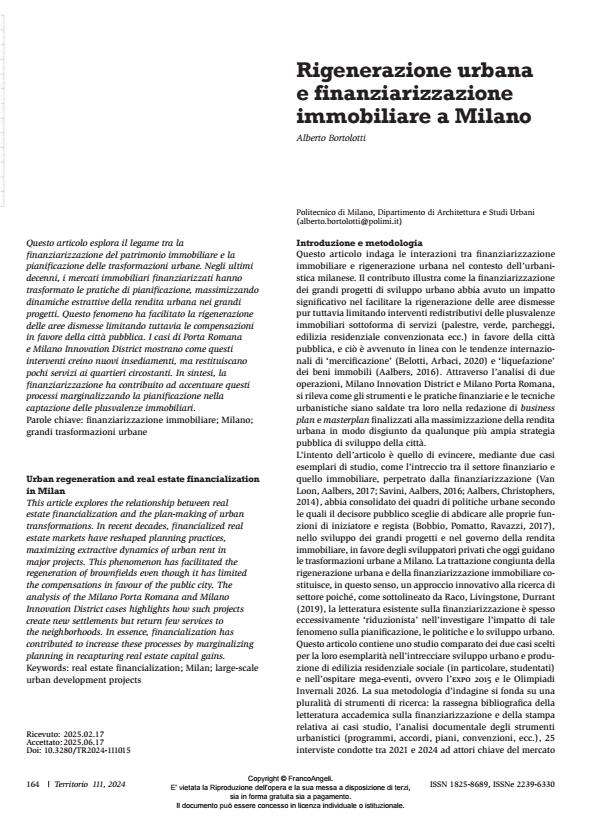
This article explores the relationship between real estate financialization and the plan-making of urban transformations. In recent decades, financialized real estate markets have reshaped planning practices, maximizing extractive dynamics of urban rent in major projects. This phenomenon has facilitated the regeneration of brownfields even though it has limited the compensations in favour of the public city. The analysis of the Milano Porta Romana and Milano Innovation District cases highlights how such projects create new settlements but return few services to the neighborhoods. In essence, financialization has contributed to increase these processes by marginalizing planning in recapturing real estate capital gains.
Keywords: real estate financialization; Milan; large-scale urban development projects
- Aalbers M.B., Christophers B., 2014, «Centring Housing in Political Economy». Housing, Theory and Society, 31, 4: 373-394. DOI: 10.1080/14036096.2014.947082
- Aalbers M.B., 2016, The Financialization of Housing: A Political Eco-nomy Approach. Londra: Routledge.
- Aalbers M.B., 2019, Financialization. In: Richardson D., Castree N., Goodchild M.F., Kobayashi A.L., Marston R. (eds), The International Encyclopedia of Geography: People, the Earth, Environment, and Technology. Oxford: Wiley. DOI: 10.1002/9781118786352
- Aalbers M.B., Rolnik R., Krijnen M., 2020, «The Financialization of Housing in Capitalism’s peripheries». Housing Policy Debate, 30, 4: 481-485. DOI: 10.1080/10511482.2020.1783812
- Anselmi G., Vicari S., 2020, «Milan makes it to the big leagues: A fi-nancialized growth machine at work». European Urban and Regional Studies, 27, 2: 106-124. DOI: 10.1177/0969776419860871
- Bassetti P., Magatti M., Sangalli C., 2005, a cura di, Milano nodo della rete globale. Milano: Mondadori.
- Belotti E., Arbaci S., 2020, «From right to good, and to asset: The state-led financialisation of the social rented housing in Italy». Environment and Planning C, 39, 2: 414-433. DOI: 10.1177/2399654420941517
- Belotti E., 2017, «The importation of social mix policy in Italy: A case study from Lombardy». Cities, 71: 41-48.
- Bobbio L., Pomatto G. Ravazzi S., 2017, a cura di, Le politiche pubbli-che. Problemi, soluzioni, incertezze, con?itti. Milano: Mondadori.
- Bolocan Goldstein M., 2015, «Un post-Expo coerente con una Milano gateway». Notiziario della Banca Popolare di Sondrio, 129: 21-23. Bolocan Goldstein M., 2017, Geogra?e del Nord. Santarcangelo di Romagna: Maggioli.
- Borghi A., 2009, Finanzaimmobiliare. Il mercato, la valutazione, gli strumenti e le tecniche di ? nanziamento. Milano: Egea
- Bricocoli M., Peverini M., 2024, Milano per Chi? Siracusa: Lettera Ventidue. Camagni R., 2016, «Urban development and control on urban land rents». Annuals of Regional Science, 56: 597-615.
- Caudo G., Memo F., 2012, Città di pietra, case di carta: ?nanziarizza-zione immobiliare e produzione dello spazio urbano. In: Lucia M. G., a cura di, Finanza e territorio, 6: 75-93.
- Comune di Milano, 2012, Piano Urbanistico di Milano. Milano: Dire-zione Generale Urbanistica.
- Comune di Milano, 2017, Milano 2030. Milano: Direzione Generale Urbanistica.
- Comune di Milano, 2023a, PII Zona Speciale Porta Romana. Milano: Direzione Generale Urbanistica.
- Comune di Milano, 2023b, Studi d’Area. Milano Direzione Edilizia e Territorio.
- Conte V., Anselmi G., 2022, «When large-scale regeneration be-comes an engine of urban growth: How new power coalitions are shaping Milan’s governance». Economy and Space A: 1-16. DOI: 10.1177/0308518X221100828
- Di Feliciantonio C., Aalbers M.B., 2018, «The Prehistories of Neo-liberal Housing Policies in Italy and Spain and Their Reification in Times of Crisis». Housing Policy Debate, 28, 1: 135-151. DOI: 10.1080/10511482.2016.1276468
- Federici M., Covelli M., Colangelo P., Forni S., 2014. Dieci anni di pro-grammazione negoziata in Lombardia. Milano: Direzione Generale Territorio, Urbanistica e Difesa del Suolo, Regione Lombardia.
- Gaeta L., 2021, Urbanistica Contrattuale. Criteri, esperienze, precauzioni. Milano: FrancoAngeli.
- Gaeta L., Di Vita S., 2021, «Planning Disaster, Successful Event, and Uncertain Future: The Twin Cases of the World Expo 2015 and Inno-vation District in Milan». Les Cahiers de la recherche architecturale urbaine et paysagère, 12.
- Geltner C., 2014, «Real estate price indices & price dynamics: An overview from an investments perspective». Annual Review of Financial Economics, 7, 1: 615-633.
- Gervasoni A., Lertora M., Mietto M., 2024, «Smart cities and sustain-able development: the MIND district case. A new model for urban regeneration». ExSUF Center publication.
- Giannattasio M., 2024, «Olimpiadi 2026 a Milano, così nasce l’Arena di Santa Giulia: 300 al lavoro in contemporanea, 35 metri d’altezza. Ma i costi decollano». Corriere della Sera https://milano.corriere. it/notizie/cronaca/24_novembre_29/olimpiadi-2026-a-milano-co-si-nasce-l-arena-di-santa-giulia-300-al-lavoro-in-contemporane-a-35-metri-d-altezza-ma-i-costi-decollano-7aee61ea-5d2a-4f43-8a34-e7f2e861fxlk.shtml (accesso: 2025.06.14).
- Harvey D., 2005, Spaces of global capitalism. A theory of uneven geo-graphical development. Londra: Verso books.
- Holm A., Alexandri G., Bernt M., 2023, eds, Housing policy under the conditions of ?nancialization. The impact of institutional investors on affordable housing in European Cities (HoPoFin). Parigi: Sciences Po publications.
- Leijten I., de Bel K., 2020, «Facing financialization in the housing sector: A human right to adequate housing for all». Netherlands Quarterly of Human Rights, 38, 2: 94-114. DOI: 10.1177/0924051920923855
- Lendlease, Arexpo, Comune di Milano, 2020, PII MIND. Milano: Dire-zione Generale Urbanistica.
- Mazzucato M., Farha L., 2023, The right to housing: A mission-oriented and human rights-based approach. Londra: Council on Urban Initiatives.
- Muller M., 2011, «State dirigisme in megaprojects: governing the 2014 Winter Olympics in Sochi». Environment and Planning A, 43: 2091-2108.
- Pasqui G., 2018, Raccontare Milano. Politiche, progetti, immaginari. Milano: FrancoAngeli.
- Raco M., 2013, State-led Privatisation and the Demise of the Democratic State: Welfare Reform and Localism in an Era of Regulatory Capita-lism. Londra: Routledge.
- Raco M., Livingstone N., Durrant D., 2019, «Seeing Like an Investor: Urban Development Planning, Financialisation, and Investors’ Per-ceptions of London as an Investment Space». European Planning Studies, 27, 6: 1064-1082. DOI: 10.1080/09654313.2019.159801
- Raco M., Brill F., 2022, London. Londra: Agenda Publishing (Mega-cities Series).
- Raco M., Tasan-Kok T., 2023, Le (in)visibili ambiguità delle riforme urbanistiche guidate dagli operatori immobiliari: essere dentro o contro il mercato. In: Balducci A. (a cura di), La città invisibile. Quello che non vediamo sta cambiando le metropoli. Milano: Annali Fondazione Feltrinelli.
- Salet W., 2008, «Rethinking Urban Projects: Experiences in Europe». Urban Studies, 45, 11: 2343-2363. DOI: 10.1177/0042098008095871
- Salet W., Majoor S., 2005, Amsterdam Zuidas. European Space. Rot-terdam: Nai 010.
- Sassen S., 2015, Espulsioni. Brutalità e complessità nell’economia globale. Bologna: Il Mulino.
- Savini F., Aalbers M. B., 2016, «The de-contextualisation of land use planning through financialisation: Urban redevelopment in Mi-lan». European Urban and Regional Studies, 23, 4: 878-894. DOI: 10.1177/0969776415585887
- Scardovi C., Bezzecchi A., 2014, Banking e Real Estate. Active Real Estate Management per le banche, gli investitori e gli operatori im-mobiliari. Milano: Egea.
- Scenari Immobiliari, 2023, Report Annuale 2023. www.scenari-immo-biliari.it (accesso: 2025.06.14).
- Scenari Immobiliari, 2025, Report Annuale 2025. www.scenari-immo-biliari.it (accesso: 2025.06.14).
- Skidmore, Owings & Merrill, 2025, Milano Cortina Olympic Village. Project Scheet. www.som.com/projects/milano-cortina-olympic-vil-lage/ (accesso: 2025.06.14).
- Tasan-Kok T., 2010, «Entrepreneurial governance: Challenges of large-scale property-led urban regeneration projects». Tijdschrift Voor Econ-omische En Sociale Geogra?e, 101, 2: 126-149.
- Van Loon J., Aalbers M.B., 2017, «How Real Estate Became ‘Just An-other Asset Class’: The Financialization of the Investment Strategies of Dutch Institutional Investors». European Planning Studies, 25, 2: 221-240. DOI: 10.1080/09654313.2016.1277693
- Volpi A., 2024, Padroni del Mondo. Come i fondi ?nanziari stanno distruggendo il mercato e la democrazia. Bari: Laterza.
- Waldron R., 2018, «Capitalizing on the State: The political economy of Real Estate Investment Trusts and the ‘Resolution’ of the crisis». Geoforum, 90.
- Weber R., 2010, «Selling city futures: The financialization of urban redevelopment policy». Economic Geography, 86, 3: 251-274.
- Wijburg G., 2020, «The de-financialization of housing: towards a research agenda». Housing Studies, 36, 8: 1276-1293. DOI: 10.1080/02673037.2020.176284
- Addressing densification in Milan. Insights from the urban design, regeneration and financialization of the ex-railyards Alberto Bortolotti, Andrea Valvason, in Italian Journal of Planning Practice 006/2026 pp.120
DOI: 10.66428/ijppv16i01a006
Alberto Bortolotti, Rigenerazione urbana e finanziarizzazione immobiliare a Milano in "TERRITORIO" 111/2024, pp 164-172, DOI: 10.3280/TR2024-111015