One Health in the context of Global Health and Planetary Health
Journal title SALUTE E SOCIETÀ
Author/s Guido Giarelli, Roberto De Vogli
Publishing Year 2026 Issue 2026/2
Language English Pages 11 P. 56-66 File size 214 KB
DOI 10.3280/SES2026-002006
DOI is like a bar code for intellectual property: to have more infomation
click here
Below, you can see the article first page
If you want to buy this article in PDF format, you can do it, following the instructions to buy download credits
FrancoAngeli is member of Publishers International Linking Association, Inc (PILA), a not-for-profit association which run the CrossRef service enabling links to and from online scholarly content.
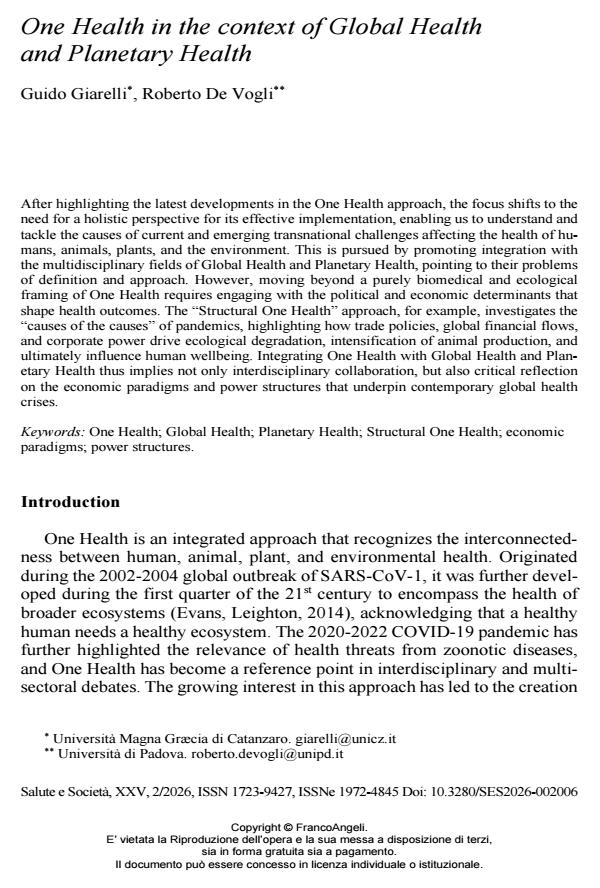
After highlighting the latest developments in the One Health approach, the focus shifts to the need for a holistic perspective for its effective implementation enabling us to understand and tackle the causes of current and emerging transnational challenges affecting the health of humans, animals, plants and the environments. This is pursued by promoting integration with the multidisciplinary fields of Global Health and Planetary Health, pointing to their problems of definitions and approach. However, moving beyond a purely biomedical and ecological framing of One Health requires engaging with the political and economic determinants that shape health outcomes. The “Structural One Health” approach, for example, investigates the “causes of the causes” of pandemics, highlighting how trade policies, global financial flows and corporate power drive ecological degradation, intensification of animal production, and ultimately influence human wellbeing. Integrating One Health with Global Health and Planetary Health thus implies not only interdisciplinary collaboration, but also critical reflection on the economic paradigms and power structures that underpin contemporary global health crises.
Keywords: One Health, Global Health, Planetary Health, Structural One Health, economic paradigms, power structures
- Abman R., Lundberg C. (2019). Does Free Trade Increase Deforestation? The Ef-fects of Regional Trade Agreements. Journal of the Association of Environ-mental and Resource Economists, 7(1): 35-72. DOI: 10.1086/70578
- Evans B.R., Leighton F.A. (2014). A History of One Health. OIE Revue Scienti-fique et Technique, 33(2): 413–20.
- De Vogli R. (2025). Managing and Preventing Pandemics: Lessons from COVID-19. London and New York: Routledge.
- FAO, UNEP, WHO, WOAH (2022). One Health Joint Plan of Action (2022-2026). Working together for the health of humans, animals, plants and the environ-ment. Rome. Available at: https://openknowledge.fao.org/items/fddae6a2-e7ef-4a2a-ad54-2463dbbb0b32 (15/02/2026).
- Guinto R. (2019). Decolonize Global Health: rewriting the narrative of global health. International health policies network (IHP network), 11. Antwerp: Insti-tute of Tropical Medicine. Available at: https://www.internationalhealthpolicies.org/blogs/decolonizeglobalhealth-rewriting-the-narrative-of-global-health/ (13/02/2026).
- Harvey D. (2007). A Brief History of Neoliberalism. Oxford: Oxford University Press.
- Hilary J (2015). There is no solution to climate change as long as TTIP exists. The Independent, September 7. Available at: https://www.bilaterals.org/?there-is-no-eu-solution-to-climate&lang=en (10/04/2026)
- Holst J. (2020). Global Health – emergence, hegemonic trends and biomedical re-ductionism. Globalization and Health, 16: 42.
- Jafar A.J.N., Patel S., Mitchell R., Redmond A. (2024). Redefining global health and shifting the balance: the ARC-H principle. BMJ Global Health, 9(2): e014487.
- Katz R., Sorrell E.M., Kornblet S.A., Fischer J.E. (2014). Global health security agenda and the international health regulations: moving forward. Biosecurity and Bioterrorism: Biodefense Strategy, Practice, and Science, 12(5): 231-238.
- Kedward K., Ryan-Collins J. (2022). From financial risk to financial harm: explor-ing the agri-finance nexus and drivers of biodiversity loss. UCL Institute for Innovation and Public Purpose, Working Paper Series (No. WP 2022/05).
- Koplan J.P., Bond T.C., Merson M.H., Reddy K.S., Rodriguez M.H., Sewankambo N.K., Wasserheit J.N. (2009). Towards a common definition of global health. The Lancet, 373 (9679): 1993-1995. DOI: 10.1016/S0140-6736(09)60332-9
- Labonté R. (2016). Health promotion in an age of normative equity and rampant inequality. International Journal of Health Policy and Management, 5(12): 675-682.
- Malm A. (2020). Corona, Climate, Chronic Emergency. War Communism in the Twenty-First Century. London: Verso Publisher.
- McInnes C., Kelley L. (2006). Health, security and foreign policy. Review of Inter-national Studies, 32(1): 5-23. DOI: 10.1017/S026021050600690
- Merson M.H., Black R.E., Mills A.J. (2006). International public health: diseases, programs, systems, and policies, 2nd ed. Sudbury (MA): Jones and Bartlett Pub-lishers.
- Metzendorf M.-I. (2025). Introducing Global Health One Health and Planetary Health. Journal of the European Association for Health Information and Li-braries (JEAHIL), 21(1): 3-4.
- Morand S., Lajaunie C. (2021). Outbreaks of Vector-Borne and Zoonotic Diseases Are Associated With Changes in Forest Cover and Oil Palm Expansion at Global Scale. Frontiers in Veterinary Science, 8: 661063.
- Our World in Data (2020). Drivers of Deforestation. What are the tropical drivers of deforestation?. Available at: https://ourworldindata.org/drivers-of-deforestation (15/02/2026)
- OHHLEP, Adisasmito W.K., Almuhhairi S., Behravesh C.B. et al. (2022). One Health: A new definition for a sustainable and healthy future. PLoS Patho-gens, 18(6): e1010537.
- Prescott S., Logan A. (2019). Planetary health: from the wellspring of holistic med-icine to personal and public health imperative. Explore, 15(2): 98-106.
- Rockström J., Gupta J., Qin D. et al. (2023). Safe and just Earth system bounda-ries. Nature, 619(7968): 102-111.
- Science in One Health (2022). Science-in-one-Health. Available at: https://www.sciencedirect.com/journal/science-in-one-health (14/02/2026).
- Syed S.B., Dadwal V., Rutter P. et al. (2012). Developed-developing country part-nerships: benefits to developed countries?. Globalization and Health, 8(1):17. DOI: 10.1186/1744-8603-8-1
- Turner G. (2014). Is global collapse imminent? An updated comparison of the Limits to Growth with historical data. MSSI Research paper 4. The University of Melbourne: Melbourne Sustainable Society Institute.
- UNEP-United Nations Environment Programme, ILRI-International Livestock Re-search Institute (2020). Preventing the next pandemic: zoonotic diseases and how to break the chain of transmission. Nairobi, Kenya. Available at: https://wedocs.unep.org/items/426976c7-ee73-4cd8-a3f2-8659d1e88b04 (08/04/2026)
- van de Pas R. (2017). Global health in the Anthropocene: Moving beyond resili-ence and capitalism. International Journal of Health Policy and Management, 6(8): 481-486.
- Wallace R., Bergam L., Koch R., Gilbert M., Hogerwerf L., Wallace R., Holmberg H. (2015). The dawn of Structural One Health: a new science tracking disease emergence along circuits of capital. Social Science and Medicine, 129: 68-77.
- Wallace R. (2016). Big Farms Big Flu: Dispatches on Infectious Disease, Agri-business, and the Nature of Science. New York: Monthly Review Press.
- Whalen E. (2021). The unemployed epidemiologist who predicted the pandemic. The Nation, August 30. Available at: https://www.thenation.com/article/society/rob-wallace-profile/ (08/04/2026)
- Whitmee S., Haines A., Beyrer C. et al. (2015). Safeguarding human health in the Anthropocene epoch: report of the Rockefeller Foundation-Lancet Commis-sion on planetary health. The Lancet, 386(10007): 1973-2028. DOI: 10.1016/S0140-6736(15)60901-
- Xia W., Hughes J., Robertson D., Jiang X. (2021). How One Pandemic Led To An-other: Asfv, the Disruption Contributing To Sars-Cov-2 Emergence in Wuhan. Preprints.
Guido Giarelli, Roberto De Vogli, One Health in the context of Global Health and Planetary Health in "SALUTE E SOCIETÀ" 2/2026, pp 56-66, DOI: 10.3280/SES2026-002006