La mappa del trauma: comportamenti di dipendenza in una prospettiva lungo il corso della vita
Journal title SALUTE E SOCIETÀ
Author/s Asia Ferroni
Publishing Year 2026 Issue 2026/2
Language Italian Pages 17 P. 160-176 File size 381 KB
DOI 10.3280/SES2026-002015
DOI is like a bar code for intellectual property: to have more infomation
click here
Below, you can see the article first page
If you want to buy this article in PDF format, you can do it, following the instructions to buy download credits
FrancoAngeli is member of Publishers International Linking Association, Inc (PILA), a not-for-profit association which run the CrossRef service enabling links to and from online scholarly content.
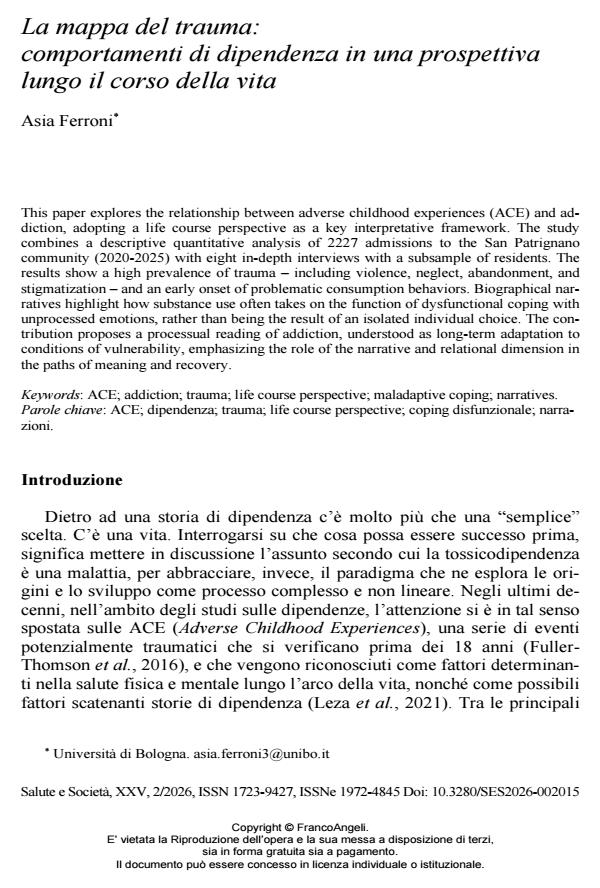
This paper explores the relationship between adverse childhood experiences (ACE) and addiction, adopting a life course perspective as a key interpretative framework. The study combines a descriptive quantitative analysis of 2227 admissions to the San Patrignano community (2020-2025) with eight in-depth interviews with a subsample of residents. The results show a high prevalence of trauma – including violence, neglect, abandonment, and stigmatization – and an early onset of problematic consumption behaviors. Biographical narratives highlight how substance use often takes on the function of dysfunctional coping with unprocessed emotions, rather than being the result of an isolated individual choice. The contribution proposes a processual reading of addiction, understood as long-term adaptation to conditions of vulnerability, emphasizing the role of the narrative and relational dimension in the paths of meaning and recovery.
Keywords: ACE; addiction; trauma; life course perspective; maladaptive coping; narratives.
- Afifi T.O., Taillieu T., Salmon S., Davila I.G., Stewart-Tufescu A., Fortier J., Struck S., Asmundson G.J.G., Sareen J., MacMillan H.L. (2020). Adverse childhood experiences (ACEs), peer victimization, and substance use among adolescents. Child Abuse Negl, 106: 104504.
- Ayres T.C. (2020). Childhood Trauma, Problematic Drug Use and Coping. Deviant Behavior, 42: 578-599. DOI: 10.1080/01639625.2020.174613
- Cardano M., Gariglio L. (2022). Metodi qualitativi. Pratiche di ricerca in presenza, a distanza e ibride. Roma: Carocci Editore.
- Centers for Disease Control and Prevention (CDC) (2020). Adverse Childhood Experiences Prevention Strategy – FY2021-FY2024. Atlanta, GA: National Center for Injury Prevention and Control, Centers for Disease Control and Prevention.
- Comiskey C. (2019). Responses to the needs of children of people who use drugs: Background paper commissioned by the EMCDDA for Health and social responses to drug problems: a European guide. Testo disponibile al sito: file:///C:/Users/marta/Downloads/ERG_BackgroundPaper_Children_FINAL[2].pdf (20/04/2026).
- Diedrick M., Clements-Nolle K., Anderson M., Yang W. (2023). Adverse childhood experiences and clustering of high-risk behaviors among high school students: a cross-sectional study. Public Health, 221: 39-45.
- Fujiwara T. (2022). Impact of adverse childhood experience on physical and mental health: A life-course epidemiology perspective. Psychiatry and Clinical Neurosciences, 76: 544-55.
- Fuller-Thomson E., Roane J.L., Brennenstuhl S. (2016). Three Types of Adverse Childhood Experiences, and Alcohol and Drug Dependence Among Adults: An Investigation Using Population-Based Data. Subst Use Misuse, 18: 1451-1461. DOI: 10.1080/10826084.2016.118108
- Garrido E.F., Weiler L.M., Taussig H.N. (2019). Adverse Childhood Experiences and Health-Risk Behaviors in Vulnerable Early Adolescents. J Early Adolesc., 38: 661-680. DOI: 10.1177/027243161668767
- Giacomello C. (2023). Listen to the silence of the child: Children share their experiences and proposals on the impact of drug use in the family. Strasburgo: Council of Europe.
- Grummitt L., Kelly E., Barrett E., Keyes K., Newton N. (2021). Targets for intervention to prevent substance use in youngpeopleexposedtochildhood adversity: A systematic review. PLoS ONE, 16: 1-29.
- Infodata (2024). Oggi in Italia si adotta molto meno di qualche decennio fa #BuoneFeste. Il sole 24 ore, testo disponibile al sito: https://www.infodata.ilsole24ore.com/2024/12/31/oggi-in-italia-si-adotta-molto-meno-di-qualche-decennio-fa/ (31/12/2024).
- Karl S. (2021). The Intersection of Childhood Trauma and Addiction. Counseling Today, 63. Testo disponibile al sito: https://www.counseling.org/publications/counseling-today-magazine/article-archive/article/legacy/the-intersection-of-childhood-trauma-and-addiction (20/04/2026).
- Levenson J.S., Grady M.D. (2016). Childhood Adversity, Substance Abuse, and Violence: Implications for Trauma-Informed Social Work Practice. Journal of Social Work Practice in Addiction, 16: 24-45.
- Levin F., Lev Bar-Or R., Forer R., Vaserman M., Kor A., Lev-Ran S. (2021). The association between type of trauma, level of exposure and addiction. Addictive Behaviors,118.
- Leza L., Siria S., López-Goñi J.J., Fernández-Montalvo J. (2021). Adverse childhood experiences and substance use disorder A scoping review. Drug Alchol Depend, 221: 108563.
- Maturo A. (2024). Il primo libro di sociologia della salute. Torino: Einaudi.
- Maurya C., Maurya P. (2023). Adverse childhood experiences and health risk behaviours among adolescents and young adults: evidence from India. BMC Public Health, 23: 2-12.
- Metzler M., Merrick M.T., Klevens J., Ports K.A., Ford D.C. (2016). Adverse childhood experiences and life opportunities: Shifting the narrative. Children and Youth Services Review, 72: 141-149.
- Moretti V. (2020). Sociologia del paziente. Milano: FrancoAngeli.
- Nurius P.S., Green S., Logan-Greene P., Borja S. (2015). Life course pathways of adverse childhood experiences toward adult psychological well-being: A stress process analysis. Child Abuse & Neglect, 45: 143-153.
- Pearlin L.I. (1989). The Sociological Study of Stress. Journal of Health and Social Behavior, 30: 241-256. DOI: 10.2307/213695
- Pearlin L.I., Menaghan E.G., Lieberman M.A., Mullan J.T. (1981). The Stress Process. Journal of Health and Social Behavior, 22: 337-356. DOI: 10.2307/213667
- Phelan J.C., Link B.G., Tehranifar P. (2010). Social conditions as fundamental causes of health inequalities: theory, evidence, and policy implications. Journal of Health and Social Behavior, 51: 28-40. DOI: 10.1177/002214651038349
- Sheffler J.L., Piazza J.R., Quinn J.M., Sachs-Ericsson N.J., Stanley I.H. (2019). Adverse childhood experiences and coping strategies: Identifying pathways to resiliency in adulthood. Anxiety Stress Coping, 32(5): 594-609. DOI: 10.1080/10615806.2019.163869
- Wendland J., Lebert A., de Oliveira C., Boujut E. (2017). Links between maltreatment during childhood or adolescence and risk-related substance use among young adults. L’Évolution Psychiatrique, 82(2): e17-e26.
Asia Ferroni, La mappa del trauma: comportamenti di dipendenza in una prospettiva lungo il corso della vita in "SALUTE E SOCIETÀ" 2/2026, pp 160-176, DOI: 10.3280/SES2026-002015