Methodologies and Tools for Measuring and Evaluating Job Performance
Journal title QUADERNI DI ECONOMIA DEL LAVORO
Author/s Azio Barani
Publishing Year 2026 Issue 2022/116
Language Italian Pages 30 P. 9-38 File size 139 KB
DOI 10.3280/QUA2022-116002
DOI is like a bar code for intellectual property: to have more infomation
click here
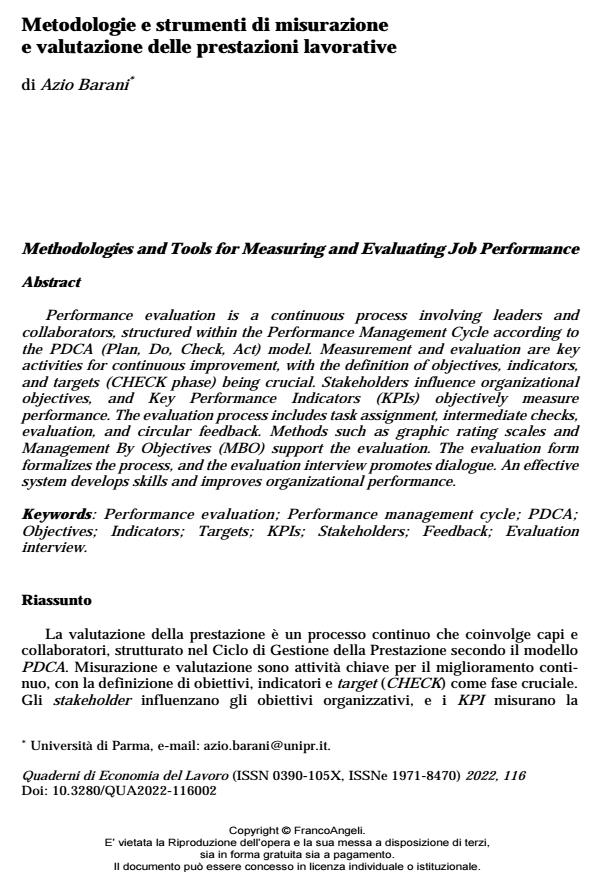
Below, you can see the article first page
If you want to buy this article in PDF format, you can do it, following the instructions to buy download credits
FrancoAngeli is member of Publishers International Linking Association, Inc (PILA), a not-for-profit association which run the CrossRef service enabling links to and from online scholarly content.
Performance evaluation is a continuous process involving leaders and collaborators, structured within the Performance Management Cycle according to the PDCA (Plan, Do, Check, Act) model. Measurement and evaluation are key activities for continuous improvement, with the definition of objectives, indicators, and targets (CHECK phase) being crucial. Stakeholders influence organizational objectives, and Key Performance Indicators (KPIs) objectively measure performance. The evaluation process includes task assignment, intermediate checks, evaluation, and circular feedback. Methods such as graphic rating scales and Management By Objectives (MBO) support the evaluation. The evaluation form formalizes the process, and the evaluation interview promotes dialogue. An effective system develops skills and improves organizational performance.
Keywords: Performance evaluation; Performance management cycle; PDCA; Objectives; Indicators; Targets; KPIs; Stakeholders; Feedback; Evaluation interview.
- Aguinis H. (2013). Performance management (3rd ed.). Boston: Pearson.
- Aguinis H., Joo H. e Gottfredson R.K. (2011). Why we hate performance management – And why we should love it. Business Horizons, 54: 503-507.
- Aguinis H. e Kraiger K. (2009). Benefits of training and development for individuals and teams, organizations, and society. Annual Review of Psychology, 60: 451-474.
- Alagaraja M. (2013). Mobilizing organizational alignment through strategic human resource development. Human Resource Development International, 16: 74-93.
- Alagaraja M. e Egan T. (2013). The strategic value of HRD in lean strategy implementation. Human Resource Development Quarterly, 24: 1-27.
- Arneson J., Rothwell W. e Naughton J. (2013). Training and development competencies redefined to create competitive advantage. T&D, 67(1): 42-47.
- Boldizzoni D. e Quaratino L. (2014). Risorse umane. Logiche e strumenti per la valorizzazione del capitale umano. Bologna: il Mulino.
- Bragger J., Kutcher E., Menier A., Sessa V. e Sumner K. (2014). Giving nonselective downsizing a performance review. Human Resource Development Review, 13: 58-78. DOI: 10.1177/1534484313492331
- Cascio W. (2014). Leveraging employer branding, performance management and human resource development to enhance employee retention. Human Resource Development International, 17: 121-128. DOI: 10.1080/13678868.2014.886443
- Castiello D’Antonio A. (2005). Il colloquio di valutazione delle prestazioni. Milano: FrancoAngeli.
- Catino M. (2012). L’organizzazione e l’ambiente. In: Capire le organizzazioni. Bologna: il Mulino.
- Chinotti O. e Festa A. (2008). Nuovi strumenti per lo sviluppo delle persone nelle organizzazioni: la tecnica della valutazione a 360°. Milano: FrancoAngeli.
- Costa G. e Giannecchini M. (2019). Il ciclo del valore delle risorse umane. In Risorse umane.
- Crawshaw J.R., Van Dick R. e Brodbeck F.C. (2012). Opportunity, fair process and relationship value: career development as a driver of proactive work behaviour. Human Resource Management Journal, 22: 4-20.
- Crouse P., Doyle W. e Young J.D. (2011). Workplace learning strategies, barriers, facilitators and outcomes: A qualitative study among human resource management practitioners. Human Resource Development International, 14: 39-55.
- Davis P.J. (2011). Seven biggest problems with performance appraisals: and seven development approaches to rectify them. Development and Learning in Organizations: An International Journal, 26(1): 11-14. DOI: 10.1108/14777281211189119
- De Lazzari P. (2005). L’impatto della Responsabilità Sociale d’Impresa sul Commitment Organizzativo: il caso ENEL. Ticonzero, knowledge and ideas for emerging leaders, 58.
- De Marinis P. (2010). L’organizzazione delle risorse umane.
- De Vito Piscicelli P. (1984). Il clima organizzativo e le sue dimensioni. Psicologia e lavoro, 2.
- Deming W. E. (1986). Out of the crisis. MIT Press.
- Drucker P.F. (1954). The practice of management. New York: Harper & Brothers.
- Ellinger A.D. (2014). Coaching and Mentoring (pp. 258-271). In: Powell R.F., Rocco T.S. e Roth G., a cura di, The Routledge Companion to Human Resource Development. New York: Routledge.
- Gabrielli G. (2010). People management. Teorie e pratiche per una gestione sostenibile delle persone. Milano: FrancoAngeli.
- Gadekar D.J. (2015). Level of Human Resources Development – Concepts and Review. Acme International Journal of Multidisciplinary Research, 3(6): 48-61.
- Hamlin B. e Stewart J. (2011). What is HRD? A definitional review and synthesis of the HRD domain. Journal of European Industrial Training, 35: 199-220.
- Johnson G., Whittington R., Scholes K., Agwin D., Régener P. e Paci A. (2019). Fondamenti di strategia. Londra: Pearson.
- Kozlowski S.W.J. e Salas E., a cura di (2010). Learning, training, and development in organizations. New York: Routledge/Taylor & Francis.
- Mariani M.G. (2011). Valutare le prestazioni: come gestire e migliorare la performance lavorativa. Bologna: il Mulino.
- McLagan P.A. (1989). Models for HRD practice. Training & Development Journal, 41(9): 49-59.
- Mintzberg H. (1996). La progettazione dell’organizzazione aziendale. Bologna: il Mulino.
- Morris J.R. (1956). Job Rotation. The Journal of Business, 29(4): 268-273.
- Muzzarelli F. (2014). Guidare l’apprendimento. Metodologie e tecniche di formazione in azienda. Milano: FrancoAngeli.
- Pfeffer J. (2009, June 30). The Trouble with Performance Reviews. Bloomberg.com. -- http://www.bloomberg.com/news/articles/2009-06-30/the-trouble-with-performance-reviewsbusinessweek-business-news-stock-market-and-financial-advice.
- Robbins S.P., Judge T.A. e Bodega D. (2016). Comportamento organizzativo. Conoscere e sviluppare competenze organizzative. Milano: Pearson Italia.
- Sarchielli G. e Fraccaroli F. (2010). Introduzione alla psicologia del lavoro. Bologna: il Mulino.
- Shewhart W. A. (1939). Statistical method from the viewpoint of quality control. Graduate School, Department of Agriculture, Washington, DC.
- Short D.C. e Bing J.W., a cura di (2003). Shaping the future of human resource development. Advances in Developing Human Resources, 5(3): 242-351.
- Silvi R. (2007). Il controllo strategico nella gestione dell’impresa. In: Lipparini A., a cura di, Economia e gestione delle imprese. Bologna: il Mulino.
- The Inner Game of Tennis: The Classic Guide to the Mental Side of Peak Performance. (1997). Vintage.
- UNI EN ISO 9001: 2015 (2015). Par. 7.1.2; 7.1.5; 7.1.6; 7.2; 7.3; 7.4.
- Werner J.M. (2014). Human Resource Development ? Human Resource Management: So what is it? Human Resource Development Quarterly, 25: 127-139.
- Werner J.M. (2017). Human Resource Development/ Talent Management (7th ed.). Boston, Mass: Cengage Learning.
- Wexley K.N. e Latham G.P. (2002). Developing and training human resources in organizations (3rd ed.). Englewood Cliffs, NJ: Pearson/Prentice Hall.
- Yawson R.M. (2013). Systems theory and thinking as a foundational theory in human resource development – a myth or reality? Human Resource Development Review, 12: 53-85.
- Yorks L. (2005). Strategic human resource development. Mason, OH: Thomson/South-Western.
- Yorks L. e Barto J. (2013). Invited reaction: The strategic value of HRD in lean strategy implementation. Human Resource Development Quarterly, 24: 29-33.
Azio Barani, Metodologie e strumenti di misurazione e valutazione delle prestazioni lavorative in "QUADERNI DI ECONOMIA DEL LAVORO" 116/2022, pp 9-38, DOI: 10.3280/QUA2022-116002