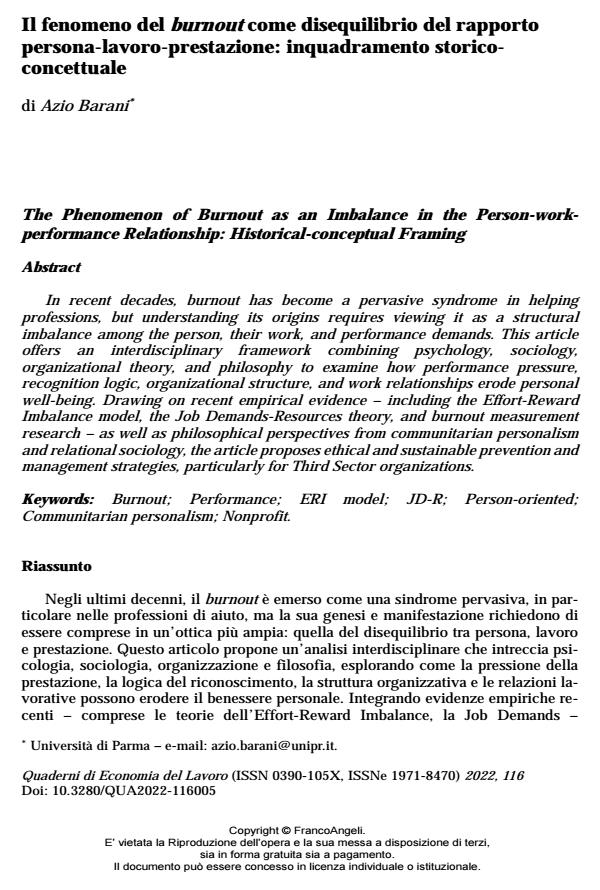
The Phenomenon of Burnout as an Imbalance in the Person-workperformance Relationship: Historical-conceptual Framing
Journal title QUADERNI DI ECONOMIA DEL LAVORO
Author/s Azio Barani
Publishing Year 2026 Issue 2022/116
Language Italian Pages 10 P. 87-96 File size 83 KB
DOI 10.3280/QUA2022-116005
DOI is like a bar code for intellectual property: to have more infomation
click here
Below, you can see the article first page
If you want to buy this article in PDF format, you can do it, following the instructions to buy download credits
FrancoAngeli is member of Publishers International Linking Association, Inc (PILA), a not-for-profit association which run the CrossRef service enabling links to and from online scholarly content.
In recent decades, burnout has become a pervasive syndrome in helping professions, but understanding its origins requires viewing it as a structural imbalance among the person, their work, and performance demands. This article offers an interdisciplinary framework combining psychology, sociology, organizational theory, and philosophy to examine how performance pressure, recognition logic, organizational structure, and work relationships erode personal well-being. Drawing on recent empirical evidence – including the Effort-Reward Imbalance model, the Job Demands-Resources theory, and burnout measurement research – as well as philosophical perspectives from communitarian personalism and relational sociology, the article proposes ethical and sustainable prevention and management strategies, particularly for Third Sector organizations.
Keywords: Burnout; Performance; ERI model; JD-R; Person-oriented; Communitarian personalism; Nonprofit.
- Bakker A.B. e Demerouti E. (2017). Job demands-resources theory: Taking stock and looking forward. Journal of Occupational Health Psychology, 22(3): 273-285.
- Barello S., Caruso R., Palamenghi L. e Graffigna G. (2021). Workload and burnout in healthcare during COVID-19: The role of emotional coping. Frontiers in Psychology, 12, 637624.
- Bhatt P. e Ramani K. (2016). Burnout and its organizational effects: A study on literature review. International Research Journal of Management and Marketing, 6(7): 34-45. -- https://econjournals.com/index.php/irmm/article/view/9398.
- Cherniss C. (1983). La sindrome del burnout. Torino: CST.
- Dall’Ora C., Ball J., Reinius M. e Griffiths P. (2020). Burnout in nursing: a theoretical review. Human Resources for Health, 18: 41. -- Testo disponibile al sito: https://doi.org/10.1186/s12960-020-00469-9.
- Deng H., Huang J., Cheung S.-F. e Zhang L. (2021). Job demands and resources, burnout, and psychological distress of employees in the Chinese non-profit sector. Frontiers in Psychology.
- Donati P. (2011a). Relational Sociology. A New Pradigm for the Social Sciences. London-New York: Routledge.
- Donati P. (2011b). Sociologia della riflessività. Come si entra nel dopo-moderno. Bologna: il Mulino.
- Edú-Valsania S., Laguía A. e Moriano J.A. (2022). Burnout: A review of theory and measurement. International Journal of Environmental Research and Public Health, 19(3): 1780.
- El Mouedden H., Vanhaecht K. e Panella M. (2022). Job Demands-Resources theory in health professions and education. BMC Medical Education, 22: 631.
- Freudenberger H.J. (1974). Staff Burn-out. Journal of Social Issues, 30(1): 159-165.
- Freudenberger H.J. (1983). Burnout: Contemporary issues, trends and concerns. In: Farber B.A., a cura di, Stress and burnout in the human service professions, pp. 1-20. Elmsford, NY: Pergamon Press.
- Green F. (2004). Work intensification, discretion, and the decline in well-being at work. European Sociological Review, 20(4): 345-361. -- Testo disponibile al sito: https://doi.org/10.1093/esr/jch022.
- Lee J. e Carter M. (2016). The person-oriented approach to burnout: A systematic review. Burnout Research, 3: 1-11.
- Leiter M.P. e Maslach C. (2016). Latent burnout profiles: A new approach to understanding the burnout experience. Burnout Research, 3: 89-100. -- Testo disponibile al sito: https://doi.org/10.1016/j.burn.2016.08.002.
- Lubbadeh A. (2020). Understanding burnout in the helping professions: A literature review. Journal of Workplace Behavioral Health, 35(3): 210-230. -- Testo disponibile al sito: https://doi.org/10.1080/15555240.2020.1788880.
- Maritain J. (1942). Integral Humanism. London: Sheed & Ward.
- Maritain J. (1947). Man and the State. Chicago: University of Chicago Press.
- Maslach C. e Jackson S.E. (1981). The measurement of experienced burnout. Journal of Occupational Behaviour, 2: 99-113. -- Testo disponibile al sito: https://doi.org/10.1002/job.4030020205.
- Maslach C. e Jackson S.E. (1984). Burnout in organizational settings. In: Rowland K. e Ferris G., a cura di, Applied Social Psychology Annual, 5: 133-153.
- Maslach C. e Leiter M.P. (1997). The truth about burnout: How organizations cause personal stress and what to do about it. San Francisco: Jossey-Bass.
- Maslach C. e Leiter M.P. (2001). Organizational causes of burnout. In: Golembiewski R.T., a cura di, Handbook of organizational behavior, 2nd ed., pp. 245-257. New York: Dekker.
- Mounier E. (1936). Manifeste au service du personnalisme. Paris: Plon.
- Patel R., Sekhon H. e Sharma R. (2016). Job Burnout: A literature review. Paripex Indian Journal of Research, 5(9): 1-8. -- Testo disponibile al sito: https://www.worldwidejournals.com/paripex/recent_issues_pdf/2016/September/job-burnout-a-literature-review_September_2016_5996591050_0206815.pdf.
- Pines A. e Aronson E. (1988). Career burnout: Causes and cures. New York: Free Press.
- Pines A. e Kafry D. (1978). Occupational tedium in the social service. Social Work, 23(6): 499-507.
- Schaufeli W.B. e Enzmann D. (1998). The burnout companion to study and practice: A critical analysis. London: Taylor & Francis.
- Schaufeli W.B., Leiter M.P. e Maslach C. (2009). Burnout: 35 years of research and practice. Career Development International, 14(3): 204-220. -- Testo disponibile al sito: https://doi.org/10.1108/13620430910966406.
- Shoman Y., Rousson V., Bianchi R. e Guseva Canu I. (2022). Emotional exhaustion as the core of burnout: A meta-analytical and longitudinal reappraisal. Frontiers in Psychology.
- Yuan Z., Yu D., Zhao H., Wang Y., Jiang W., Chen D., Liu X. e Li X. (2021). Burnout of healthcare workers based on the Effort-Reward Imbalance model: A cross-sectional study in China. International Journal of Public Health, 66.
Azio Barani, Il fenomeno del burnout come disequilibrio del rapporto persona-lavoro-prestazione: inquadramento storicoconcettuale in "QUADERNI DI ECONOMIA DEL LAVORO" 116/2022, pp 87-96, DOI: 10.3280/QUA2022-116005