Labour, Performance and Outsourcing Processes: The Evolution of the Phenomenon in the Banking Sector
Journal title QUADERNI DI ECONOMIA DEL LAVORO
Author/s Azio Barani
Publishing Year 2026 Issue 2022/116
Language Italian Pages 14 P. 255-268 File size 54 KB
DOI 10.3280/QUA2022-116011
DOI is like a bar code for intellectual property: to have more infomation
click here
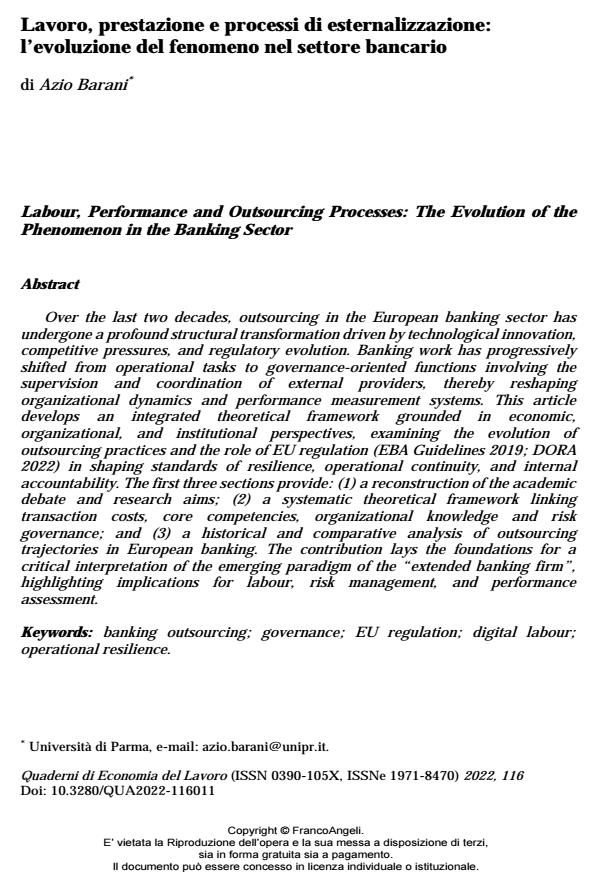
Below, you can see the article first page
If you want to buy this article in PDF format, you can do it, following the instructions to buy download credits
FrancoAngeli is member of Publishers International Linking Association, Inc (PILA), a not-for-profit association which run the CrossRef service enabling links to and from online scholarly content.
Over the last two decades, outsourcing in the European banking sector has undergone a profound structural transformation driven by technological innovation, competitive pressures, and regulatory evolution. Banking work has progressively shifted from operational tasks to governance-oriented functions involving the supervision and coordination of external providers, thereby reshaping organizational dynamics and performance measurement systems. This article develops an integrated theoretical framework grounded in economic, organizational, and institutional perspectives, examining the evolution of outsourcing practices and the role of EU regulation (EBA Guidelines 2019; DORA 2022) in shaping standards of resilience, operational continuity, and internal accountability. The first three sections provide: (1) a reconstruction of the academic debate and research aims; (2) a systematic theoretical framework linking transaction costs, core competencies, organizational knowledge and risk governance; and (3) a historical and comparative analysis of outsourcing trajectories in European banking. The contribution lays the foundations for a critical interpretation of the emerging paradigm of the “extended banking firm”, highlighting implications for labour, risk management, and performance assessment.
Keywords: banking outsourcing; governance; EU regulation; digital labour; operational resilience.
- Amiti M. e Wei S.-J. (2004). Fear of service outsourcing: Is it justified? IMF Working Paper WP/04/186. International Monetary Fund. -- Testo disponibile al sito: https://www.imf.org/external/pubs/ft/wp/2004/wp04186.pdf.
- Arner D.W., Barberis J. e Buckley R.P. (2017). FinTech, RegTech and the reconceptualization of financial regulation. Northwestern Journal of International Law & Business, 37(3): 371-413. -- Testo disponibile al sito: https://papers.ssrn.com/sol3/papers.cfm?abstract_id=2847806&utm.
- Aubert B.A., Patry M. e Rivard S. (2005). A framework for information technology outsourcing risk management. SIGMIS Database, 36(4), (Fall): 9-28. DOI: 10.1145/1104004.1104007
- Autor D.H. (2015). Why are there still so many jobs? The history and future of workplace automation. Journal of Economic Perspectives, 29(3): 3-30.
- Basel Committee on Banking Supervision. (2021). Principles for operational resilience. Bank for International Settlements. -- Testo disponibile al sito: https://www.bis.org/bcbs/publ/d516.pdf.
- Batt R. e Nohara H. (2009). How institutions and business strategies affect wages: A cross-national study of call centers. ILR Review, 62(4): 533-552. DOI: 10.1177/001979390906200404
- Callon M. (1986). Some elements of a sociology of translation: Domestication of the scallops and the fishermen of St Brieuc Bay. In: Law J., a cura di, Power, action and belief: A new sociology of knowledge?. Londra: Routledge.
- Carletti E., Claessens S., Fatás A. e Vives X., a cura di (2020). The bank business model in the post-Covid-19 world. CEPR Press. -- https://cepr.org/system/files/publication-files/60039-barcelona_2_the_bank_business_model_in_the_post_covid_19_world.pdf.
- Deloitte (2018). Global outsourcing survey 2018. -- Testo disponibile al sito: https://www2.deloitte.com/global/en/pages/consulting/articles/global-outsourcing-survey.html.
- Drahokoupil J., a cura di (2015). The outsourcing challenge: Organizing workers across fragmented production networks. European Trade Union Institute.
- Doellgast V. e Greer I. (2007). Vertical Disintegration and the Disorganization of German Industrial Relations. British Journal of Industrial Relations, 45: 55-76.
- Dosi G., Marengo L. e Fagiolo G. (2021). Organization and management in a complex environment: Lessons from the banking sector. Journal of Economic Behavior & Organization, 189: 767-785. -- Testo disponibile al sito: https://doi.org/10.1016/j.jebo.2021. 05.010.
- European Banking Authority (2019). Guidelines on outsourcing arrangements (EBA/GL/2019/02). -- https://www.eba.europa.eu/sites/default/files/documents/10180/ 2551996/EBA%20revised%20Guidelines%20on%20outsourcing%20arrangements.pdf.
- European Commission (2022). Regulation (EU) 2022/2554 of the European Parliament and of the Council of 14 December 2022 on digital operational resilience for the financial sector (DORA). Official Journal of the European Union. -- https://eur-lex.europa.eu/eli/reg/2022/2554.
- Financial Stability Board (2020). Regulatory and supervisory issues relating to outsourcing and third-party relationships. -- https://www.fsb.org/2020/11/regulatory-and-supervisory-issues-relating-to-outsourcing-and-third-party-relationships/.
- Grossman G.M. e Helpman E. (2005). Outsourcing in a global economy. Review of Economic Studies, 72(1): 135-159. -- Testo disponibile al sito: https://doi.org/10.1111/j.1467-937X.2004.00323.x.
- Huws U., Spencer N. e Syrdal D. (2018). Work in the European gig economy. Foundation for European Progressive Studies & University of Hertfordshire. -- https://www.feps-europe.eu/resources/publications/555-work-in-the-european-gig-economy.html.
- Lacity M. e Willcocks L. (2016). Robotic process automation: The next transformation lever for shared services. London School of Economics/ Outsourcing Unit. -- https://papers.ssrn.com/sol3/papers.cfm?abstract_id=2865784.
- Monferrà S. (2007). Il rapporto banca-impresa in Italia. Roma: Bancaria Editrice.
- Organisation for Economic Co-operation and Development. (2018). New forms of work in the digital economy. OECD Publishing. -- https://www.oecd.org/employment/new-forms-of-work.htm.
- Oshri I., Kotlarsky J. e Willcocks L. (2015). The handbook of global outsourcing and offshoring 3rd edition. Palgrave Macmillan.
- Pisano G.P. e Shih W.C. (2009). Restoring American competitiveness. Harvard Business Review, 87(7-8): 114-125. -- https://hbr.org/2009/07/restoring-american-competitiveness.
- Power M. (2007). Organized uncertainty: Designing a world of risk management. Oxford University Press.
- Prahalad C.K. e Hamel G. (1990). The core competence of the corporation. Harvard Business Review, 68(3): 79-91. -- https://hbr.org/1990/05/the-core-competence-of-the-corporation?utm.
- Quinn J.B. (1999) Strategic outsourcing: leveraging knowledge capabilities. MIT Sloan Management Review, 40(4): 9-21.
- Quinn J.B. (2000). Outsourcing innovation: the new engine of growth. MIT Sloan Management Review, 41(4): 13.
- Teece D.J. (2014). The foundations of enterprise performance: Dynamic and ordinary capabilities in an (economic) theory of firms. Academy of Management Perspectives, 28(4): 328-352.
- Weil D. (2014). The Fissured Workplace: Why Work Became so Bad for so many and what can be done to improve it. Cambridge, MA: Harvard University Press.
- Williamson O.E. (1985). The economic institutions of capitalism. Washington: Free Press.
- Willcocks L., Lacity M. e Craig A. (2016). Service automation: Robots and the future of work. Steve Brookes Publishing.
Azio Barani, Lavoro, prestazione e processi di esternalizzazione: l’evoluzione del fenomeno nel settore bancario in "QUADERNI DI ECONOMIA DEL LAVORO" 116/2022, pp 255-268, DOI: 10.3280/QUA2022-116011