Heroes without masks. Superheroes and families with teenage children
Journal title TERAPIA FAMILIARE
Author/s Marco Cappellini
Publishing Year 2026 Issue 2026/140
Language Italian Pages 21 P. 56-76 File size 170 KB
DOI 10.3280/TF2026-140004
DOI is like a bar code for intellectual property: to have more infomation
click here
Below, you can see the article first page
If you want to buy this article in PDF format, you can do it, following the instructions to buy download credits
FrancoAngeli is member of Publishers International Linking Association, Inc (PILA), a not-for-profit association which run the CrossRef service enabling links to and from online scholarly content.
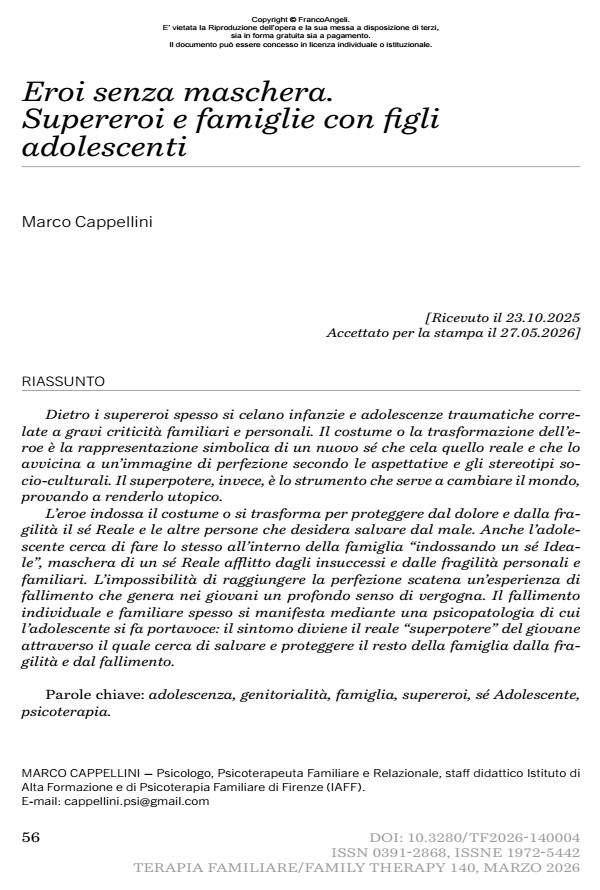
Behind superheroes often lie traumatic childhoods and adolescences linked to serious family and personal problems. The hero’s costume or transformation is a symbolic representation of a new self that conceals the real one and brings him closer to the image of perfection according to sociocultural expectations and stereotypes. Superpowers, on the other hand, are the tools used to change the world by trying to make it utopian. The hero wears the costume or transforms himself to protect the real self and other people he wants to save from evil from pain and fragility. The adolescent tries to do the same within the family by “wearing an ideal self”, a mask of a real self afflicted by personal and family failures and fragilities. The impossibility of achieving perfection triggers an experience of failure that generates a deep sense of shame in young people. Individual and family failure often manifests itself through a psychopathology of which the adolescent becomes the spokesperson: the symptom becomes the young person’s real “superpower” through which they try to save and protect the rest of the family from fragility and failure.
Keywords: adolescence, parenting, family, superheroes, Adolescent self, psychotherapy.
- Ammaniti M. (2024). I paradossi degli adolescenti. Milano: Raffaello Cortina Editore.
- Amsterdam S. (2012). Ritratto di famiglia con superpoteri. Milano: Isbn edizioni. Andolfi M. & Angelo C. (1987). Tempo e mito nella psicoterapia familiare. Torino: Bollati Boringhieri.
- Andolfi M. & Mascellani A. (2010). Storie di adolescenza. Esperienze di terapia familiare. Milano: Raffaello Cortina Editore.
- Bateson G. (1977). Verso un’ecologia della mente. Milano: Adelphi.
- Bion W.R. (1967). Second thoughts: Selected papers on psychoanalysis. London: Heinemann Medical.
- Ceberio M.R. (2022). Anche i supereroi vanno in terapia. Roma: Alpes.
- Cigoli V. & Scabini E. (2000). Il famigliare. Legami, simboli e transizioni. Milano: Raffaello Cortina Editore.
- de Bernart R. & Buralli B. (2001). Il letto a sei piazze. La terapia sessuale trigenerazionale di coppia. In: Caroli F. (a cura di), Psicobiettivo, vol. 1. Milano: FrancoAngeli.
- de Bernart R. (2007, 2008). Immagine e implicito. Maieutica, 2730: 455468. DOI: 10.3280/PSOB2019001004
- de Bernart R. (2011). Cinema e Terapia Familiare. Il ciclo di vita della famiglia attraverso la cinepresa. Milano: FrancoAngeli.
- Gallese V. & Morelli U. (2024). Cosa significa essere umani? Corpo, cervello e relazione per vivere nel presente. Milano: Raffaello Cortina Editore.
- Lancini M. (2019). Il ritiro sociale negli adolescenti. La solitudine di una generazione iperconnessa. Milano: Raffaello Cortina Editore.
- Lancini M., Cirillo L., Scodeggio T. & zanella T. (2020). L’adolescente. Psicopatologia e psicoterapia evolutiva. Milano: Raffaello Cortina Editore.
- Menarini R., & Pontalti C. (1986). Il set familiare: note per una diagnosi gruppoanalitica in psicopatologia. Psicoterapia e Scienze Umane, 20: 6778.
- Minuchin S. (1974). Famiglia e terapia della famiglia. Roma: Astrolabio.
- Monguzzi F. (2010). Curare la coppia. Processi terapeutici e fattori mutativi. Milano: FrancoAngeli.
- Morin E. (1990). Introduzione al pensiero complesso. Milano: Sperling & Kupfer. Nicolò A.M. (2000). La memoria nella trasmissione generazionale della famiglia. Psiche, 2: 111122.
- Nicolò A.M. (2021). Rotture evolutive. Psicoanalisi dei breakdown e delle soluzioni difensive. Milano: Raffaello Cortina Editore.
- Nietzsche F. (1899). Così parlò Zarathustra. Torino: Bocca. Nucci M. (2013). Le lacrime degli eroi. Torino: Einaudi.
- Rogers C. (1951). ClientCentered Therapy: Its Current Practice, Implications and Theory. London: Constable
- Telfener U. (2015). La manutenzione dell’amore. Roma: Castelvecchi.
Marco Cappellini, Eroi senza maschera. Supereroi e famiglie con figli adolescenti in "TERAPIA FAMILIARE" 140/2026, pp 56-76, DOI: 10.3280/TF2026-140004