Internal auditors’ recognition of conflict of interest situations: A vignette-based analysis
Journal title MANAGEMENT CONTROL
Author/s Cristina Cersosimo, Rocco Frondizi, Franco Ernesto Rubino
Publishing Year 2026 Issue 2026/2
Language English Pages 19 P. 169-187 File size 122 KB
DOI 10.3280/MACO2026-002008
DOI is like a bar code for intellectual property: to have more infomation
click here
Below, you can see the article first page
If you want to buy this article in PDF format, you can do it, following the instructions to buy download credits
FrancoAngeli is member of Publishers International Linking Association, Inc (PILA), a not-for-profit association which run the CrossRef service enabling links to and from online scholarly content.
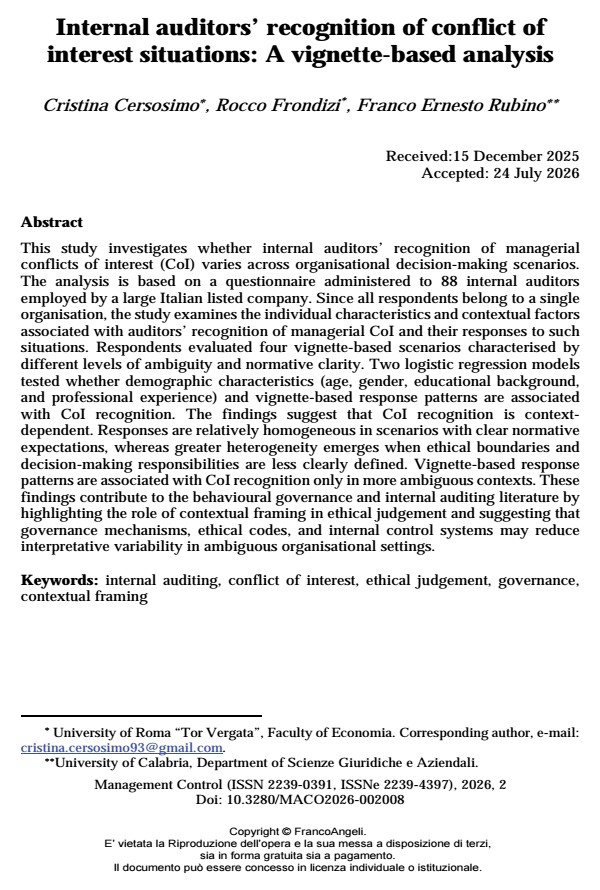
This study investigates whether internal auditors’ recognition of managerial conflicts of interest (CoI) varies across organisational decision-making scenarios. The analysis is based on a questionnaire administered to 88 internal auditors employed by a large Italian listed company. Since all respondents belong to a single organisation, the study examines the individual characteristics and contextual factors associated with auditors’ recognition of managerial CoI and their responses to such situations. Respondents evaluated four vignette-based scenarios characterised by different levels of ambiguity and normative clarity. Two logistic regression models tested whether demographic characteristics (age, gender, educational background, and professional experience) and vignette-based response patterns are associated with CoI recognition. The findings suggest that CoI recognition is context-dependent. Responses are relatively homogeneous in scenarios with clear normative expectations, whereas greater heterogeneity emerges when ethical boundaries and decision-making responsibilities are less clearly defined. Vignette-based response patterns are associated with CoI recognition only in more ambiguous contexts. These findings contribute to the behavioural governance and internal auditing literature by highlighting the role of contextual framing in ethical judgement and suggesting that governance mechanisms, ethical codes, and internal control systems may reduce interpretative variability in ambiguous organisational settings.
Keywords: internal auditing, conflict of interest, ethical judgement, governance, contextual framing
Cristina Cersosimo, Rocco Frondizi, Franco Ernesto Rubino, Internal auditors’ recognition of conflict of interest situations: A vignette-based analysis in "MANAGEMENT CONTROL" 2/2026, pp 169-187, DOI: 10.3280/MACO2026-002008