Open Science for Welfare: Reflections on the FOSSR Digital Infrastructure
Journal title WELFARE E ERGONOMIA
Author/s Caterina Ambrosio, Ciro Clemente De Falco, Luciana Taddei
Publishing Year 2026 Issue 2026/1
Language Italian Pages 13 P. 41-53 File size 130 KB
DOI 10.3280/WE2026-0001004
DOI is like a bar code for intellectual property: to have more infomation
click here
Below, you can see the article first page
If you want to buy this article in PDF format, you can do it, following the instructions to buy download credits
FrancoAngeli is member of Publishers International Linking Association, Inc (PILA), a not-for-profit association which run the CrossRef service enabling links to and from online scholarly content.
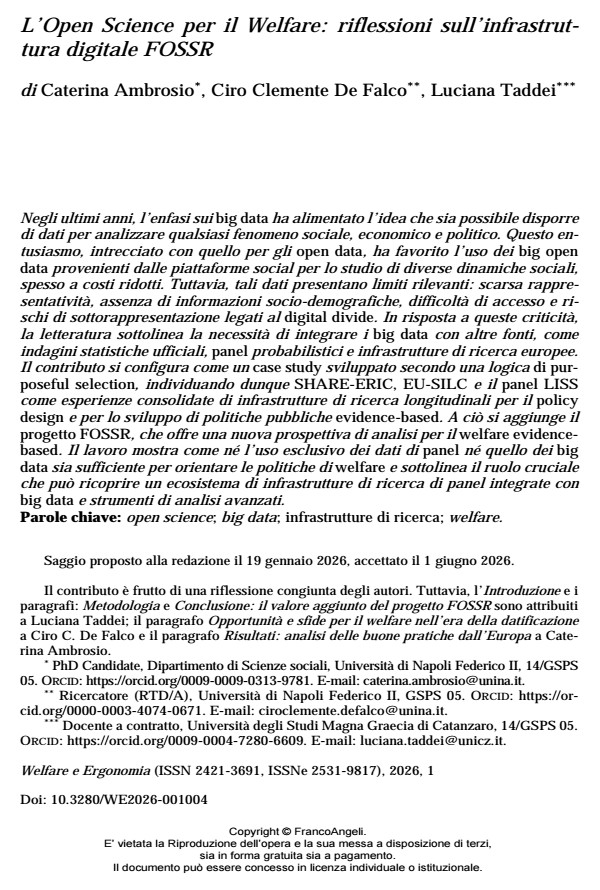
In recent years, the growing emphasis on big data has fostered the belief that virtually any social, economic, or political phenomenon can be analysed through data. This enthusiasm, intertwined with the rise of open data, has encouraged the use of social big data derived from social media platforms to investigate a wide range of social dynamics, often at relatively low cost. However, these data sources also present significant limitations, including limited representativeness, lack of socio-demographic information, restricted accessibility, and risks of underrepresentation associated with the digital divide. In response to these challenges, the literature increasingly highlights the need to integrate big data with other sources, such as official statistical surveys, probabilistic panels, and European research infrastructures. This contribution takes the form of a case study developed according to a purposeful selection logic, identifying SHARE-ERIC, EU-SILC, and the LISS panel as established experiences of longitudinal research infrastructures for policy design and the development of evidence-based public policies. Added to this is the FOSSR project, which offers a new analytical perspective for evidence-based welfare. The paper shows that neither the exclusive use of panel data nor of big data alone is sufficient to guide welfare policies, and it highlights the crucial role that an ecosystem of panel research infrastructures integrated with big data and advanced analytical tools can play.
Keywords: open science; big data; research infrastructures; welfare.
- Addeo F., Cerbara L., Ciancimino G., Santurro M., Germani D., Marseglia E., Perrotti M., Piacentini F., Colella E. and Righetto G. (2025). FOSSR Online Training ‘Designing and implementing longitudinal and panel surveys’.
- Aragona B. and De Rosa R. (2018). Policy making at the time of Big Data: datascape, datasphere, data culture. Sociologia Italiana, 11. DOI: 10.1485/AIS_2018/11_3434226
- Borgman C.L. (2015). Big Data, Little Data, No Data: Scholarship in the Networked World. Cambridge, MA: MIT Press.
- Cerbara L., Biolcati Rinaldi F., Ecchia G., Germani D., Mencarini L., Pennacchiotti C., Primerano I., Santurro M., Taddei L., Vezzoni C. and Weber G. (2026, in corso di pubblicazione). Probabilistic surveys to monitor population and societal change. In: E. Reale and G. Cerulli, editors, Research infrastructures for open science in social science research: Lessons from the FOSSR case. Springer Nature.
- Cheney-Lippold J. (2017). We Are Data: Algorithms and the Making of Our Digital Selves. NYU Press.
- D’Ambrosio G., Marchesini N., Pennacchiotti C. e Primerano I. (2025). Creazione e sviluppo di un’infrastruttura di ricerca nelle scienze sociali in Italia: il progetto FOSSR. IRPPS Working Papers, 1(1): 1-39. -- http://epub.irpps.cnr.it/index.php/wp/article/view/321.
- Das M., Knoef M. (2019). Experimental and Longitudinal Data for Scientific and Policy Research: Open Access to Data Collected in the Longitudinal Internet Studies for the Social Sciences (LISS) Panel. In: Crato N., Paruolo P., editors, Data-Driven Policy Impact Evaluation. Springer, Cham. 131-146. DOI: 10.1007/978-3-319-78461-8_9
- De Bresser J. and Knoef M. (2015). Can the Dutch meet their own retirement expenditure goals?. Labour Economics, 34: 100-117.
- Kitchin R. (2014). The Data Revolution: Big Data, Open Data, Data Infrastructures and Their Consequences. London: Sage. DOI: 10.4135/9781473909472
- Manovich L. (2011). Trending: The promises and the challenges of big social data. Debates in the digital humanities, 2(1): 460-475.
- Miguel E., Camerer C., Casey K., Cohen J., Esterling K. M., Gerber A., ... and Van der Laan M. (2014). Promoting transparency in social science research. Science, 343(6166): 30-31.
- O’Neil C. (2016). Weapons of Math Destruction: How Big Data Increases Inequality and Threatens Democracy. New York: Crown Publishing.
- Patton M.Q. (2002). Qualitative Research & Evaluation Methods (3rd ed.). Thousand Oaks, CA: Sage Publications.
- Piacentini F., Colella E. and Righetto G. (2025, luglio 16). FOSSR Online Training ‘Designing and implementing longitudinal and panel surveys’.
- Punziano G., Marrazzo F. and Acampa S. (2021). An application of content analysis to crowdtangle data: the 2020 constitutional referendum campaign on Facebook. Current Politics & Economics of Europe, 32(4).
- Reale E. and Cerulli G. (2023, ottobre 16). FOSSR First Policy-maker session. Data driven policy learning: the role of FOSSR.
- Rogers R. (2013). Digital methods. Cambridge, MA: MIT Press.
- Santini Z.I., Jose P.E., Koyanagi A., Meilstrup C., Nielsen L., Madsen K.R. and Koushede V. (2020). Formal social participation protects physical health through enhanced mental health: A longitudinal mediation analysis using three consecutive waves of the Survey of Health, Ageing and Retirement in Europe (SHARE). Social Science & Medicine, 251, 112906.
- Santurro M., Biolcati Rinaldi F., Cerbara L., Heins F., Paparusso A., Pennacchiotti C., Piacentini F., Taddei L. and Vezzoni C. (2025). Designing the Italian Online Probability Panel: Innovations and Challenges to Foster Open Science. In: di Bella E., Gioia V., Lagazio C., Zaccarin S., editors, Statistics for Innovation 1. SIS 2025. Italian Statistical Society Series on Advances in Statistics. Springer, Cham. DOI: 10.1007/978-3-031-96736-8_43
- Simons-Op het Veld A.M.W. (2018). Socioeconomic health inequalities: exploring the role of social mobility, unhealthy homogenization, and perceived classism. Doctoral Thesis, Maastricht University. Datawyse / Universitaire Pers Maastricht.
- Stake R.E. (1995). The Art of Case Study Research. Thousand Oaks, CA: Sage Publications.
- Taddei L. and Paolucci M. (2026). The Rise of Social Science Infrastructures in Europe and Italy. In: Taddei L., Paolucci M., editors, Longitudinal Data Infrastructures in Europe. Tools for Open Science in Social Science Research, pp. 69-79. Cham: Springer.
- Taddei L., Biolcati Rinaldi F., Heins F., Marchesini N., Paparusso A., Pennacchiotti C., Piacentini F., Primerano I., Vezzoni C., Santurro M. (2026). The Italian way to an Online Probability Panel. In: Taddei L., Paolucci M., editors, Longitudinal Data Infrastructures in Europe. Tools for Open Science in Social Science Research, pp. 141-152. Cham: Springer.
- Taddei L., D’Ambrosio G., Visconti F. (2026). Gli Online Probability Panel: caratteristiche, potenzialità e sviluppi. In: Cerbara L., Pennacchiotti C., Primerano I., Taddei L., editors, Italian Online Probability Panel. Ideazione, realizzazione e contesto del primo panel probabilistico online in Italia, pp. 30-47. Milano: FrancoAngeli.
- Taddei L., Germani D., Marchesini N., Paolillo R., Pennacchiotti C., Primerano I., Santurro M. and Cerbara L. (2025). Comparison of Online Probability Panels in Europe: New Trends and Old Challenges in the Era of Open Science. Societies, 15(8): 210.
- Trezza D. (2023). To scrape or not to scrape, this is dilemma. The post-API scenario and implications on digital research. Frontiers in Sociology, 8.
- Van Dijck J. (2014). Datafication, dataism and dataveillance: Big Data between scientific paradigm and ideology. Surveillance & Society, 12(2): 197-208.
- Wilkinson M.M., Dumontier M., Aalbersberg I.J., Appleton G., Axton M., Baak A., Blomberg N., Boiten J.W., da Silva Santos L.B., Bourne P.E., Bouwman J., Brookes A.J., Clark T., Crosas M., Dillo I., Dumon O., Edmunds S., Evelo C. T., Finkers R. et al. (2016). The FAIR Guiding Principles for scientific data management and stewardship. Scientific Data, 3, 160018.
- Yin R. K. (2018). Case study research and applications: design and methods (Sixth edition.). SAGE Publications, Inc.
Caterina Ambrosio, Ciro Clemente De Falco, Luciana Taddei, L’Open Science per il Welfare: riflessioni sull’infrastruttura digitale FOSSR in "WELFARE E ERGONOMIA" 1/2026, pp 41-53, DOI: 10.3280/WE2026-0001004