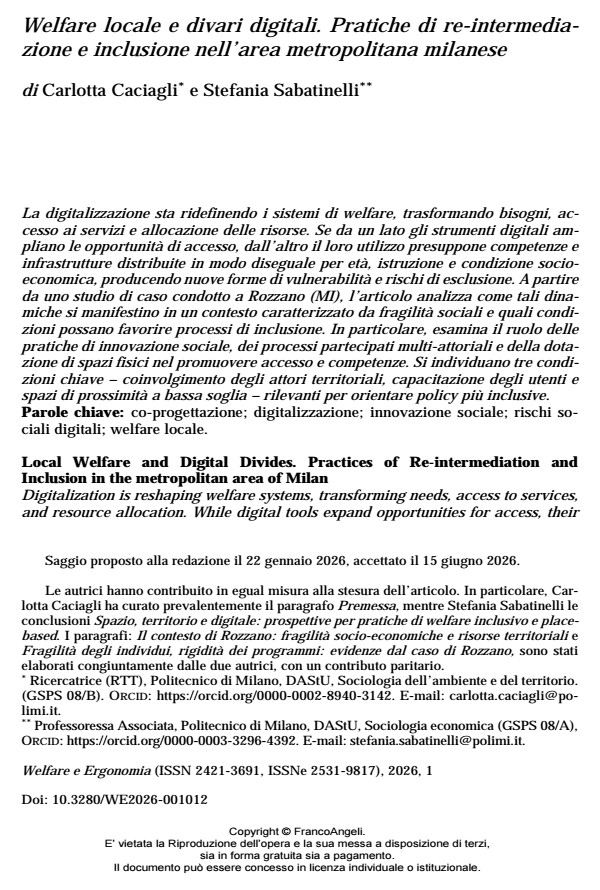
Local Welfare and Digital Divides. Practices of Re-intermediation and Inclusion in the metropolitan area of Milan
Journal title WELFARE E ERGONOMIA
Author/s Carlotta Caciagli, Stefania Sabatinelli
Publishing Year 2026 Issue 2026/1
Language Italian Pages 12 P. 155-166 File size 49 KB
DOI 10.3280/WE2026-0001012
DOI is like a bar code for intellectual property: to have more infomation
click here
Below, you can see the article first page
If you want to buy this article in PDF format, you can do it, following the instructions to buy download credits
FrancoAngeli is member of Publishers International Linking Association, Inc (PILA), a not-for-profit association which run the CrossRef service enabling links to and from online scholarly content.
Digitalization is reshaping welfare systems, transforming needs, access to services, and resource allocation. While digital tools expand opportunities for access, their use also presupposes skills and infrastructures that are unevenly distributed across age groups, educational levels, and socio-economic conditions, generating new forms of vulnerability and risks of exclusion. Drawing on a case study conducted in Rozzano (Milan), this article examines how these dynamics are embodied in a context characterized by social fragilities and explores the conditions that can foster social inclusion. In particular, it investigates the role of social innovation practices, multi-stakeholder participatory processes, and space infrastructures in promoting access and capabilities. The study identifies three key conditions – continuous stakeholder engagement, inhabitants’ empowerment, and low-threshold proximity spaces – relevant for paving the way for more inclusive policies.
Keywords: co-design; digitalization; social innovation; digital social risks; local welfare.
- Andreotti A. e Mingione E. (2012). The City as Local Welfare System. In: Carmon N. e Faistein, S.S., a cura di (2013). Policy, Planning, and People. Promoting Justice in Urban Development, Philadelphia: University of Pennsylvania Press, pp. 224-241.
- Batko K. (2023). Digital social innovation based on Big Data Analytics for health and well-being of society. Journal of Big Data, 10(1): 171.
- Bauriedl S. e Strüver A., a cura di (2022). Platformized cities and Urban Life. Columbia: Columbia University Press.
- Bricocoli M. e Sabatinelli S. (2024). Italian social policies coping with fragility: the challenge of continuity in time, space and life pathways. In: Curci F. e Chiffi D., a cura di, Fragility and Antifragility in Cities and Regions. Space, Uncertainty and Inequality, Edward Elgar, pp. 184-197.
- Buffat A. (2015). Street-level bureaucracy and e-government. Public Management Review, 17(1): 149-161. DOI: 10.1080/14719037.2013.771699.
- Caciagli C., Piscitelli P. e Mastrantoni C. (2024). Il progetto dello Spazio Verso. Per un approccio ecologico alla digitalizzazione del Welfare. Territorio, 111(3): 145-153. (Fascicolo stampato nel 2026). DOI: 10.3280/TR2024-111013
- Campedelli M. e Vesan P. (2023). Welfare digitalizzato, welfare digitale e i nuovi rischi sociali digitali: un’introduzione. Social Policies, 10(2): 169-192. DOI: 10.7389/108019
- Della Porta D. (2010). L’intervista qualitativa. Roma-Bari: Laterza.
- Galluzzo L. e Mastrantoni C. (2025). “Towards Inclusive Digital Welfare: A Multi-Layered Co-Design Approach”, paper presented at the Service Design and Innovation Conference, Hyderabad.
- Gui M. (2019). Il digitale a scuola. Rivoluzione o abbaglio? Bologna: il Mulino.
- Henman P. (2010). Transforming Government: People, Process and Policy. Palgrave Macmillan.
- Istat (2024). Cittadini e ICT anno 2024, report Istat 28 aprile 2025. -- https://www.istat.it/wp-content/uploads/2025/04/report_cittadini-e-ict_2024.pdf.
- Istat (2023). Competenze digitali e caratteristiche socio-culturali della popolazione: forti divari, report Istat 20 dicembre 2023. -- https://www.istat.it/wp-content/uploads/2023/12/ Cittadini-e-ICT-2023.pdf.
- Kaun A. e Liminga A. (2023). Welfare service centers: Maintenance, repair, and care at the analog interfaces of the digital welfare state. New Media & Society, 27(5): 3039-3054. DOI: 10.1177/14614448231220362.
- Klinenberg E. (2018). Palaces for the people: How social infrastructure can help fight inequality, polarization, and the decline of civic life. New York: Crown.
- Latham A. and Layton J. (2019). Social infrastructure and the public life of cities: Studying urban sociality and public spaces. Geography Compass, 13(7), e12444.
- Moulaert F. and Nussbaumer J. (2005). Defining the social economy and its governance at the neighbourhood level: A methodological reflection, Urban Studies, 42(11): 2071-2088. DOI: 10.1080/420980500279752
- Pattarin E. (2013). Carenze e limiti dell’istruzione e formazione professionale in Italia. Scuola Democratica, 3: 691-710.
- Sabatinelli S. (2017). Il ruolo dello spazio nell’innovazione del welfare locale. Territorio, 83: 75-80.
- Sibilla M. and Gorgoni A. (2022). Smart welfare and slow digital poverty: The new face of social work. European Journal of Social Work, 26(3): 519-531. DOI: 10.1080/13691457.2022.2040440
- van Dijk J. (2020). The digital divide. Cambridge & Medford, MA: Polity Press.
- Yin R.K. (2003). Designing case studies. Qualitative research methods, 5(14): 359-386.
Carlotta Caciagli, Stefania Sabatinelli, Welfare locale e divari digitali. Pratiche di re-intermediazione e inclusione nell’area metropolitana milanese in "WELFARE E ERGONOMIA" 1/2026, pp 155-166, DOI: 10.3280/WE2026-0001012