The human relation in all its states. The floating objects as complexity revealers and factors of change
Journal title TERAPIA FAMILIARE
Author/s Philippe Caillé
Publishing Year 2026 Issue 2026/141
Language Italian Pages 17 P. 36-52 File size 133 KB
DOI 10.3280/TF2026-141003
DOI is like a bar code for intellectual property: to have more infomation
click here
Below, you can see the article first page
If you want to buy this article in PDF format, you can do it, following the instructions to buy download credits
FrancoAngeli is member of Publishers International Linking Association, Inc (PILA), a not-for-profit association which run the CrossRef service enabling links to and from online scholarly content.
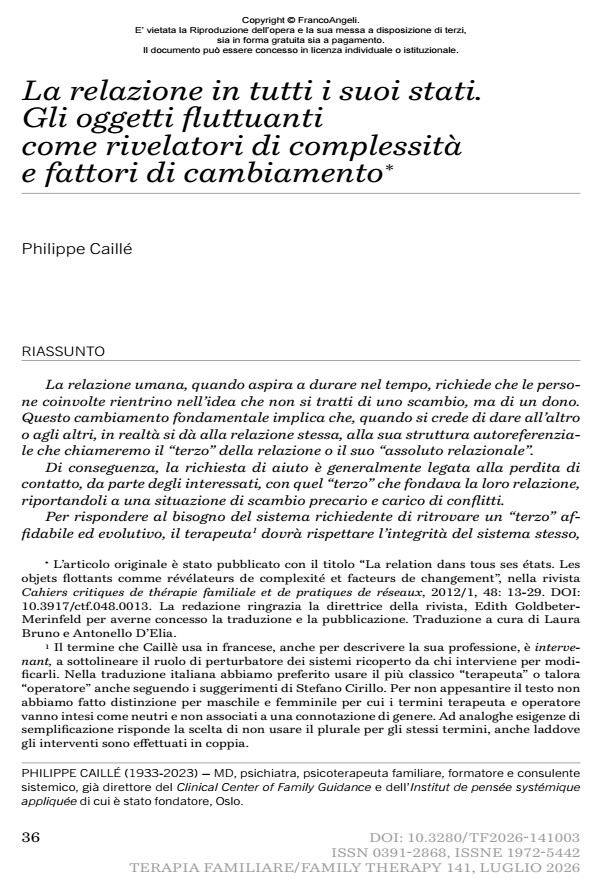
The human relation that wants to perpetuate itself requires from its participants that they quit the exchange cycle to enter the gift cycle. This fundamental change implies that, when you believe to give to the other or to the others, you are really giving to the relation, to its selfreferring structure which we like to call the “third” of the relation or its “relational absolute”. Owing to this fact, the request of help usually results in contact losing by the members of a relation with its grounding “third”, leading them back to a precarious situation of simple exchange rapidly weighed down with conflicts. Responding to the need of the demanding system to rediscover a reliable and evolutionary “third”, the therapist should respect the integrity of the demanding system by rapidly creating the space of shared work which we call the “intermediary space” and by trying to lead the demanding system toward the discovery of its “third” by the employment of the “floating objects”, revealers of relational complexity. This very experience will conduct the demanding system to recover an authentic “third” and thereby a new autonomy, putting to an end the task of the therapist.
- Anspach M.R. (2002). A charge de revanche. Figures élémentaires de la réciprocité. Paris: Seuil.
- Bateson g. (1979). Mind and Nature. A Necessary Unity. New York: Dutton (trad. it.: Mente e natura. Un’unità necessaria. Milano: Adelphi, 1984).
- Briggs J., Peat F.D. (1991). Un miroir turbulent. Guide illustré de la théorie du chaos. Paris: Inter éditions.
- Bruni F., Caruso S., Caspani S., Polimeno A., Ramella Benna S. (2007). I destini incrociati e la psicoterapia. Una suggestione analogica. Psicobiettivo, 27: pp. 13563. Caillé P. (1999). La société postmoderne peutelle faire l’économie du couple? Cahiers critiques de thérapie familiale et de pratiques de réseaux, 33: 1531.
- Caillé P. (2001). De l’intérêt de pouvoir bien se raconter. L’histoire et le récit de l’histoire dans la relation thérapeutique. Générations, 24: 5660.
- Caillé P. (2001). Parcours de changement pour le systémicien en formation. Thérapie Familiale, 22(1): 320.
- Caillé P. (2004). Un et un font trois. Le couple d’aujourd’hui et sa thérapie. Paris: Fabert éditeur, IV ed. (trad. it.: Uno e uno fanno tre. Quale psicoterapia per la coppia di oggi. Roma: Armando Editore, 2007).
- Caillé P. (2006). Familles et thérapeutes. Lecture systémique d’une interaction. Paris: ESF éditeur, IV ed. (trad. it.: Il rapporto famigliaterapeuta. Lettura sistemica di una interazione. Roma: Nuova Italia Scientifica, 1990).
- Caillé P. (2007). Voyage en systémique. L’intervenant, les demandeurs d’aide, la formation. Paris: Fabert éditeur. (trad. it.: Viaggio nella sistemica. Il terapeuta, le domande di aiuto, la formazione. Milano: Alpes Italia, 2015).
- Caillé P. (2010). Vous avez dit famille… Famille traditionnelle ou constellation affective? In: D’Amore S. (ed.), Les nouvelles familles. Approches cliniques. Bruxelles: De Boeck.
- Caillé P. (2012). Les incertitudes identitaires de la famille contemporaine. L’apport des objets flottants. Cahiers critiques de thérapie familiale et de pratiques de réseaux, 47: 1938.
- Caillé P., Rey Y. (1996). Il était une fois… La méthode narrative en systémique. Paris: ESF éditeur, II ed. (trad. it.: C’era una volta. Il metodo narrativo in terapia sistemica. Milano: FrancoAngeli, 1998).
- Caillé P., Rey Y. (2004). Les objets flottants. Méthodes d’entretiens systémiques. Paris: Fabert éditeur, V ed. (trad. it.: Gli oggetti fluttuanti. Metodi di interviste sistematiche. Roma: Armando Editore, 2005).
- Caillé P., Soerensen T. (1993). Recherche sur la thérapie de couple constructiviste. Une étude prospective, méthode et résultats d’ensemble. Thérapie Familiale, 14(1): pp. 3151.
- Carse J.P. (1986). Finite and Infinite Games. A Vision of Life as Play and Possibility. New York: Macmillan.
- Damasio A.R. (1994). Descartes’ Error, Emotion, Reason, and the Human Brain. New York: Putnam Books (trad. it.: L’errore di Cartesio. Emozione, ragione e cervello umano. Milano: Adelphi, 1995).
- Damasio A.R. (1999). The Feeling of What Happens. Body and Emotion in the Making of Consciousness. New York: Harcourt Brace & Company (trad. it.: Emozione e coscienza. Milano: Adelphi, 2000).
- Gaillard J.P (2009). Enfants et adolescents en mutation. Paris: ESF éditeur.
- Gallese V. (2005). Embodied simulation: from neurons to phenomenal experience. Phenomenology and the Cognitive Sciences, 4: 2348.
- Gross M. (2012). Le coût de l’altérité sexuelle dans l’homoparentalité. Cahiers critiques de thérapie familiale et de pratiques de réseau, 47: 9511.
- Le goff J.F. (2006). Construction d’un totem en thérapie familiale. Thérapie familiale, 27(4): 361375.
- Mauss M. (1950). Essai sur le don. In: Sociologie et Anthropologie. Paris: PUF. (trad. it.: Saggio sul dono. Forma e motivo dello scambio nelle società arcaiche. Torino: Einaudi, 2002).
- Morin E. (1991). La méthode, vol. 4: Les Idées. Paris: Seuil. (trad. it.: Il metodo 4. Le idee: habitat, vita, organizzazione, usi e costumi. Milano: Raffaello Cortina, 2008).
- OlliéDressayre J., Mérigot D. (2001). Le génogramme imaginaire: liens du sang, liens du coeur. Paris: ESF éditeur.
- Onnis L. (1992). Langage du corps et langage de la thérapie: la sculpture du “futur” comme modèle d’intervention systémique dans les situations psychosomatiques. Thérapie Familiale, 13(1): 319.
- Onnis L. (1996). Le langage du corps en thérapie: les sculptures du présent et du futur. In: Onnis L. (ed.), Les langages du corps. Paris: ESF.
- Onnis. L. (2009). Corps et contexte. La thérapie familiale des troubles psychosomatiques. Paris: Fabert éditeur (ed. orig.: Corpo e contesto. Terapia familiare dei disturbi psicosomatici. Roma: Nuova Italia Scientifica, 1985).
- Rizzolatti G., Sinigaglia C. (2008). Les neurones miroirs. Paris: Odile Jacob (ed. orig.: So quel che fai. Il cervello che agisce e i neuroni specchio. Milano: Raffaello Cortina, 2006).
Philippe Caillé, La relazione in tutti i suoi stati. Gli oggetti fluttuanti come rivelatori di complessità e fattori di cambiamento in "TERAPIA FAMILIARE" 141/2026, pp 36-52, DOI: 10.3280/TF2026-141003