Internal auditors’ recognition of conflict of interest situations: A vignette-based analysis
Titolo Rivista MANAGEMENT CONTROL
Autori/Curatori Cristina Cersosimo, Rocco Frondizi, Franco Ernesto Rubino
Anno di pubblicazione 2026 Fascicolo 2026/2
Lingua Inglese Numero pagine 19 P. 169-187 Dimensione file 122 KB
DOI 10.3280/MACO2026-002008
Il DOI è il codice a barre della proprietà intellettuale: per saperne di più
clicca qui
Qui sotto puoi vedere in anteprima la prima pagina di questo articolo.
Se questo articolo ti interessa, lo puoi acquistare (e scaricare in formato pdf) seguendo le facili indicazioni per acquistare il download credit. Acquista Download Credits per scaricare questo Articolo in formato PDF
FrancoAngeli è membro della Publishers International Linking Association, Inc (PILA), associazione indipendente e non profit per facilitare (attraverso i servizi tecnologici implementati da CrossRef.org) l’accesso degli studiosi ai contenuti digitali nelle pubblicazioni professionali e scientifiche.
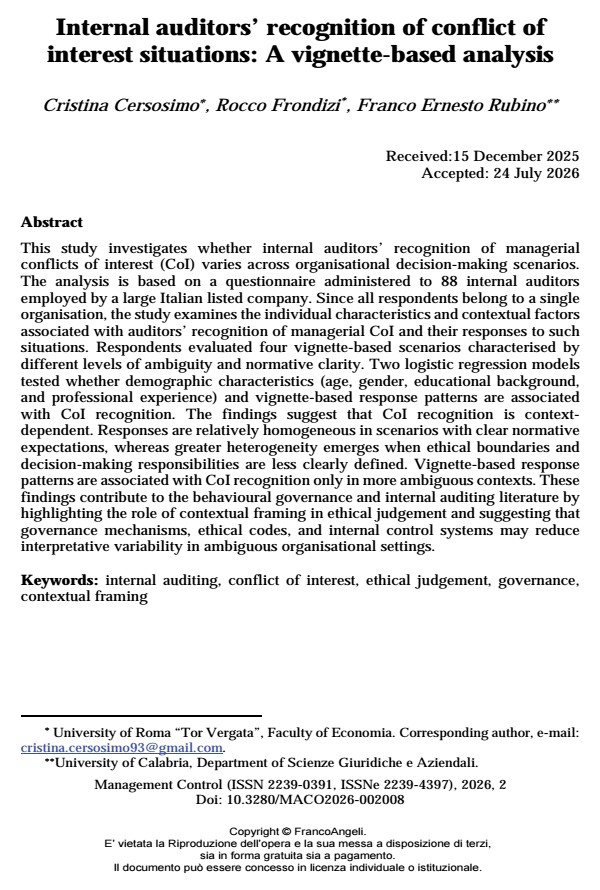
This study investigates whether internal auditors’ recognition of managerial conflicts of interest (CoI) varies across organisational decision-making scenarios. The analysis is based on a questionnaire administered to 88 internal auditors employed by a large Italian listed company. Since all respondents belong to a single organisation, the study examines the individual characteristics and contextual factors associated with auditors’ recognition of managerial CoI and their responses to such situations. Respondents evaluated four vignette-based scenarios characterised by different levels of ambiguity and normative clarity. Two logistic regression models tested whether demographic characteristics (age, gender, educational background, and professional experience) and vignette-based response patterns are associated with CoI recognition. The findings suggest that CoI recognition is context-dependent. Responses are relatively homogeneous in scenarios with clear normative expectations, whereas greater heterogeneity emerges when ethical boundaries and decision-making responsibilities are less clearly defined. Vignette-based response patterns are associated with CoI recognition only in more ambiguous contexts. These findings contribute to the behavioural governance and internal auditing literature by highlighting the role of contextual framing in ethical judgement and suggesting that governance mechanisms, ethical codes, and internal control systems may reduce interpretative variability in ambiguous organisational settings.
Parole chiave:internal auditing, conflict of interest, ethical judgement, governance, contextual framing
Cristina Cersosimo, Rocco Frondizi, Franco Ernesto Rubino, Internal auditors’ recognition of conflict of interest situations: A vignette-based analysis in "MANAGEMENT CONTROL" 2/2026, pp 169-187, DOI: 10.3280/MACO2026-002008