Are large-scale regeneration plans favouring the replacement of poor by rich in Paris?
Titolo Rivista TERRITORIO
Autori/Curatori Félix Adisson
Anno di pubblicazione 2013 Fascicolo 2013/65
Lingua Inglese Numero pagine 9 P. 22-30 Dimensione file 608 KB
DOI 10.3280/TR2013-065003
Il DOI è il codice a barre della proprietà intellettuale: per saperne di più
clicca qui
Qui sotto puoi vedere in anteprima la prima pagina di questo articolo.
Se questo articolo ti interessa, lo puoi acquistare (e scaricare in formato pdf) seguendo le facili indicazioni per acquistare il download credit. Acquista Download Credits per scaricare questo Articolo in formato PDF
FrancoAngeli è membro della Publishers International Linking Association, Inc (PILA), associazione indipendente e non profit per facilitare (attraverso i servizi tecnologici implementati da CrossRef.org) l’accesso degli studiosi ai contenuti digitali nelle pubblicazioni professionali e scientifiche.
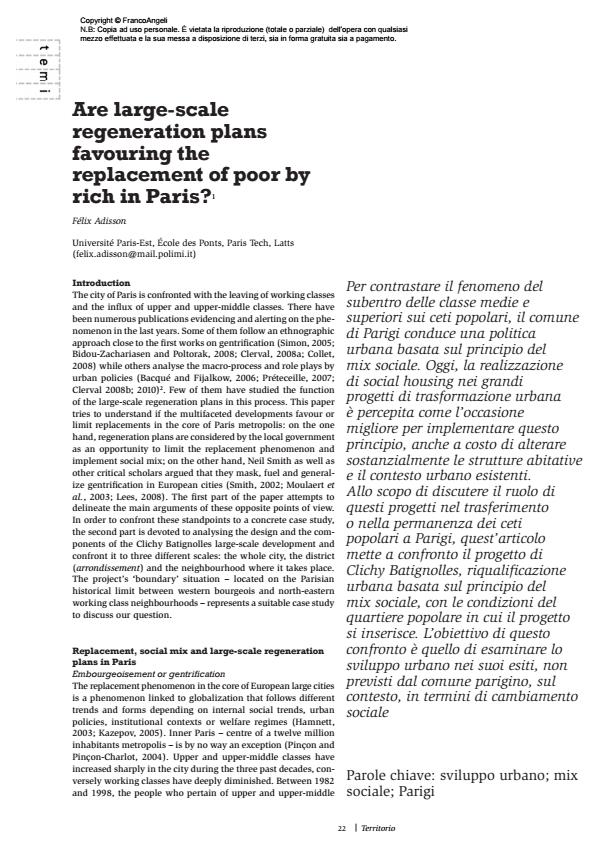
In order to fight the problem of the replacement of the lower classes by the middle and upper classes, the City of Paris is pursuing an urban policy based on the principle of a social mix. Today, the creation of social housing in large urban development projects is perceived as the best opportunity to implement this principle, even at the cost of substantially altering existing dwelling structures and the urban context. In order to discuss the role of these projects in the transfer or the maintenance of the lower classes in Paris, this paper compares the Clichy Batignolles project, an urban redevelopment project based on the principle of social mix, with the conditions of the working class neighbourhood in which the project is set. The objective of this comparision is to examine urban development in terms of the results which the City of Paris did not envisage, on the context, in terms of social change.
Parole chiave:Urban development; social mix; Paris
- Apur, 2010a, Le logement à Paris, un état des lieux pour préparer le programme local de l’habitat, Paris
- Apur, 2010b, La politique de la ville à Paris, observatoire des quartiers prioritaires, Paris
- Selod H., 2004, «La mixité économique et sociale», in Thisse J.F., Maurel F., Perrot, Puig J.P., Renard V. (dir.), Villes et Economie, La Documentation Française, Paris, pp. 129-156.
- Semapa, 2012, «Les bureaux», Paris Rive Gauche, February, 7 (http:// www.parisrivegauche.com/semapa/paris_rive_gauche/menu_haut/ le_projet/les_programmes_realises/les_bureaux).
- Simon P., 2005, «Gentrification of Old Neighbourhoods and Social Integration in Europe», in Kazepov, op.cit., pp. 210-232.
- Smith N., 1979, «Toward a Theory of Gentrification: A Back to the City Movement by Capital, not People», Journal of the American Planning Association, vol. 4, n. 45, pp. 538-548 DOI: 10.1080/01944367908977002
- Smith N., 1996, The New Urban Frontier, Gentrification and the Revanchist City, Routledge, London
- Smith N., 2002, «New Globalism, New Urbanism: Gentrification as Global Urban Strategy», Antipode, vol. 3, n. 34, pp. 427-450 DOI: 10.1111/1467-8330.00249
- Vincendon S, 2012, «A Paris on invite les zinzins», Grand Paris et Petit Détours, February, 7 (http://grandparis.blogs.liberation.fr/ vincendon/2011/02/a-paris-on-invite-les-zinzins.html).
- Zukin S., 1991, Landscape of Power: From Detroit to Disney World, University of California Press, Berkeley.
- Apur, 2010c, Les chiffres du logement social à Paris début 2010, n. 41, Paris
- Apur, 2010d, Paris 17ème, éléments de diagnostic: préparation du Plh de Paris, Paris
- Authier J.Y., Bidou-Zachariasen C., 2008, dir., «La gentrification urbaine», Espaces et Sociétés, n. 132-133, p. 264 (special issue).
- Bacqué M.H., Simon P., 2001, «De la mixité comme idéal et comme politique. À la recherche du dosage social optimal dans la ville», Mouvements, n. 13, pp. 22-24
- Bacqué M.H., Fijalkow Y., 2006, «En attendant la gentrification: discours et politiques à la Goutte d’Or (1982-2000)», Sociétés contemporaines, n. 63, pp. 63-81 DOI: 10.3917/soco.063.0063
- Bidou-Zachariasen C., Poltorak J.F., 2008, «Le ‘travail’ de gentrification: les transformations sociologiques d’un quartier parisien populaire», Espaces et sociétés, n. 132-133, pp. 107-124 DOI: 10.3917/esp.132.0107
- Charmes E., 2005, «Le Retour à la rue comme support de la gentrification», Espaces et sociétés, n. 122, pp. 115-135 DOI: 10.3917/esp.122.0115
- Clerval A., 2008a, «Les anciennes cours réhabilitées des faubourgs: une forme de gentrification à Paris», Espaces et Sociétés, n. 132-133, pp. 91-106 DOI: 10.3917/esp.132.0091
- Clerval A., 2008b, La gentrification à Paris intra-muros: dynamiques spatiales, rapports sociaux et politiques publiques, PhD thesis, Université Paris I, Panthéon Sorbonne, Paris
- Clerval A., 2010, «Les dynamiques spatiales de la gentrification à Paris», Cybergeo: European Journal of Geography, article 505 (http://cybergeo. revues.org/23231).
- Collet A., 2008, «Les ‘gentrifieurs’ du Bas Montreuil: vie résidentielle et vie professionnelle», Espaces et sociétés, n. 132-133, pp. 125-141 DOI: 10.3917/esp.132.0125
- Fijalkow Y., Préteceille E., 2006, dir., «Gentrification, discours et politique», Sociétés Contemporaines, n. 63, p. 140 (special issue).
- Hamnett C., 2003, «Gentrification and the middle class remaking of Inner London, 1961-2001», Urban Studies, vol. 12, n. 40, pp. 2401-2426 DOI: 10.1080/0042098032000136138
- Kazepov Y., 2005, ed., Cities of Europe: Changing Contexts, Local Arrangements, and the Challenge to Urban Cohesion, Malden, Blackwell, pp. 210-232
- Lees L., 2008, «Gentrification and Social Mixing: Towards an Inclusive Urban Renaissance?», Urban Studies, vol. 12, n. 45, pp. 2449-2470 DOI: 10.1177/0042098008097099
- Mairie de Paris, 2003, Programme Local de l’Habitat, orientations et programmes d’actions 2003-2007, Paris
- Mairie de Paris, 2011, Clichy Batignolles, Lancement d’une pièce urbaine majeure entre parc et paysage ferroviaire, Paris
- Mairie de Paris, 2012, «Créer une ville mixte et animée», Clichy Batignolles, la ville se réinvente, February, 7 (http://clichy-batignolles.fr/ enjeux-ambitions/lemergence-la-ville-durable/creer-une-ville-mixteet- animee/creer-une-ville-mixte-e).
- Moulaert F., Rodriguez A., Swyngedouw E., 2003, eds., The Globalized City: Economic Restructuring and Social Polarization in European Cities, Oxford U.P., Oxford
- Pinçon M., Pinçon-Charlot M., 2004, Sociologie de Paris, La Découverte, Paris
- Préteceille E., 2007, «Is Gentrification a Useful Paradigm to Analyse Social Changes in the Paris Metropolis?», Environment and Planning A, vol. 1, n. 39, pp. 10-31 DOI: 10.1068/a3970
- Savini F., 2012, «Who Makes the (new) Metropolis? Cross-border Coalition and Urban Development in Paris», Environment and Planning A, vol. 8, n. 44, pp. 1875-1895 DOI: 10.1068/a44632
- From state restructuring to urban restructuring: The intermediation of public landownership in urban development projects in France Félix Adisson, in European Urban and Regional Studies /2018 pp.373
DOI: 10.1177/0969776417717308
Félix Adisson, Are large-scale regeneration plans favouring the replacement of poor by rich in Paris? in "TERRITORIO" 65/2013, pp 22-30, DOI: 10.3280/TR2013-065003