Models of hybrid work: implementing remote work in post-pandemic times
Titolo Rivista STUDI ORGANIZZATIVI
Autori/Curatori Sara Recchi, Giovanna Fullin, Valentina Pacetti, Anne-Iris Romens
Anno di pubblicazione 2025 Fascicolo 2025/2
Lingua Inglese Numero pagine 30 P. 90-119 Dimensione file 277 KB
DOI 10.3280/SO2025-002004
Il DOI è il codice a barre della proprietà intellettuale: per saperne di più
clicca qui
Qui sotto puoi vedere in anteprima la prima pagina di questo articolo.
Se questo articolo ti interessa, lo puoi acquistare (e scaricare in formato pdf) seguendo le facili indicazioni per acquistare il download credit. Acquista Download Credits per scaricare questo Articolo in formato PDF
FrancoAngeli è membro della Publishers International Linking Association, Inc (PILA), associazione indipendente e non profit per facilitare (attraverso i servizi tecnologici implementati da CrossRef.org) l’accesso degli studiosi ai contenuti digitali nelle pubblicazioni professionali e scientifiche.
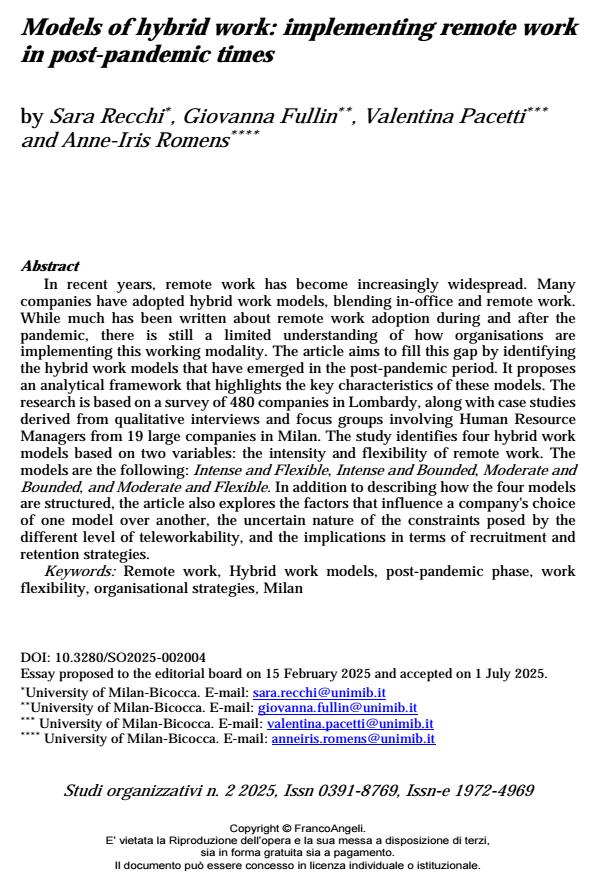
In recent years, remote work has become increasingly widespread. Many companies have adopted hybrid work models, blending in-office and remote work. While much has been written about remote work adoption during and after the pandemic, there is still a limited understanding of how organisations are implementing this working modality. The article aims to fill this gap by identifying the hybrid work models that have emerged in the post-pandemic period. It proposes an analytical framework that highlights the key characteristics of these models. The research is based on a survey of 480 companies in Lombardy, along with case studies derived from qualitative interviews and focus groups involving Human Resource Managers from 19 large companies in Milan. The study identifies four hybrid work models based on two variables: the intensity and flexibility of remote work. The models are the following: Intense and Flexible, Intense and Bounded, Moderate and Bounded, and Moderate and Flexible. In addition to describing how the four models are structured, the article also explores the factors that influence a company's choice of one model over another, the uncertain nature of the constraints posed by the different level of teleworkability, and the implications in terms of recruitment and retention strategies.
Il lavoro da remoto ha conosciuto una diffusione sempre maggiore negli ultimi anni, spingendo numerose aziende ad adottare e consolidare modelli di lavoro ibridi che combinano attività in presenza con periodi di lavoro svolto al di fuori della sede aziendale. Nonostante l'ampia letteratura che ha esplorato l’adozione del lavoro remoto durante e dopo la pandemia, permane una comprensione limitata su come le organizzazioni stiano effettivamente implementando queste modalità di lavoro. Questo articolo si propone di colmare tale lacuna, analizzando i modelli di lavoro ibrido che si sono affermati nel contesto post-pandemico e proponendo un quadro analitico che ne evidenzi le caratteristiche principali. La ricerca si basa su una survey che ha coinvolto 480 aziende in Lombardia e su studi di caso costruiti a partire da interviste qualitative e focus group con responsabili di risorse umane di 19 grandi aziende milanesi. L'articolo identifica quattro modelli di lavoro ibrido, costruiti sulla base di due variabili: l’intensità e la flessibilità del lavoro da remoto. I modelli identificati sono quattro: intenso flessibile, intenso regolato, limitato regolato e limitato flessibile. Oltre a descrivere come tali modelli si articolano, il presente contributo esamina i fattori che spingono le aziende a scegliere un modello piuttosto che un altro, la natura incerta dei vincoli posti dai diversi livelli di remotizzabilità e le implicazioni in termini di reclutamento e retention.
Parole chiave:Lavoro da remoto, modelli di lavoro ibrido, post pandemia, flessibilità, strategie organizzative, Milano
- Anakpo, G., Nqwayibana, Z., Mishi, S. (2023). “The impact of work-from-home on employee performance and productivity: a systematic review”, Sustainability, 15(5): 4529.
- Azzolari, D., Fullin, G., Modica, E., Pacetti, V., Tosi, S. (2022). A casa tutto bene? Le condizioni fisiche e psicologiche dei lavoratori ‘in smart’. In: Peruzzi, M., Sacchetto, D. (eds) Il lavoro da remoto al tempo della pandemia, Torino: Giappichelli. pp. 97-129.
- Bertolini, S., Tosi, S. (2022). “Distanziamenti e capitale sociale in smart working”, Meridiana: rivista di storia e scienze sociali, 104 (2): 101-123.
- Boell, S. K., Cecez-Kecmanovic, D., Campbell, J. (2016). “Telework paradoxes and practices: The importance of the nature of work”, New Technology, Work and Employment, 31(2): 114-131.
- Brussevich, M., Dabla-Norris, M. E., Khalid, S. (2020). Who will bear the brunt of lockdown policies? Evidence from tele-workability measures across countries, International Monetary Fund.
- Centro Studi Assolombarda (2024). Lo smart working in numeri, Rapporto n.4.
- Centro Studi Confcommercio di Milano, Lodi e Monza Brianza, (2024). Lo smart working è ancora necessario?
- Chung, H., Birkett, H., Forbes, S. Seo, H. (2021). “Covid-19, flexible working, and implications for gender equality in the United Kingdom”, Gender and Society, 35 (2): 218-232. DOI: 10.1177/08912432211001304.
- Chung, H. (2022). The flexibility paradox: Why flexible working leads to (self-) exploitation. Bristol: Policy Press.
- Demetriades, S., Cabrita, J., Eiffe, F. (2023). The future of telework and hybrid work, Ireland: Eurofound.
- Dingel J., Neiman B. (2020). “How many jobs can be done at home?”, Journal of Public Economics, 1–8.
- Eurofound (2022). The rise in telework: Impact on working conditions and regulations, Publications Office of the European Union, Luxembourg.
- Eurofound (2023a). The future of telework and hybrid work, Publications Office of the European Union, Luxembourg.
- Eurofound (2023b). Hybrid work in Europe: Concept and practice, Publications Office of the European Union, Luxembourg.
- European Commission, Joint Research Centre (2020). Telework in the EU before and after the COVID-19: Where we were, where we head to (JRC120945), Publications Office of the European Union, Luxembourg.
- Eurostat (2024a). Employed persons working from home as a percentage of the total employment, by sex, age and professional status (%). Available at: https://ec.europa.eu/eurostat/databrowser/view/lfsa_ehomp__custom_12158505/default/table?lang=en
- Eurostat (2024b). Meetings via the internet by size class of enterprise. Available at: https://ec.europa.eu/eurostat/databrowser/view/isoc_ci_mvis/default/table?lang=en
- Felstead, A., Jewson, N., Walters, S. (2003). “Managerial control of employees working at home”, British journal of industrial relations, 41(2): 241-264. DOI: 10.1111/1467-8543.00271.
- Felstead, A. (2022). Remote working: A research overview. London: Routledge.
- Fullin, G., Pacetti, V., Recchi, S. (2024). “Progettare il lavoro ibrido: lo spazio come strumento organizzativo nella fase postemergenziale”, Cambio: rivista sulle trasformazioni sociali, 27 (1):15-32.
- George, T. J., Atwater, L. E., Maneethai, D., Madera, J. M. (2022). “Supporting the productivity and wellbeing of remote workers: Lessons from COVID-19”, Organizational Dynamics, 51(2): 100869.
- Goglio, V., Pacetti, V. (2022). “Tecnologia e controllo nel lavoro da remoto”, Meridiana: rivista di storia e scienze sociali, 104 (2): 47-73.
- Gutiérrez-Crocco, F., Martin-Caballero, A., Godoy, A. (2024). “The impact of remote work on managerial compliance: changes in the control regime over line managers”, Work, Employment and Society, 38(2): 527-548. DOI: 10.1177/09500170221142713.
- Hicks, M. S. (2020). The number of people who can telework is higher than was estimated, Monthly Labor Review, U.S. Bureau of Labor Statistics.
- Inapp (2022). Il lavoro da remoto: le modalità attuative, gli strumenti e il punto di vista dei lavoratori, Inapp Policy Brief.
- ISTAT (2019). Dati statistici per il territorio. Regione Lombardia. Available at: www.istat.it
- ISTAT (2024), Rapporto Bes 2023: Il benessere equo e sostenibile in Italia. Roma: ISTAT.
- Jämsen, R., Sivunen, A., Blomqvist, K. (2022). “Employees’ perceptions of relational communication in full-time remote work in the public sector”, Computers in Human Behavior, 132: 107240.
- Lilischkis, S. (2003). More yo-yos, pendulums and nomads: Trends of mobile and multi-location work in the information society, STAR Issue Report No. 36, Empirica.
- Mazmanian, M., Orlikowski, W.J., Yates, J. (2013). “The autonomy paradox: the implications of mobile email devices for knowledge professionals”, Organization Science, 24 (5): 1337-1357.
- Messenger, J. C., Gschwind, L. (2016). “Three generations of Telework: New ICT s and the (R)evolution from Home Office to Virtual Office”, New Technology, Work and Employment, 31(3): 195-208.
- Messenger, J., Vargas, O. L., Gschwind, L., Boehmer, S., Vermeylen, G., Wilkens, M. (2017). Working anytime, anywhere: The effects on the world of work” (pp. 72-72). Publications Office of the European Union, Luxembourg.
- Norlander, P.; Erickson, C. (2022). The Role of Institutions in Job Teleworkability before and after the COVID-19 Pandemic, Discussion Paper, No. 1172, Global Labor Organization (GLO), Essen.
- Olson, M. H. (1983). “Remote office work: Changing work patterns in space and time”, Communications of the ACM, 26(3): 182-187. DOI: 10.1145/358061.358068.
- Pacetti, V., Rossi, P., Romens, A. I. (2023). “Remotizzare, o non remotizzare: questo è il dilemma. Imprese e sindacati di fronte alla remotizzazione ibrida del lavoro”, Stato e mercato, 43(3): 421-449. DOI: 10.1425/112849.
- Peters, P., Van der Lippe, A. G. (2005). Who can telework? The influence of job category and individual job traits on employees' access to weekly home-based telework. Randbound University.
- Recchi, S., Romens, A. I., Scalise, G. (2025). “Post-pandemic remote work and the Italian care model: constraint or opportunity?”, International Journal of Sociology and Social Policy, 45(13/14):19-33. DOI: 10.1108/IJSSP-10-2024-0497.
- Sostero, M., Milasi, S., Hurley, J., Fernandez-Macías, E., Bisello, M. (2020). Teleworkability and the COVID-19 crisis: a new digital divide?, JRC Working Papers Series on Labour, Education and Technology, No. 2020/05, European Commission, Joint Research Centre (JRC), Seville.
- Urien, B. (2023). “Teleworkability, preferences for telework, and well-being: a systematic review”, Sustainability, 15(13): 10631.
- Van Zoonen, W., Sivunen, A. E. (2022). “The impact of remote work and mediated communication frequency on isolation and psychological distress”, European Journal of Work and Organizational Psychology, 31(4): 610-621. DOI: 10.1080/1359432X.2021.2002299.
- Wontorczyk, A., Roznowski, B. (2022). “Remote, hybrid, and on-site work during the SARS-CoV-2 pandemic and the consequences for stress and work engagement”, International journal of environmental research and public health, 19(4): 2400.
- Yang, L., Holtz, D., Jaffe, S., Suri, S., Sinha, S., Weston, J., Teevan, J. (2022). “The effects of remote work on collaboration among information workers”; Nature human behaviour, 6(1): 43-54.
- Algorithmic Nudging and Employee Well-being: A Mixed-Methods Study on the Double-Edged Sword of AI-Driven Management in the Hybrid Work Era H Abd Rahman, Sulfiani Sulfiani, A Syafir Rahman, Kamaruddin, Andi, in International Journal of Economics (IJEC) /2026 pp.129
DOI: 10.55299/ijec.v5i1.1797
Sara Recchi, Giovanna Fullin, Valentina Pacetti, Anne-Iris Romens, Models of hybrid work: implementing remote work in post-pandemic times in "STUDI ORGANIZZATIVI " 2/2025, pp 90-119, DOI: 10.3280/SO2025-002004