Lavoro, prestazione e processi di esternalizzazione: l’evoluzione del fenomeno nel settore bancario
Titolo Rivista QUADERNI DI ECONOMIA DEL LAVORO
Autori/Curatori Azio Barani
Anno di pubblicazione 2026 Fascicolo 2022/116
Lingua Italiano Numero pagine 14 P. 255-268 Dimensione file 54 KB
DOI 10.3280/QUA2022-116011
Il DOI è il codice a barre della proprietà intellettuale: per saperne di più
clicca qui
Qui sotto puoi vedere in anteprima la prima pagina di questo articolo.
Se questo articolo ti interessa, lo puoi acquistare (e scaricare in formato pdf) seguendo le facili indicazioni per acquistare il download credit. Acquista Download Credits per scaricare questo Articolo in formato PDF
FrancoAngeli è membro della Publishers International Linking Association, Inc (PILA), associazione indipendente e non profit per facilitare (attraverso i servizi tecnologici implementati da CrossRef.org) l’accesso degli studiosi ai contenuti digitali nelle pubblicazioni professionali e scientifiche.
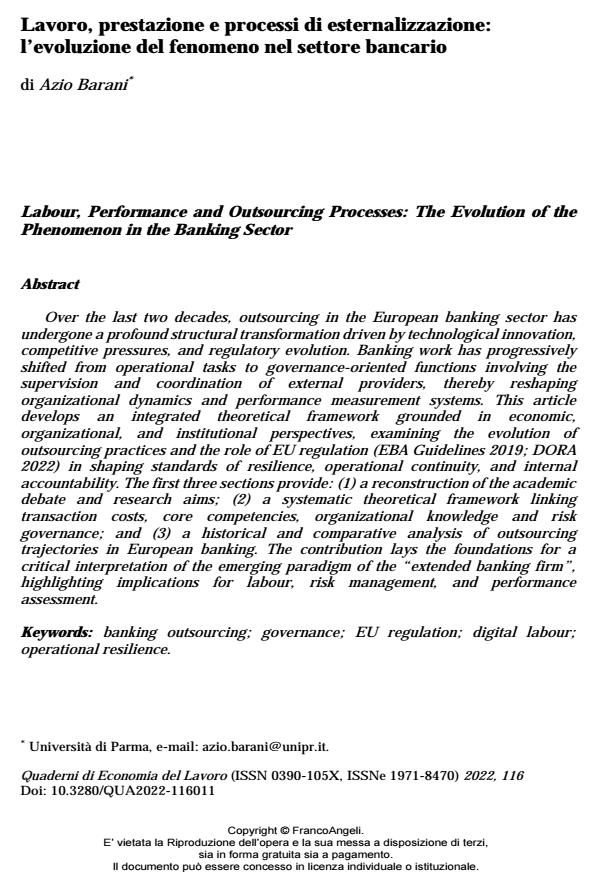
L’esternalizzazione nel settore bancario europeo ha conosciuto negli ultimi due decenni una trasformazione profonda, sospinta da innovazione tecnologica, pressioni competitive e mutamenti regolamentari. Il lavoro bancario si è progressivamente spostato da attività operative a funzioni di governo, controllo e supervisione di fornitori esterni, ridisegnando le dinamiche organizzative e le metriche di performance. Il presente articolo sviluppa un quadro teorico integrato che combina approcci economici, organizzativi e istituzionali, esaminando l’evoluzione dei processi di outsourcing e il ruolo crescente svolto dalla regolazione europea (EBA Guidelines 2019; DORA 2022) nella definizione di standard di resilienza, continuità operativa e responsabilità interna. I primi tre paragrafi propongono: (1) una ricostruzione del dibattito e delle finalità della ricerca; (2) un inquadramento teorico sistematico che collega costi di transazione, competenze distintive, conoscenza organizzativa e governance dei rischi; (3) un’analisi storica e comparata dell’evoluzione dell’outsourcing bancario nell’ultimo ventennio. Il contributo pone le basi per una lettura critica del nuovo paradigma dell’“impresa bancaria estesa”, evidenziando implicazioni per il lavoro, per la gestione del rischio e per la misurazione della performance.
Parole chiave:outsourcing bancario; governance; regolazione europea; lavoro digitale; resilienza operativa.
- Amiti M. e Wei S.-J. (2004). Fear of service outsourcing: Is it justified? IMF Working Paper WP/04/186. International Monetary Fund. -- Testo disponibile al sito: https://www.imf.org/external/pubs/ft/wp/2004/wp04186.pdf.
- Arner D.W., Barberis J. e Buckley R.P. (2017). FinTech, RegTech and the reconceptualization of financial regulation. Northwestern Journal of International Law & Business, 37(3): 371-413. -- Testo disponibile al sito: https://papers.ssrn.com/sol3/papers.cfm?abstract_id=2847806&utm.
- Aubert B.A., Patry M. e Rivard S. (2005). A framework for information technology outsourcing risk management. SIGMIS Database, 36(4), (Fall): 9-28. DOI: 10.1145/1104004.1104007
- Autor D.H. (2015). Why are there still so many jobs? The history and future of workplace automation. Journal of Economic Perspectives, 29(3): 3-30.
- Basel Committee on Banking Supervision. (2021). Principles for operational resilience. Bank for International Settlements. -- Testo disponibile al sito: https://www.bis.org/bcbs/publ/d516.pdf.
- Batt R. e Nohara H. (2009). How institutions and business strategies affect wages: A cross-national study of call centers. ILR Review, 62(4): 533-552. DOI: 10.1177/001979390906200404
- Callon M. (1986). Some elements of a sociology of translation: Domestication of the scallops and the fishermen of St Brieuc Bay. In: Law J., a cura di, Power, action and belief: A new sociology of knowledge?. Londra: Routledge.
- Carletti E., Claessens S., Fatás A. e Vives X., a cura di (2020). The bank business model in the post-Covid-19 world. CEPR Press. -- https://cepr.org/system/files/publication-files/60039-barcelona_2_the_bank_business_model_in_the_post_covid_19_world.pdf.
- Deloitte (2018). Global outsourcing survey 2018. -- Testo disponibile al sito: https://www2.deloitte.com/global/en/pages/consulting/articles/global-outsourcing-survey.html.
- Drahokoupil J., a cura di (2015). The outsourcing challenge: Organizing workers across fragmented production networks. European Trade Union Institute.
- Doellgast V. e Greer I. (2007). Vertical Disintegration and the Disorganization of German Industrial Relations. British Journal of Industrial Relations, 45: 55-76.
- Dosi G., Marengo L. e Fagiolo G. (2021). Organization and management in a complex environment: Lessons from the banking sector. Journal of Economic Behavior & Organization, 189: 767-785. -- Testo disponibile al sito: https://doi.org/10.1016/j.jebo.2021. 05.010.
- European Banking Authority (2019). Guidelines on outsourcing arrangements (EBA/GL/2019/02). -- https://www.eba.europa.eu/sites/default/files/documents/10180/ 2551996/EBA%20revised%20Guidelines%20on%20outsourcing%20arrangements.pdf.
- European Commission (2022). Regulation (EU) 2022/2554 of the European Parliament and of the Council of 14 December 2022 on digital operational resilience for the financial sector (DORA). Official Journal of the European Union. -- https://eur-lex.europa.eu/eli/reg/2022/2554.
- Financial Stability Board (2020). Regulatory and supervisory issues relating to outsourcing and third-party relationships. -- https://www.fsb.org/2020/11/regulatory-and-supervisory-issues-relating-to-outsourcing-and-third-party-relationships/.
- Grossman G.M. e Helpman E. (2005). Outsourcing in a global economy. Review of Economic Studies, 72(1): 135-159. -- Testo disponibile al sito: https://doi.org/10.1111/j.1467-937X.2004.00323.x.
- Huws U., Spencer N. e Syrdal D. (2018). Work in the European gig economy. Foundation for European Progressive Studies & University of Hertfordshire. -- https://www.feps-europe.eu/resources/publications/555-work-in-the-european-gig-economy.html.
- Lacity M. e Willcocks L. (2016). Robotic process automation: The next transformation lever for shared services. London School of Economics/ Outsourcing Unit. -- https://papers.ssrn.com/sol3/papers.cfm?abstract_id=2865784.
- Monferrà S. (2007). Il rapporto banca-impresa in Italia. Roma: Bancaria Editrice.
- Organisation for Economic Co-operation and Development. (2018). New forms of work in the digital economy. OECD Publishing. -- https://www.oecd.org/employment/new-forms-of-work.htm.
- Oshri I., Kotlarsky J. e Willcocks L. (2015). The handbook of global outsourcing and offshoring 3rd edition. Palgrave Macmillan.
- Pisano G.P. e Shih W.C. (2009). Restoring American competitiveness. Harvard Business Review, 87(7-8): 114-125. -- https://hbr.org/2009/07/restoring-american-competitiveness.
- Power M. (2007). Organized uncertainty: Designing a world of risk management. Oxford University Press.
- Prahalad C.K. e Hamel G. (1990). The core competence of the corporation. Harvard Business Review, 68(3): 79-91. -- https://hbr.org/1990/05/the-core-competence-of-the-corporation?utm.
- Quinn J.B. (1999) Strategic outsourcing: leveraging knowledge capabilities. MIT Sloan Management Review, 40(4): 9-21.
- Quinn J.B. (2000). Outsourcing innovation: the new engine of growth. MIT Sloan Management Review, 41(4): 13.
- Teece D.J. (2014). The foundations of enterprise performance: Dynamic and ordinary capabilities in an (economic) theory of firms. Academy of Management Perspectives, 28(4): 328-352.
- Weil D. (2014). The Fissured Workplace: Why Work Became so Bad for so many and what can be done to improve it. Cambridge, MA: Harvard University Press.
- Williamson O.E. (1985). The economic institutions of capitalism. Washington: Free Press.
- Willcocks L., Lacity M. e Craig A. (2016). Service automation: Robots and the future of work. Steve Brookes Publishing.
Azio Barani, Lavoro, prestazione e processi di esternalizzazione: l’evoluzione del fenomeno nel settore bancario in "QUADERNI DI ECONOMIA DEL LAVORO" 116/2022, pp 255-268, DOI: 10.3280/QUA2022-116011