Internal auditors’ recognition of conflict of interest situations: A vignette-based analysis
Titolo Rivista MANAGEMENT CONTROL
Autori/Curatori Cristina Cersosimo, Rocco Frondizi, Franco Ernesto Rubino
Anno di pubblicazione 2026 Fascicolo 2026/2
Lingua Inglese Numero pagine 19 P. 169-187 Dimensione file 122 KB
DOI 10.3280/MACO2026-002008
Il DOI è il codice a barre della proprietà intellettuale: per saperne di più
clicca qui
Qui sotto puoi vedere in anteprima la prima pagina di questo articolo.
Se questo articolo ti interessa, lo puoi acquistare (e scaricare in formato pdf) seguendo le facili indicazioni per acquistare il download credit. Acquista Download Credits per scaricare questo Articolo in formato PDF
FrancoAngeli è membro della Publishers International Linking Association, Inc (PILA), associazione indipendente e non profit per facilitare (attraverso i servizi tecnologici implementati da CrossRef.org) l’accesso degli studiosi ai contenuti digitali nelle pubblicazioni professionali e scientifiche.
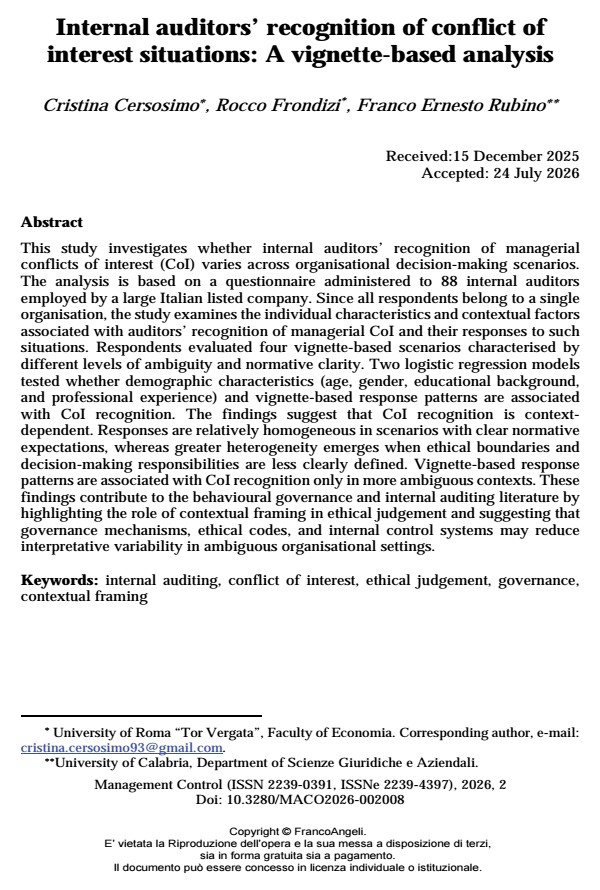
This study investigates whether internal auditors’ recognition of managerial conflicts of interest (CoI) varies across organisational decision-making scenarios. The analysis is based on a questionnaire administered to 88 internal auditors employed by a large Italian listed company. Since all respondents belong to a single organisation, the study examines the individual characteristics and contextual factors associated with auditors’ recognition of managerial CoI and their responses to such situations. Respondents evaluated four vignette-based scenarios characterised by different levels of ambiguity and normative clarity. Two logistic regression models tested whether demographic characteristics (age, gender, educational background, and professional experience) and vignette-based response patterns are associated with CoI recognition. The findings suggest that CoI recognition is context-dependent. Responses are relatively homogeneous in scenarios with clear normative expectations, whereas greater heterogeneity emerges when ethical boundaries and decision-making responsibilities are less clearly defined. Vignette-based response patterns are associated with CoI recognition only in more ambiguous contexts. These findings contribute to the behavioural governance and internal auditing literature by highlighting the role of contextual framing in ethical judgement and suggesting that governance mechanisms, ethical codes, and internal control systems may reduce interpretative variability in ambiguous organisational settings.
Parole chiave:internal auditing, conflict of interest, ethical judgement, governance, contextual framing
- Adams M. B. (1994), Agency Theory and the Internal Audit. Managerial Auditing Journal, 8(9), 8-12.
- Aguinis H., Bradley K. J. (2014), Best practice recommendations for designing and implementing experimental vignette methodology studies, Organizational Research Methods, 17(4), pp. 351-371.
- Alexander C. S., Becker H. J. (1978), The use of vignettes in survey research, Public Opinion Quarterly, 42(1), pp. 93-104.
- Allegrini M., D’Onza G. (2011), Corporate governance, risk management e responsabilità sociale fra presente e futuro dell’attività di internal auditing, Management Control, 1, pp. 151-178.
- Arena M. and Azzone G. (2009), Identifying Organizational Drivers of Internal Audit Effectiveness, International Journal of Auditing, 13, pp. 43-60.
- Argenti J. (1997), Stakeholders: the case against. Long Range Planning, 30(3), pp. 442-445.
- Caldarelli A., Marchi L. (2018), Il sistema di controllo interno nelle imprese non grandi, Management Control.
- Carmeli A., Tishler A. (2004), The relationships between intangible organizational elements and organizational performance. Strategic Management Journal, 25(13), pp. 1257-1278.
- Deitch C., Hegewisch A. (2013), Title VII Sex and Race Discrimination Litigation Settlements as Opportunities for Organizational Change. Journal of Business and Psychology, 28(4), pp. 425-438.
- Demmke C., Autioniemi J., Lenner F. (2021), The end of the world as we know it - public ethics in times of de-standardization and individualization. Public Management Review.
- D’Onza G. (2013), L’internal auditing: Profili organizzativi, dinamica di funzionamento e creazione del valore, Torino, G. Giappichelli Editore.
- D’Onza G., Rigolini A., & Brotini F. (2016), Esiste una strategia di Internal Auditing che crea valore? Un’analisi empirica del contesto italiano, Management Control, 1, pp. 125-148. DOI: 10.3280/MACO2016-001008
- Everett J., Tremblay M. (2014), Ethics and internal audit: Moral will and moral skill in a heteronomous field, Critical Perspectives on Accounting, 25(3), pp. 181-196,
- Grafton J., Lillis A. M., Mahama H. (2011), Mixed methods research in accounting, Qualitative Research in Accounting and Management, 8(1), pp. 5-21, DOI: 10.1108/11766091111124676
- Gramling A. A., Maletta M. J., Schneider A., Church B. K. (2004), The role of the internal audit function in corporate governance: A synthesis of the extant internal auditing literature and directions for future research, Journal of Accounting Literature, 23, pp. 194-244.
- Hambrick D. C. (2007), Upper echelons theory: An update, Academy of Management Review, 32(2), pp. 334-343.
- Hambrick D. C., Mason P. A. (1984), Upper echelons: The organization as a reflection of its top managers, Academy of Management Review, 9(2), pp. 193-206.
- Jensen M. C., Meckling W. H. (1976), Theory of the firm: managerial behavior, agency costs and ownership structure, Journal of Financial Economics, 4(3), pp. 305-360,
- Jones T. M. (1991), Ethical decision making by individuals in organizations: An issue-contingent model, Academy of Management Review, 16(2), pp. 366-395.
- Larkin J. M. (2000), The Ability of Internal Auditors to Identify Ethical Dilemmas, Journal of Business Ethics, 23(4), pp. 401-409, DOI: 10.1023/A:1006150718834
- Marginson D. (2004), The case study, the interview and the issues: A personal reflection, in Humphrey C., Lee B. (eds), The Real Life Guide to Accounting Research, Elsevier.
- Michiels A., Lybaert N., Steijvers T. (2015), Dividends and family governance practices in private family firms. Small Business Economics, 4(2), pp. 299-314.
- Mihre D. G., & Grant B. (2017), The role of internal auditing in corporate governance: A Foucauldian analysis, Accounting, Auditing & Accountability Journal, 30(3), pp. 699-719. DOI: 10.1108/AAAJ-10-2012-1134
- Moore D. A., Tetlock P. E., Tanlu L., Bazerman M. H. (2006), Conflicts of interest and the case of auditor independence: Moral seduction and strategic issue cycling, Academy of Management Review, 31(1), pp. 10-29.
- Nekhili M., Boukadhaba A., Nagati H., Chtioui T. (2021), ESG performance and market value: the moderating role of employee board representation. International Journal of Human Resource Management, 32(1), pp. 3061-3087.
- Otero L., Alaraj R., Lado-Sestayo R. (2020), How corporate governance and ownership affect banks’ risk-taking in the MENA countries?, European Journal of Management and Business Economics, 29(2), pp. 182-198.
- Paape L., Scheffe J., & Snoep P. (2003), The relationship between the internal audit function and corporate governance in the EU – A survey, International Journal of Auditing, 7(3), pp. 247-262.
- Peng C. Y. J., Lee K. L., Ingersoll G. M. (2002), An introduction to logistic regression analysis and reporting, The journal of Educational Research, 96(1), pp. 3-14, DOI: 10.2307/27542407
- Pfeiffer I., Jarchow S. (2024), The determinants of compensation report transparency: Manager incentives and firm characteristics, Journal of Business Economics, 94(4), pp. 659-691.
- Rakipi R., D’Onza G. (2024), The involvement of internal audit in environmental, social, and governance practices and risks: Stakeholders’ salience and insights from audit committees and chief executive officers, International Journal of Auditing, 28(3), pp. 522-535.
- Rest J. R. (1986), Moral Development: Advances in Research and Theory, Praeger, New York.
- Ritchie J., Lewis J. (2003), Qualitative Research Practice, Sage Publications, London, Thousand Oaks and New Delhi.
- Rodgers W. (2009), Auditor independence and corporate governance: ethical dilemmas. European Journal of International Management, 3(1), pp. 60-74.
- Sarens G., Abdolmohammadi M. J., & Lenz R. (2012), Factors associated with the internal audit function’s role in corporate governance, Journal of Applied Accounting Research, 13(2), pp. 191-204. DOI: 10.1108/09675421211254876
- Spercel T. (2024), The Business Judgment Rule in Stakeholder Capitalism, Northwestern Journal of International Law and Business, 44(3).
- Tran A. H., Le H., Trinh H. T., Palka P., Knapkova A., Hanh L. M., Trang H. C. (2016), Financial Reporting quality and investment in sustainable development – Evidence from Vietnam, Proceeding of the 3rd International Conference of Finance and Economics, pp. 9-29.
- Treviño L. K. (1986), Ethical decision making in organizations: A person-situation interactionist model, Academy of Management Review, 11(3), pp. 601-617.
- Turlea E., Stefanescu A. (2009), Internal audit and risk management in public sector entities between tradition and actuality. Journal of Financial Audit, 11(1), pp. 210-217.
- Tversky A., Kahneman D. (1981), The framing of decisions and the psychology of choice, Science, 211(4481), pp. 453-458.
- Vadasi C., Bekiaris M., & Andrikopoulos A. (2020), Corporate governance and internal audit: An institutional theory perspective, Corporate Governance, 20(1), pp. 175-190. DOI: 10.1108/CG-07-2019-0215
- Wang M. T. M., Grey A. (2017), Bolland, M. J. Conflicts of interest and expertise of independent commenters in news stories about medical research, Canadian Medical Association Journal, 189(15), E553-E559.
- Woodbine G. F. (2004), Moral Choice and the Declining Influence of Traditional Value Orientations Within the Financial Sector of a Rapidly Developing Region of the People?, Republic of China, Journal of Business Ethics, 55(1), pp. 43-60,
- Yin R. K. (2014), Case Study Research: Design and Methods, Sage Publications, Thousand Oaks, CA.
- Zakriya M., & Chams N. (2025), From “Who Cares” to “What They Care About”: The Impact of Corporate Governance on Environmental and Social Performance in China, Corporate Governance: An International Review, 33(5), pp. 1277-1298.
Cristina Cersosimo, Rocco Frondizi, Franco Ernesto Rubino, Internal auditors’ recognition of conflict of interest situations: A vignette-based analysis in "MANAGEMENT CONTROL" 2/2026, pp 169-187, DOI: 10.3280/MACO2026-002008