Protection of competition and labour market. Interventions by competition authorities and recent developments in case law.
Journal title GIORNALE DI DIRITTO DEL LAVORO E DI RELAZIONI INDUSTRIALI
Author/s Serena Stella
Publishing Year 2025 Issue 2025/187
Language Italian Pages 22 P. 465-486 File size 174 KB
DOI 10.3280/GDL2025-187006
DOI is like a bar code for intellectual property: to have more infomation
click here
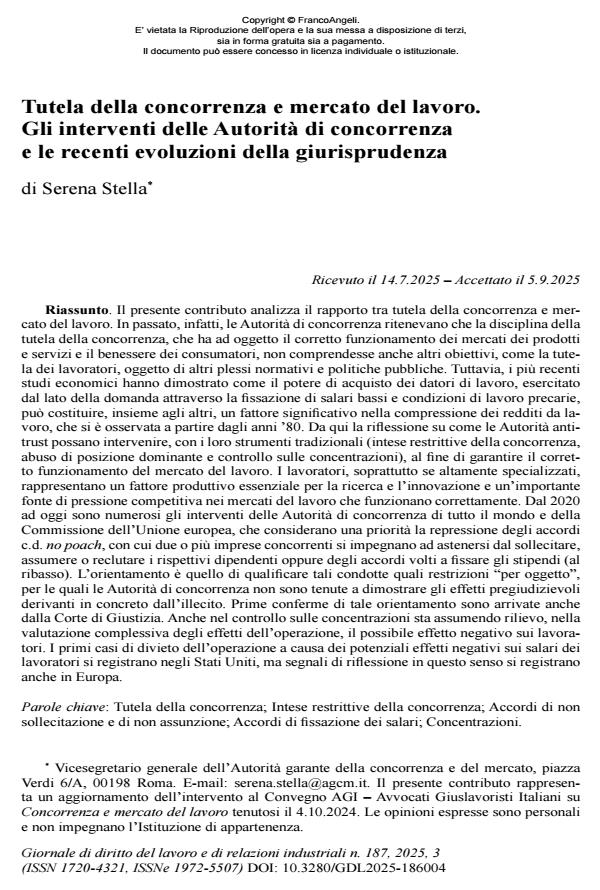
Below, you can see the article first page
If you want to buy this article in PDF format, you can do it, following the instructions to buy download credits
FrancoAngeli is member of Publishers International Linking Association, Inc (PILA), a not-for-profit association which run the CrossRef service enabling links to and from online scholarly content.
This contribution examines the intersection between competition law enforcement and the regulation of labor markets. Traditionally, competition authorities have considered that the objectives of competition law – ensuring the proper functioning of product and service markets and safeguarding consumer welfare – did not encompass broader policy concerns such as the protection of workers, which were entrusted to other regulatory regimes and public policies. Recent economic research, however, has highlighted how employers’ buyer power, exercised on the demand side through the imposition of low wages and precarious working conditions, has been a significant factor in the long-term stagnation and compression of labor income since the 1980s. This development has prompted renewed reflection on the role of antitrust authorities and the extent to which their traditional instruments (prohibition of restrictive agreements, abuse of dominance, and merger control) may contribute to the proper functioning of labor markets. Workers – particularly those with high levels of specialization – are now increasingly recognized as a crucial input for innovation and a source of competitive pressure in well-functioning labor markets. Since 2020, a growing number of enforcement actions by competition authorities worldwide, as well as by the European Commission, have prioritized the prohibition of socalled no-poach agreements, under which competing firms commit not to solicit, hire, or recruit one another’s employees, and of wage-fixing agreements. The prevailing approach is to treat such conduct as restrictions “by object,” thereby dispensing competition authorities from the need to demonstrate actual anticompetitive effects. Early confirmations of this approach have also been provided by the Court of Justice. Furthermore, in the field of merger control, the potential adverse effects on workers are beginning to be taken into account in the overall assessment of concentrations. The first prohibitions of merger transactions on the basis of potential negative effects on employees’ wages have emerged in the United States, and early signs of a similar orientation are observable in the European debate.
Keywords: Competition law; Restrictive agreements; No-poach and non-solicitation agreements; Wage-fixing agreements; Mergers.
- Araki S., Bassanini A., Green A., Marcolin L., Volpin C. (2023). Labor Market Concentration and Competition Policy Across the Atlantic. UCLR, 90: 339 ss.
- Baglev A. (2022). Poland issues first nopoach infringement decision. 24.10.2022. Testo disponibile al sito: globalcompetitionreview.com/article/polandissuesfirstnopoachinfringementdecision (consultato il 13.7.2025).
- Bansa D., Meja B., Brintone J., Hirch L. (2025). The “nopoach” approach: latest trends in antitrust enforcement of labour markets. 11.8.2025. Testo disponibile al sito: globalcompetitionreview.com/review/theantitrustreviewoftheamericas/2026/article/thenopoachapproachlatesttrendsinantitrustenforcementoflabourmarkets (consultato il 13.7.2025).
- Caforio V., Maggiolino M. (2023). Quando la concorrenza e la sua tutela fanno bene ai lavoratori. MCR: 49 ss.
- Card D. (2022). Who Set Your Wage? AER, 112(4): 1075 ss.
- Luisetto L.G., Nogler L. (2024). Monopsonio e lavoro: introduzione al tema. E&L: 61 ss. Manning A. (2021). Monopsony in Labor Markets: A Review. ILR, 74(1): 3 ss.
- Polden D.J. (2024). NoPoach Agreements: An Overview of US, EU, and National Case Law. Testo disponibile al sito: digitalcommons.law.scu.edu/facpubs/1022/ (consultato il 13.7.2025).
Serena Stella, Tutela della concorrenza e mercato del lavoro. Gli interventi delle Autorità di concorrenza e le recenti evoluzioni della giurisprudenza in "GIORNALE DI DIRITTO DEL LAVORO E DI RELAZIONI INDUSTRIALI " 187/2025, pp 465-486, DOI: 10.3280/GDL2025-187006