Resource-Spaces and Circularity along the Eastern Coastal Area of Naples
Journal title CRIOS
Author/s Maria Simioli
Publishing Year 2025 Issue 2023/26
Language Italian Pages 16 P. 62-77 File size 19261 KB
DOI 10.3280/CRIOS2023-026010
DOI is like a bar code for intellectual property: to have more infomation
click here
Below, you can see the article first page
If you want to buy this article in PDF format, you can do it, following the instructions to buy download credits
FrancoAngeli is member of Publishers International Linking Association, Inc (PILA), a not-for-profit association which run the CrossRef service enabling links to and from online scholarly content.
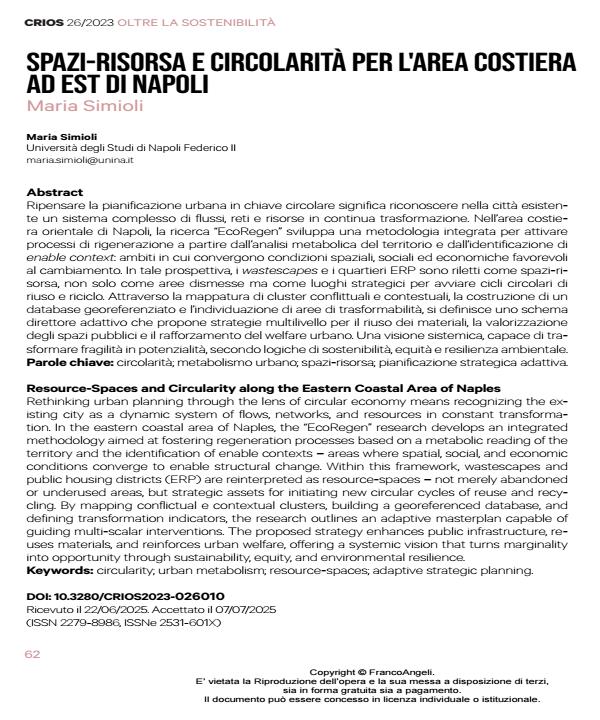
Rethinking urban planning through the lens of circular economy means recognizing the existing city as a dynamic system of flows, networks, and resources in constant transformation. In the eastern coastal area of Naples, the “EcoRegen” research develops an integrated methodology aimed at fostering regeneration processes based on a metabolic reading of the territory and the identification of enable contexts – areas where spatial, social, and economic conditions converge to enable structural change. Within this framework, wastescapes and public housing districts (ERP) are reinterpreted as resourcespaces – not merely abandoned or underused areas, but strategic assets for initiating new circular cycles of reuse and recycling. By mapping conflictual e contextual clusters, building a georeferenced database, and defining transformation indicators, the research outlines an adaptive masterplan capable of guiding multiscalar interventions. The proposed strategy enhances public infrastructure, reuses materials, and reinforces urban welfare, offering a systemic vision that turns marginality into opportunity through sustainability, equity, and environmental resilience.
Keywords: circularity; urban metabolism; resourcespaces; adaptive strategic planning.
- Bahers J., Athanassiadis A., Perrotti D. and Kampelmann S. (2022). ‘The place of space in urban metabolism research: Towards a spatial turn? A review and future agenda’, Landscape and Urban Planning, 221(12).
- Bote Alonso I., SanchezRivero M.V., Montalban Pozas B. (2022). ‘Mapping sustainability and circular economy in cities: Methodological framework from Europe to the Spanish case’, Journal of Cleaner Production, 357.
- Brenner N.J. (2014). Implosions/Explosions: Towards a Study of Planetary Urbanization. Berlin: Jovis.
- Circle Economy, Fabric TNO and Gemeente Amsterdam (2015). Circular Amsterdam: A Vision and Action Agenda for the City and the Metropolitan Area.
- Circle Economy, Glasgow Chamber of Commerce, Zero Waste Scotland and Glasgow City Council (2016). Circular Glasgow: A Vision and Action Plan for the City of Glasgow.
- Cui T., Zhang J. (2018). ‘Bibliometric and review of the research on circular economy through the evolution of Chinese public policy’, Scientometrics, 116.
- Dijst M., Worrell E., Bocker L. (2018). ‘Exploring urban metabolism: Towards an interdisciplinary perspective’, Resources, Conservation & Recycling, 132.
- Ellen MacArthur Foundation (2015). Circularity Indicators. An Approach to Measuring Circularity. Methodology.
- European Commission (2019). The European Green Deal. COM (2019) 640 final.
- European Commission (2020). A new Circular Economy Action Plan. For a cleaner and more competitive Europe. COM (2020) 98 final.
- Fini G. (2017). ‘Il piano all’estero di SecchiViganò. Continuità, temi e dispositivi di progetto’, in Renzoni, C., Tosi, M.C. (eds.) Bernardo Secchi. Libri e piani. Roma: Officina Edizioni, pp. 211–221.
- Formato E. (2021). ‘Nuovi standard: boschi, radure e altre terre comuni’, in Baioni, M. et al. (eds.) Diritti in città. Gli standard urbanistici in Italia dal 1968 a oggi. Roma: Donzelli Editore.
- Galuzzi P. (2010). ‘Il futuro non è più quello di una volta. La dimensione programmatica e operativa del progetto urbanistico’, in Bossi, P., Moroni, S., Poli, M. (eds.) Le città e il tempo. Interpretazione e azione. Milan: Maggioli Editore.
- Kennedy C., Cuddihy J., Engelyan J. (2007). ‘The changing metabolism of cities’, Journal of Industrial Ecology, 11.
- Lucertini G., Musco F. (2020). ‘Circular Urban Metabolism Framework’, One Earth, 2(2).
- Magnier A., Morandi M. (2011). Paesaggi in mutamento. L’approccio paesaggistico alla trasformazione della città europea. Milan: Franco Angeli.
- Mang P., Haggard B. (2016). Regenerative development and design: a framework for evolving sustainability. Hoboken, NJ: Wiley.
- Mazza L. (1997). ‘Il tempo del piano’, Urbanistica, 109.
- Mazzarella C., Amenta L. (2022). ‘The Circular Metabolic Urban Landscape’, in Amenta, L., Russo, M. and van Timmeren, A. (eds.) Regenerative Territories: Dimensions of Circularity for Healthy Metabolisms. GeoJournal Library, 128.
- Newell P., Cousins J. (2014). ‘The boundaries of urban metabolism: Towards a political–industrial ecology’, Progress in Human Geography, 39(6).
- Polistena G. (2016). Diacronia. Appunti per un’ontologia del tempo. Milano: Mimesis Edizioni.
- Potting J., Hekkert M., Worrell E., Hanemaaije A. (2017). Circular Economy: Measuring innovation in the product chain. Bilthoven: Netherlands Environmental Assessment Agency.
- Prendeville S., Cherimb E., Bocken N. (2018). ‘Circular Cities: Mapping Six Cities in Transition’, Environmental Innovation and Societal Transitions, 26, pp. 171–194.
- Russo M. (2015). ‘Multiscalarità. Dimensioni e spazi della contemporaneità’, Archivio di Studi Urbani e Regionali, 113.
- Sánchez Levoso A., Gasol C.M., MartínezBlanco J., Gabarell Durany X., Lehmann M., Farreny Gaya R. (2020). ‘Methodological framework for the implementation of circular economy in urban systems’, Journal of Cleaner Production, 248.
- Sanson P. (2007). Le paysage urbain: représentations, significations, communication. Paris: L’Harmattan.
- Steiner,F.R. (2008). The Living Landscape: An Ecological Approach to Landscape Planning. Washington, DC: Island Press. Tanikawa H., Hashimoto, S. (2010). ‘Urban stock overtime: spatial material stock analysis using 4dGIS’, Building Research and Information, 37(5–6).
- Tsui T., Wuyts W., Van den Berghe K. (2024). ‘Geographic Information Systems for Circular Cities and Regions’, in De Wolf, C., Çetin, S. and Bocken, N. (eds.) A Circular Built Environment in the Digital Age. Switzerland: Springer.
- Tutino A. (1986). L’efficacia del piano. Rome: Edizioni Lavoro. Wolman A. (1965). ‘The metabolism of cities’, Scientific American, 213, pp. 179–190.
Maria Simioli, Spazi-risorsa e circolarità per l'area costiera ad est di Napoli in "CRIOS" 26/2023, pp 62-77, DOI: 10.3280/CRIOS2023-026010