Northeast Passage: many norths of the northern macro-region
Journal title ARCHIVIO DI STUDI URBANI E REGIONALI
Author/s Francesca Governa
Publishing Year 2026 Issue 2025/144
Language Italian Pages 10 P. 135-144 File size 96 KB
DOI 10.3280/ASUR2025-144008
DOI is like a bar code for intellectual property: to have more infomation
click here
Below, you can see the article first page
If you want to buy this article in PDF format, you can do it, following the instructions to buy download credits
FrancoAngeli is member of Publishers International Linking Association, Inc (PILA), a not-for-profit association which run the CrossRef service enabling links to and from online scholarly content.
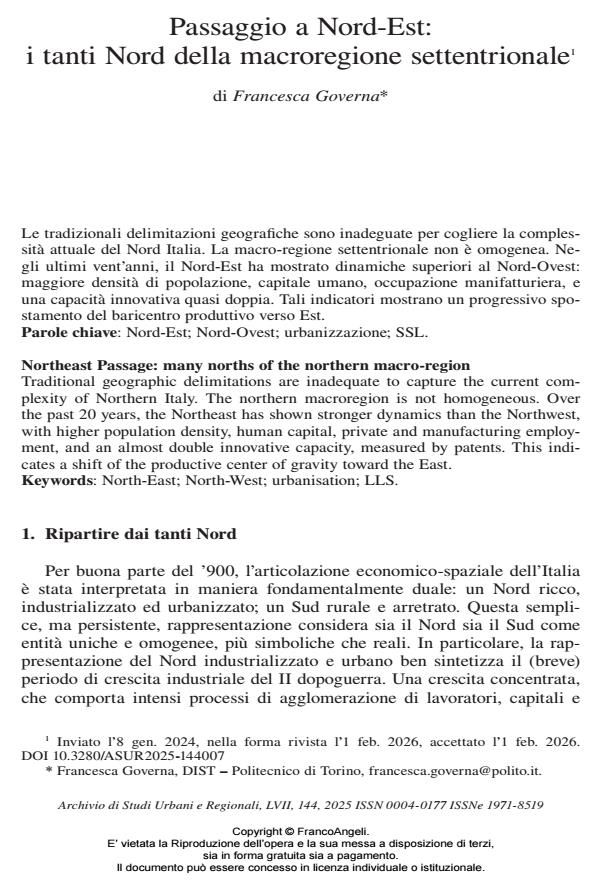
Traditional geographic delimitations are inadequate to capture the current complexity of Northern Italy. The northern macroregion is not homogeneous. Over the past 20 years, the Northeast has shown stronger dynamics than the Northwest, with higher population density, human capital, private and manufacturing employment, and an almost double innovative capacity, measured by patents. This indicates a shift of the productive center of gravity toward the East.
Keywords: NorthEast; NorthWest; urbanisation; LLS.
- Accetturo A., Aimone Gigio L., Beretta E., Camussi S.A., Cannari L., Coin D., Conti L., Cullino R., Fabbrini A., Fabrizi C., Iuzzolino G., Mori A., Olivieri E., Orame A., Mancini A.L., Mattevi E., Piselli P., Revelli D., Rossi P., Scalise D., Staderini A., Tanzi G. e Vacca V.P. (2015). Deindustrializzazione e terziarizzazione: trasformazioni strutturali nelle regioni del nordovest. Occasional Paper, 282. Roma: Banca d’Italia.
- Bagnasco A. (1977). Tre Italie: la problematica territoriale dello sviluppo italiano. Bologna: il Mulino.
- Balducci A., Fedeli V. e Curci F., eds. (2017). PostMetropolitan Territories: Looking for a New Urbanity. London: Routledge.
- Becattini G. (1987). Mercato e forze locali: il distretto industriale. Bologna: il Mulino.
- Becattini G. (1998). Distretti industriali e made in Italy: le basi socioculturali del nostro sviluppo economico. Torino: Bollati Boringhieri.
- Becattini G. (2000). Dal distretto industriale allo sviluppo locale: svolgimento e difesa di una idea. Torino: Bollati Boringhieri.
- Berta G. (2015). La via del Nord: dal miracolo economico alla stagnazione. Bologna: il Mulino.
- Boeri S., Lanzani A. e Marini E. (1993). Il territorio che cambia: ambienti, paesaggi e immagini della regione milanese. Milano: Abitare Segesta.
- Bolocan Goldstein M. (2017). Geografie del Nord. Santarcangelo di Romagna: Maggioli.
- Bonomi A. e Abruzzese A., a cura di (2004). La città infinita. Milano: Bruno Mondadori.
- Brenner N. and Katsikis N. (2020). Operational Landscapes: Hinterlands of the Capitalocene. Architectural Design, 90(1): 2231.
- Brenner N. and Schmid C. (2015). Towards a New Epistemology of the Urban? City, 19(23): 15182.
- Buzzacchi L., De Marco A., Governa F. e Salone C. (2022). Lo spostamento del triangolo: densità e trasformazioni economiche nella differenziazione spaziale del Nord Italia. L’industria, 1: 3779.
- Clementi A., Dematteis G. e Palermo P.C., a cura di (1996). Le forme del territorio italiano. Bari: Laterza.
- Daniele V., Malanima P. and Ostuni N. (2018). Geography, Market Potential and Industrialization in Italy, 19712001. Papers in Regional Science, 97(3): 639662.
- Dematteis G., a cura di (1992). Il fenomeno urbano in Italia: interpretazioni, prospettive, politiche. Milano: FrancoAngeli.
- Felice E. (2019). The Roots of a Dual Equilibrium: Gdp, Productivity, and Structural Change in the Italian Regions in the Long Run, 18712011. European Review of Economic History, 23(4): 499528.
- Fenoaltea S. (2006). L’economia italiana dall’Unità alla Grande Guerra. Bari: Laterza.
- Gabert P. (1964). Turin ville industrielle: étude de géographie economique et humaine. Paris: PUF.
- Governa F. and Salone C. (2022). Lost in Transition: Turns and Twists of Turin’s PostFordist Governance. Iglus Quaterly, 8(4): 614.
- Governa F. e Sampieri A. (2022). Infrastrutture globali e divenire urbano. Pireo, Trieste e il “Corridoio Adriatico”. Territorio, 103: 2330.
- Indovina F. (1990). La città diffusa. In: Indovina F., Matassoni F., Savino M., Sernini M., Torres M., Vettoretto L., La città diffusa, Venezia: IuavDaest, 2143.
- Indovina F. (1999). La città diffusa: cos’è e come si governa. In: Indovina F., a cura di, Territorio. Innovazione. Economia. Pianificazione. Politiche. Vent’anni di ricerca Daest. Venezia: IuavDaest, 4759.
- Kanai J.M. and Schindler S. (2019). Periurban promises of connectivity: Linking projectled polycentrism to the infrastructure scramble. Environment and Planning A: Economy and Space, 51(2): 302322.
- Paasi A. (2002). Place and Region: Regional Worlds and Words. Progress in Human Geography, 26(6): 80211.
- Paasi A., Harrison J. and Jones M., eds. (2018). Handbook of the Geographies of Regions and Territories. London: Edward Elgar.
- Perulli P., a cura di (2012). Nord. Una cittàregione globale. Bologna: il Mulino. Scott A. (2001). Global Cityregions: Trends, Theory, Policy. Oxford: Oxford University Press.
- Soja E.W. (2000). Postmetropolis: Critical Studies of Cities and Regions. New York: Wiley.
- Turri E. (2000). La megalopoli padana. Venezia: Marsilio.
- Viesti G. (2021), Centri e periferie: Europa, Italia, Mezzogiorno dal XX al XXI secolo. Bari: Laterza.
- Zacchia C. e Fuà G. (1983). Industrializzazione senza fratture. Bologna: il Mulino.
- Zovico F. (2020). Le nuove geografie del PIL. Milano: EGEA.
Francesca Governa, Passaggio a Nord-Est: i tanti Nord della macroregione settentrionale in "ARCHIVIO DI STUDI URBANI E REGIONALI" 144/2025, pp 135-144, DOI: 10.3280/ASUR2025-144008