Measuring emotional labor indicators: First adaptation and validation of the Italian version of the Dutch Questionnaire on Emotional Labor (D-QEL)
Journal title PSICOLOGIA DELLA SALUTE
Author/s Simone Catalano
Publishing Year 2026 Issue 2026/2
Language Italian Pages 18 P. 143-160 File size 165 KB
DOI 10.3280/PDS2026-002009
DOI is like a bar code for intellectual property: to have more infomation
click here
Below, you can see the article first page
If you want to buy this article in PDF format, you can do it, following the instructions to buy download credits
FrancoAngeli is member of Publishers International Linking Association, Inc (PILA), a not-for-profit association which run the CrossRef service enabling links to and from online scholarly content.
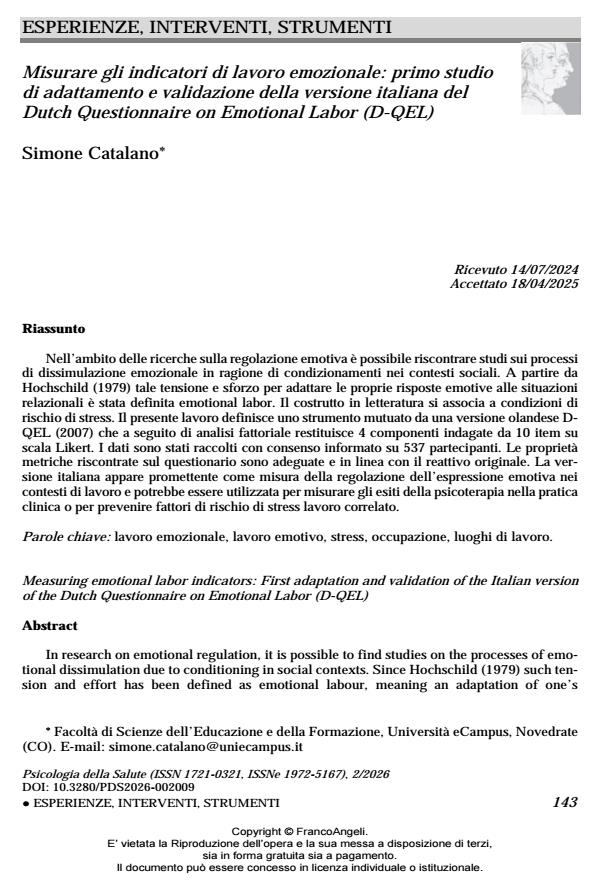
In research on emotional regulation, it is possible to find studies on the processes of emotional dissimulation due to conditioning in social contexts. Since Hochschild (1979) such tension and effort has been defined as emotional labour, meaning an adaptation of one’s emotional responses to relational situations. In the literature the construct is associated with stress risk conditions. The present study defines a measurement based on the Dutch version D-QEL (2007). According to factor analysis it reveals 4 components investigated by 10 items on a Likert scale. Data were collected via informed consent from 537 participants. The metric properties of the questionnaire are adequate and in line with the original instrument. The Italian version appears promising as a measurement of emotional expression’s control in workplaces and could be used to measure psychotherapy outcomes in clinical practice or to prevent work-related stress risk factors.
Keywords: emotional labor, stress, occupation, workplaces.
- Hochschild, A. R. (1975). The sociology of feeling and emotion: Selected possibilities. Sociological Inquiry, 45: 280-307.
- Hochschild, A. R. (1979). Emotion work, feeling rules, and social structure. American Journal of Sociology, 85 (3): 551-575. DOI: 10.1086/22704
- Abraham, R. (1998). Emotional dissonance in organizations: Antecedents, consequences, and moderators. Genetic, social, and general psychology monographs, 124(2): 229-246.
- Ashforth, B. E. and Humphrey, R. H. (1993). Emotional labor in service roles: The influence of identity. Academy of management review, 18(1): 88-115. DOI: 10.2307/25882
- Barbaranelli, C. (2006). Analisi dei dati con SPSS. Vol. 2: Le analisi multivariate. Milano: LED Edizioni Universitarie.
- Bellè, E., Bruni, Attila, A. and Poggio, B. (2014). L’emotività al lavoro: tra emotional labour e sentimental work. Rassegna italiana di sociologia, 4: 651-676. DOI: 10.1423/78745
- Brotheridge, C. M. and Grandey, A. A. (2002). Emotional labor and burnout: Comparing two perspectives of “people work”. Journal of vocational behavior, 60 (1): 17-39.
- Catalano, S. and Cerniglia, I. (2009). Approcci psicometrici alla valutazione della regolazione affettiva. Roma: Aracne.
- Catalano, S. and Folini, L. (2023). La relazione tra le competenze socio-emotive e le abilità di resilienza: uno studio su insegnanti e educatori specializzati nel sostegno. Integrazione scolastica e sociale, 22 (4): 47-63. DOI: 10.14605/ISS224230
- Chen C. C., Lan Y. L., Chiou S. L. and Lin Y. C. (2022). The Effect of Emotional Labor on the Physical and Mental Health of Health Professionals: Emotional Exhaustion Has a Mediating Effect. Healthcare, 11 (1): 104-112.
- Cian, Y. S., Chi, N. W. and Grandey, A. A. (2024). Breaking The Negative Spiral of Daily Surface Acting via Home Activities. Academy of Management Proceedings, 1.
- Feng, H., Zhang, M., Zhang, J. and Li, X. (2025). Development and psychometric evaluation of the Nursing Teacher Emotional Labor Scale. BMC nursing, 24 (1): 1-12.
- Giacomantonio, M. and Livi, S. (2008). Lavoro emotivo e benessere: due modelli a confronto. Giornale italiano di psicologia, 35 (2): 337-352. DOI: 10.1421/2721
- Giorgi, I., Baiardi, P., Tringali, S., Candura, S., Gardinali, F., Grignani, E., ... and Imbriani, M. (2011). Il Maugeri Stress Index questionnaire per la valutazione dello stress lavoro correlato. Giornale italiano di medicina del lavoro ed ergonomia, 33 (3, suppl. B): B78-B84.
- Glomb, T. M. and Tews, M. J. (2004). Emotional labor: A conceptualization and scale development. Journal of Vocational Behavior, 64 (1): 1-23. DOI: 10.1016/S0001-8791(03)00038-1
- Grandey, A. and Sayre, G. (2019). Emotional Labor: Regulating Emotions for a Wage. Current Directions in Psychological Science, 28: 1-7. DOI: 10.1177/0963721418812771
- Grandey, A. A., Beehr, T. and Hershcovis, S. (2022). A call for preventing interpersonal stressors at work. Journal of Occupational Health Psychology, 27 (1): 3–6.
- Gross, J. J. (2013). Conceptualizing emotional labor: An emotion regulation perspective. In Grandey A. A., Diefendorff J. M. and Rupp D. E. (Eds.). Emotional labor in the 21st century: Diverse perspectives on emotion regulation at work (pp. 288–294). London: Routledge/Taylor & Francis Group.
- Guan, B. and Jepsen, D. M. (2024). Managing emotions in ongoing service relationships: new intrinsic and extrinsic emotion regulation strategies from aged care. The International Journal of Human Resource Management, 35 (1): 36-66. DOI: 10.1080/09585192.2023.221171
- Hochschild, A. R. (2019). The managed heart: Commercialization of human feeling. Berkeley: University of California Press.
- Hong, E. and Lee, Y. S. (2016). The mediating effect of emotional intelligence between emotional labour, job stress, burnout and nurses’ turnover intention. International journal of nursing practice, 22 (6): 625-632.
- Hu, L. T. and Bentler, P. M. (1998). Fit indices in covariance structure modeling: Sensitivity to underparameterized model misspecification. Psychological methods, 3 (4): 424-453. DOI: 10.1037/1082-989X.3.4.42
- Joffe, A. D. and Peters, L. (2024). The association between emotional labour, affective symptoms, and burnout in Australian psychologists. Australian Psychologist, 59 (4): 1-13. DOI: 10.1080/00050067.2023.229966
- Karimi, L., Leggat, S. G., Donohue, L., Farrell, G. and Couper, G. E. (2014). Emotional rescue: The role of emotional intelligence and emotional labour on well-being and job-stress among community nurses. Journal of advanced nursing, 70 (1): 176-186.
- Kim, J., Jang, S. and Ji, J. C. (2024). Effects of Emotional Labor and Job Stress Perceived by Insurance and Asset Managers on Their Job Satisfaction. Iranian Journal of Public Health, 53 (5): 1096-1103.
- Kruml, S. M. and Geddes, D. (2000). Exploring the dimensions of emotional labor: The heart of Hochschild’s work. Management communication quarterly, 14 (1): 8-49. DOI: 10.1177/089331890014100
- Liu, Z., Zhang, H., Liu, J., Zhao, J., Feng, Y., Liu, J., Tao S., Liu W., Zou D., Wang C., Wang N., Liu Z., Liu X., Wu L., Liang L., Xu W., Wu Q. and Liu, C. (2024). Emotional labour and turnover intention among nurses in China: Mediating effects of nurse–patient relationship and self-rated health. International Nursing Review.
- Mann, S. and Cowburn, J. (2005). Emotional labour and stress within mental health nursing. Journal of psychiatric and mental health nursing, 12 (2): 154-162.
- Mayer, J. D. and Salovey, P. (1997). What is emotional intelligence? In Salovey P. and Sluyter D. J. (a cura di). Emotional development and emotional intelligence: Educational implications (pp. 3-34). New York: Basic Books.
- Mohsin, F. Z. and Ayub, N. (2020). General emotional labor scale: Development and establishing psychometric properties. Business Review, 15 (1): 83-96. DOI: 10.54784/1990-6587.101
- Morris, J. A., and Feldman, D. C. (1996). The dimensions, antecedents, and consequences of emotional labor. Academy of management review, 21 (4): 986-1010.
- Näring, G., Briët, M., and Brouwers, A. (2006). Beyond demand–control: Emotional labour and symptoms of burnout in teachers. Work and Stress, 20 (4): 303-315. DOI: 10.1080/0267837060106518
- Pratesi, A. (2024). Lavoro emotivo, lavoro emozionale e strutture sociali nel contributo di Arlie Hochschild. In Mari G., Ammannati F., Brogi S., Faitini T., Fermani A. and Seghezzi F. (a cura di). Idee di lavoro e di ozio per la nostra civiltà (pp. 202-210). Firenze: Florence University Press (FUP).
- Rogers, M. E., Creed, P. A. and Searle, J. (2014). Emotional labour, training stress, burnout, and depressive symptoms in junior doctors. Journal of Vocational Education and Training, 66 (2): 232-248. DOI: 10.1080/13636820.2014.88415
- Saei, E., Sarshar, S. and Lee, R. T. (2024). Emotional labor and burnout among nurses in Iran: core self-evaluations as mediator and moderator. Human Resources for Health, 22 (1): 14-25.
- Takšic, V., Mohoric, T., and Duran, M. (2009). Emotional skills and competence questionnaire (ESCQ) as a self-report measure of emotional intelligence. Horizons of Psychology, 18 (3): 7-21.
- Wang, Z., Jiang, Z., and Blackman, A. (2024). Why and when do emotionally intelligent employees perform safely? The roles of thriving at work and career adaptability. Applied Psychology, 73 (2): 723-747.
- Yang, C., Chen, Y. and Zhao, X. (2019). Emotional labor: scale development and validation in the Chinese context. Frontiers in psychology, 10: 1-15.
- Ybema, J. F. and Smulders, P. (2002). Emotionele belasting en de noodzaak tot het verbergen van emoties op het werk. Gedrag en Organisatie, 15 (3): 129–146.
- Zammuner, V. L. and Galli, C. (2005). Wellbeing: Causes and consequences of emotion regulation in work settings. International review of psychiatry, 17 (5): 355-364. DOI: 10.1080/09540260500238348
Simone Catalano, Misurare gli indicatori di lavoro emozionale: primo studio di adattamento e validazione della versione italiana del Dutch Questionnaire on Emotional Labor (D-QEL) in "PSICOLOGIA DELLA SALUTE" 2/2026, pp 143-160, DOI: 10.3280/PDS2026-002009