Quando la fame smette di essere una prova: GLP-1, volontà delegata e nuova morale del controllo alimentare
Journal title SALUTE E SOCIETÀ
Author/s Angelo Falzarano
Online First 10/16/2026 Issue 2026/Online First
Language Italian Pages 16 P. 1-16 File size 357 KB
DOI 10.3280/SES2026-22901
DOI is like a bar code for intellectual property: to have more infomation
click here
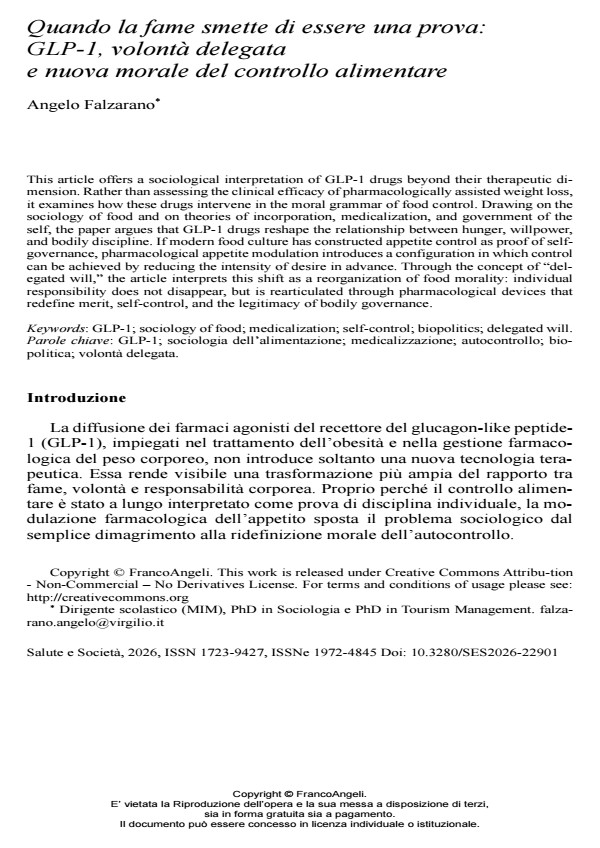
Below, you can see the article first page
If you want to buy this article in PDF format, you can do it, following the instructions to buy download credits
FrancoAngeli is member of Publishers International Linking Association, Inc (PILA), a not-for-profit association which run the CrossRef service enabling links to and from online scholarly content.
This article offers a sociological interpretation of GLP-1 drugs beyond their therapeutic di-mension. Rather than assessing the clinical efficacy of pharmacologically assisted weight loss, it examines how these drugs intervene in the moral grammar of food control. Drawing on the sociology of food and on theories of incorporation, medicalization, and government of the self, the paper argues that GLP-1 drugs reshape the relationship between hunger, willpower, and bodily discipline. If modern food culture has constructed appetite control as proof of self-governance, pharmacological appetite modulation introduces a configuration in which control can be achieved by reducing the intensity of desire in advance. Through the concept of “del-egated will,” the article interprets this shift as a reorganization of food morality: individual responsibility does not disappear, but is rearticulated through pharmacological devices that redefine merit, self-control, and the legitimacy of bodily governance.
Keywords: GLP-1; sociology of food; medicalization; self-control; biopolitics; delegated will. Parole chiave: GLP-1; sociologia dell’alimentazione; medicalizzazione; autocontrollo; bio-politica; volontà delegata.
Angelo Falzarano, Quando la fame smette di essere una prova: GLP-1, volontà delegata e nuova morale del controllo alimentare in "SALUTE E SOCIETÀ" Online First/2026, pp 1-16, DOI: 10.3280/SES2026-22901