Dalla crisi della conoscenza alla sfida sociologica: la capacità negativa come disposizione epistemica durante la pandemia da COVID-19
Journal title SALUTE E SOCIETÀ
Author/s Roberto Lusardi
Publishing Year 2026 Issue 2026/3
Language Italian Pages 16 P. 9-24 File size 343 KB
DOI 10.3280/SES2026-003002
DOI is like a bar code for intellectual property: to have more infomation
click here
Below, you can see the article first page
If you want to buy this article in PDF format, you can do it, following the instructions to buy download credits
FrancoAngeli is member of Publishers International Linking Association, Inc (PILA), a not-for-profit association which run the CrossRef service enabling links to and from online scholarly content.
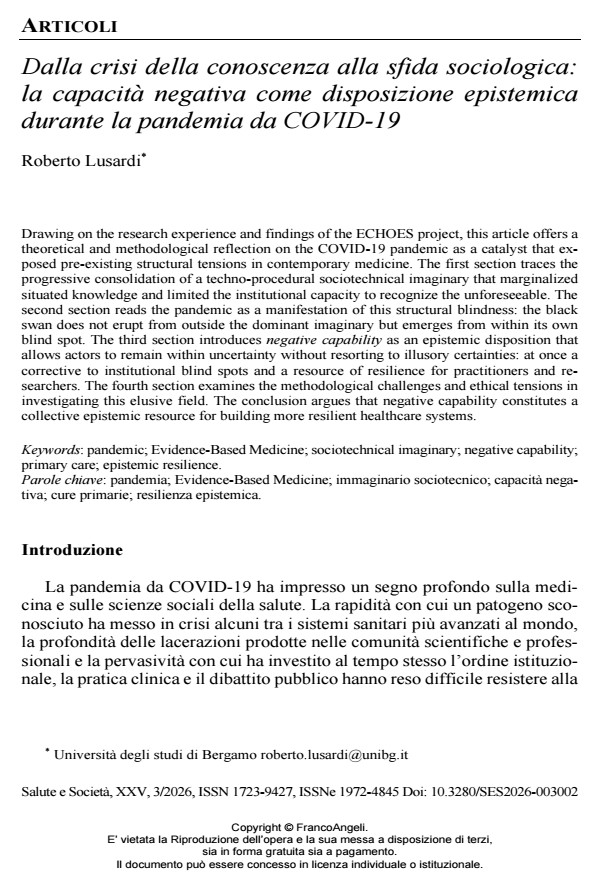
Drawing on the research experience and findings of the ECHOES project, this article offers a theoretical and methodological reflection on the COVID-19 pandemic as a catalyst that exposed pre-existing structural tensions in contemporary medicine. The first section traces the progressive consolidation of a techno-procedural sociotechnical imaginary that marginalized situated knowledge and limited the institutional capacity to recognize the unforeseeable. The second section reads the pandemic as a manifestation of this structural blindness: the black swan does not erupt from outside the dominant imaginary but emerges from within its own blind spot. The third section introduces negative capability as an epistemic disposition that allows actors to remain within uncertainty without resorting to illusory certainties: at once a corrective to institutional blind spots and a resource of resilience for practitioners and researchers. The fourth section examines the methodological challenges and ethical tensions in investigating this elusive field. The conclusion argues that negative capability constitutes a collective epistemic resource for building more resilient healthcare systems.
Keywords: pandemic; Evidence-Based Medicine; sociotechnical imaginary; negative capability; primary care; epistemic resilience.
- Lanzara G.F. (2016). Shifting Practices. Reflections on Technology, Practice, and Innovation. Cambridge, MA: MIT Press.
- Lee R.M. (1993). Doing Research on Sensitive Topics. London: SAGE Publications.
- Alvesson M., Sandberg J., Einola K. (2022). Reflexive Research Design. In: Flick U., a cura di, The SAGE Handbook of Qualitative Research Design. London: SAGE Publications.
- Beck U. (2000). La società del rischio. Verso una seconda modernità. Roma: Carocci (ed. orig. 1986).
- Belleri G. (2022). La crisi della medicina territoriale. Romagnano al Monte (SA): Booksprint.
- Bloor D. (1976). Knowledge and Social Imagery. London: Routledge.
- Bronzini M., Polini B. (2025). Rethinking medical knowledge in the post-pandemic era: A meta-narrative review of Evidence-Based Medicine’s critiques and future directions. Sociology Compass, 19(9): e70114.
- Brown P., Zinn J. (2021). COVID-19, pandemic risk and inequality: emerging social science insights at 24 months. Health, Risk & Society, 23(7-8): 273-288. DOI: 10.1080/13698575.2021.201628
- Burawoy M. (2005). For public sociology. American Sociological Review, 70(1): 4-28. DOI: 10.1177/00031224050700010
- Cavicchi I. (2020). L’evidenza scientifica in medicina. L’uso pragmatico della verità. Roma: Nexus.
- De Graaff B., Bal J., Bal R. (2021). Layering risk work amidst an emerging crisis: an ethnographic study on the governance of the COVID-19 pandemic in a university hospital in the Netherlands. Health, Risk & Society, 23(3-4): 111-127. DOI: 10.1080/13698575.2021.191021
- Denzin N.K. (2024). Qualitative Inquiry and the Politics of Evidence. In: Denzin N.K., Lincoln Y.S., Giardina M.D., Cannella G.S., a cura di, The SAGE Handbook of Qualitative Research, 6ª ed. London: SAGE Publications.
- Douglas M. (1986). How Institutions Think. Syracuse, NY: Syracuse University Press.
- Favretto A.R., Tomelleri S., Maturo A., a cura di (2021). L’impatto sociale del COVID-19. Milano: FrancoAngeli.
- Flick U., a cura di (2022). The SAGE Handbook of Qualitative Research Design. London: SAGE Publications.
- Freidson E. (2002). La dominanza medica. Le basi sociali della malattia e delle istituzioni sanitarie. Milano: FrancoAngeli (ed. orig. 1970).
- Gabbay J., Le May A. (2004). Evidence based guidelines or collectively constructed “mindlines”? Ethnographic study of knowledge management in primary care. BMJ, 329(7473): 1013.
- Giarelli G., Vicarelli G., a cura di (2021). Libro Bianco. Il Servizio Sanitario Nazionale e la pandemia da COVID-19: Problemi e proposte. Milano: FrancoAngeli.
- Gonçalves da Silva R., Au L. (2022). The blind spots of sociotechnical imaginaries: COVID-19 scepticism in Brazil, the United Kingdom and the United States. Science, Technology and Society, 27(4): 611-629. DOI: 10.1177/0971721822112521
- Greenhalgh T. (2020). Will COVID-19 be evidence-based medicine’s nemesis? PLoS Medicine, 17(6): e1003266.
- Greenhalgh T., Howick J., Maskrey N., Evidence Based Medicine Renaissance Group (2014). Evidence Based Medicine: A movement in crisis? BMJ, 348: g3725.
- Greenhalgh T., Ozbilgin M., Tomlinson D. (2022). How COVID-19 spreads: narratives, counter narratives, and social dramas. BMJ, 378: e069867.
- Hammersley M. (2018). What is Ethnography? Can it Survive? Should it? In: Iphofen R., Tolich M., a cura di, The SAGE Handbook of Qualitative Research Ethics. London: SAGE Publications.
- Iphofen R., Tolich M., a cura di (2018). The SAGE Handbook of Qualitative Research Ethics. London: SAGE Publications.
- Jasanoff S. (2015). Future Imperfect: Science, Technology, and the Imaginations of Modernity. In: Jasanoff S., Kim S.-H., a cura di, Dreamscapes of Modernity: Sociotechnical Imaginaries and the Fabrication of Power. Chicago: University of Chicago Press.
- Jasanoff S., Kim S.-H. (2009). Containing the atom: Sociotechnical imaginaries and nuclear power in the United States and South Korea. Minerva, 47(2): 119-146.
- Jasanoff S., Hilgartner S., Hurlbut J.B., Özgöde O., Rayzberg M. (2021). Comparative COVID Response: Crisis, Knowledge, Politics. Ithaca, NY: CompCoRe Network, Cornell University.
- Lello E., Bertuzzi N. (2022). Dissenso informato. Pandemia: il dibattito mancato e le alternative possibili. Roma: Castelvecchi.
- Lusardi R., Aprile L. (2025). In scienza e coscienza. Expertise medica e agire morale durante la pandemia di COVID-19. Quaderni di Sociologia, 99: 81-102.
- Lusardi R., Bronzini M., Piras E.M. (2023). Low-intensity epistemic war. Medical communities and the development of legitimate knowledge in times of radical uncertainty. Rassegna Italiana di Sociologia, 64(4): 633-668. DOI: 10.1423/11240
- Lusardi R., Manghi S. (2014). I limiti del sapere tecnico: i saperi sociali nella scena della cura. In: Vicarelli G., a cura di, Cura e salute. Roma: Carocci.
- Lusardi R., Tomelleri S. (2020). Algoritmi, cigni neri e virus. Sociologia Italiana, 16: 23-38. DOI: 10.1485/2281-2652-202016-
- Magatti M. (2009). La libertà immaginaria. Le illusioni del capitalismo tecnonichilista. Milano: Feltrinelli.
- Migliorati L. (2020). Un sociologo nella Zona Rossa: Rischio, paura, morte e creatività ai tempi di COVID-19. Milano: FrancoAngeli.
- Mormina M. (2022). Knowledge, expertise and science advice during COVID-19: In search of epistemic justice for the ‘wicked’ problems of post-normal times. Social Epistemology, 36(6): 671-685. DOI: 10.1080/02691728.2022.210375
- Omran A.R. (1971). The Epidemiologic transition: A theory of the epidemiology of population change. The Milbank Memorial Fund Quarterly, 49(4): 509-538. DOI: 10.2307/334937
- Parsons T., Fox R. (1952). Illness, therapy and the modern American family. Journal of Social Issues, 8: 31-44.
- Sackett D.L., Rosenberg W.M.C., Gray J.A.M., Haynes R.B., Richardson W.S. (1996). Evidence Based Medicine: What it is and what it isn’t. BMJ, 312(7023): 71-72.
- Santosa A., Wall S., Fottrell E., Högberg U., Byass P. (2014). The development and experience of epidemiological transition theory over four decades: A systematic review. Global Health Action, 7(1): 23574.
- Taleb N.N. (2008). Il cigno nero. Come l’improbabile governa la nostra vita. Milano: Il Saggiatore (ed. orig. 2007).
- Timmermans S., Berg M. (2003). The Gold Standard. The Challenge of Evidence-Based Medicine and Standardization in Health Care. Philadelphia: Temple University Press.
- Vicarelli G. (2004). Aziendalizzazione e management nell’evoluzione del sistema sanitario italiano. Salute e Società, 3: 19-38.
Roberto Lusardi, Dalla crisi della conoscenza alla sfida sociologica: la capacità negativa come disposizione epistemica durante la pandemia da COVID-19 in "SALUTE E SOCIETÀ" 3/2026, pp 9-24, DOI: 10.3280/SES2026-003002