La medicina generale come frontiera della cura
Journal title SALUTE E SOCIETÀ
Author/s Micol Bronzini
Publishing Year 2026 Issue 2026/3
Language Italian Pages 19 P. 42-60 File size 335 KB
DOI 10.3280/SES2026-003004
DOI is like a bar code for intellectual property: to have more infomation
click here
Below, you can see the article first page
If you want to buy this article in PDF format, you can do it, following the instructions to buy download credits
FrancoAngeli is member of Publishers International Linking Association, Inc (PILA), a not-for-profit association which run the CrossRef service enabling links to and from online scholarly content.
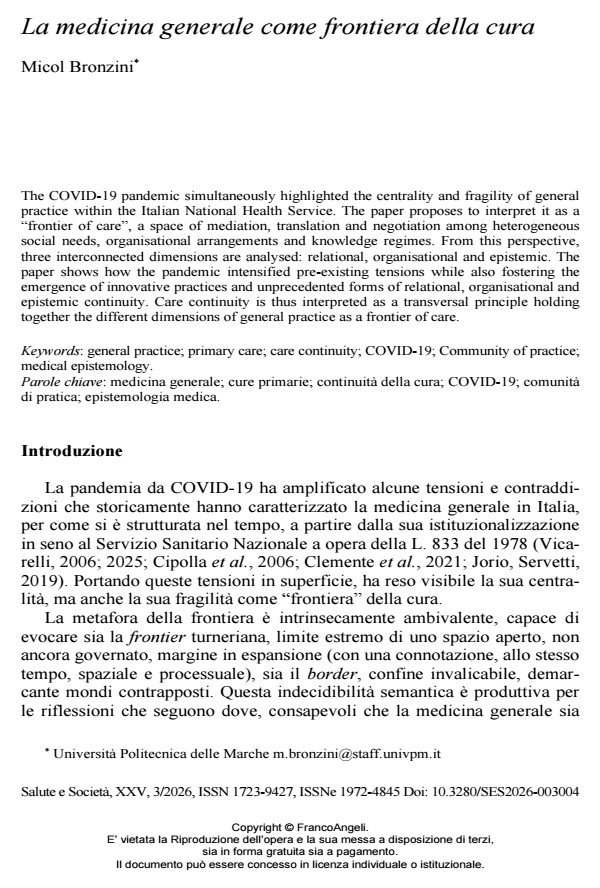
The COVID-19 pandemic simultaneously highlighted the centrality and fragility of general practice within the Italian National Health Service. The paper proposes to interpret it as a “frontier of care”, a space of mediation, translation and negotiation among heterogeneous social needs, organisational arrangements and knowledge regimes. From this perspective, three interconnected dimensions are analysed: relational, organisational and epistemic. The paper shows how the pandemic intensified pre-existing tensions while also fostering the emergence of innovative practices and unprecedented forms of relational, organisational and epistemic continuity. Care continuity is thus interpreted as a transversal principle holding together the different dimensions of general practice as a frontier of care.
Keywords: general practice; primary care; care continuity; COVID-19; Community of practice; medical epistemology.
- Lusardi R., Aprile L. (2025). In scienza e coscienza. Expertise medica e agire morale durante la pandemia di COVID-19. Quaderni di Sociologia, 99: 81-102.
- Ardissone A. (2024). “In such a dark period, the only light”: Patients’ motivations and strategies to seek care from an online health community during the COVID-19 pandemic. SSS Qualitative Research in Health, 5: 100425.
- Ashcroft R. (2004). Current epistemological problems in evidence based medicine. Journal of Medical Ethics, 30(2): 131-135.
- Bodenheimer T., Wagner E.H., Grumbach K. (2002). Improving Primary Care for Patients With Chronic Illness. JAMA, 288(14): 1775-1779.
- Bronzini M., Lusardi R. (2025). Le organizzazioni temporanee nelle emergenze sanitarie. Il caso delle Usca. La Rivista delle Politiche Sociali, 1: 69-88.
- Bronzini M., Polini B. (2025). Rethinking Medical Knowledge in the Post-Pandemic Era: A Meta-Narrative Review of Evidence-Based Medicine’s Critiques and Future Directions. Sociology Compass, 19: e70114.
- CERGAS, a cura di (2024). Rapporto OASI 2024. Osservatorio sulle Aziende e sul Sistema sanitario Italiano. Milano: Egea.
- Cipolla C., Corposanto C., Tousijn W., a cura di (2006). I medici di medicina generale in Italia. Milano: FrancoAngeli.
- Clemente C., Favretto A.R., Genova A., Marzulli M., Servetti D. (2021). Il territorio e la salute di comunità. In: Vicarelli G., Giarelli G., a cura di, Libro Bianco. Il SSN e la pandemia da COVID-19. Milano: FrancoAngeli.
- Dell’Olio M., Reeve J. (2024). Addressing hidden tensions and grey areas of general practice: a qualitative study of the experiences of newly qualified GPs attending a course on generalist medicine. British Journal of General Practice, 74(746): 637-643.
- Esposito M., Meglio L. (2021). «Ho fatto il Covid»: le voci dei guariti. Una indagine empirica su vissuto sociale ed esperienza di malattia nell’Italia centrale. Salute e Società, 20(suppl. 2): 68-84. DOI: 10.3280/SES2021-002-S100
- Eurispes (2021). 33° Rapporto Italia. Percorsi di ricerca nella società italiana. Testo disponibile al sito: https://eurispes.eu/wp-content/uploads/2022/03/eurispes_sintesi-rapporto-italia-2021.pdf (08/07/2026)
- Eurispes (2023). 2° Rapporto sul sistema sanitario italiano. Testo disponibile al sito: https://eurispes.eu/ricerca-rapporto/termometro-della-salute-2-rapporto-sul-sistema-sanitario-eurispes-ed-enpam/ (08/07/2026)
- Euromedia Research (2021). I medici di famiglia. Il ruolo, l’importanza di una scelta di fiducia e il rapporto con i cittadini… cosa è cambiato con la pandemia? Testo disponibile al sito: https://www.fimmg.org/it/Indagine-Euromedia-Research_Medici-di-Famiglia_small-pdf/ (17/07/2026)
- Feinstein A.R. (1967). Clinical Judgment. Baltimore: Williams & Wilkins.
- Gabbay J., Le May A. (2004). Evidence based guidelines or collectively constructed “mindlines?” Ethnographic study of knowledge management in primary care. BMJ, 329(7473):1013.
- Gabbay J., Le May A. (2011). Practice-based evidence for healthcare: clinical mindlines. Abingdon: Routledge.
- Genova A. (2021). Il medico di famiglia di fronte all’emergenza: una prima indagine esplorativa nel caso studio di Pesaro Urbino. In: Favretto A.R., Maturo A., Tomelleri S., a cura di, L’impatto sociale del COVID-19. Milano: FrancoAngeli.
- Green L.A., Hickner J. (2006). A Short History of Primary Care Practice-Based Research Networks: From Concept to Essential Research Laboratories. Journal of the American Board of Family Medicine, 19(1): 1-10.
- Greenhalgh T. (2023). COVID-19 and Primary Care: Taking Stock. Annals of Family Medicine, 21(1): 1-3.
- Greenhalgh T., Wieringa S. (2011). Is it time to drop the “knowledge translation” metaphor? A critical literature review. Journal of the Royal Society of Medicine, 104(12): 501-509.
- Heltveit-Olsen S.R., Lunde L., Brænd A.M., Spehar I., Høye S., Skoglund I., Sundvall P.D., Fossum G.H., Straand J., Risør M.B. (2023). Experiences and management strategies of Norwegian GPs during the COVID-19 pandemic: a longitudinal interview study. Scandinavian Journal of Primary Health Care, 41(1): 2-12. DOI: 10.1080/02813432.2022.214279
- Hjortdahl P. (2001). Continuity of care: general practitioners’ knowledge about, and sense of responsibility toward their patients. Family Practice, 9(1): 3-8.
- Jacobson L.D., Edwards A.G., Granier S.K., Butler C.C. (1997). Evidence-based medicine and general practice. British Journal of General Practice, 47(420): 449-52.
- Jorio E., Servetti D. (2019). La difficile riforma dell’assistenza primaria, tra legge statale, accordi collettivi e programmazione regionale. Corti supreme e salute, 2: 259-287.
- Lave J., Wenger E. (1991). Situated Learning: Legitimate Peripheral Participation. Cambridge: Cambridge University Press.
- Lusardi R., Bronzini M., Piras E.M. (2023). Low intensity epistemic war. Medical communities and the development of legitimate knowledge in times of radical uncertainty. Rassegna Italiana di Sociologia, 64(4): 643-674. DOI: 10.1423/11240
- Magi M., Moretti C. (2019). Definizioni di salute e nuovi modelli di assistenza territoriale. L’assistente sociale nell’Unità Territoriale Professionale della Medicina Generale. In: Ingrosso M., Pierucci P., a cura di, Relazioni di cura nell’era digitale. Le persone in cura come partner nei percorsi terapeutici, Roma: Aracne.
- McWhinney I.R. (1989). A Textbook of Family Medicine. Oxford: Oxford University Press.
- Ministero della Salute (2023). Annuario Statistico del Servizio Sanitario Nazionale. Testo disponibile al sito: https://www.salute.gov.it/new/sites/default/files/imported/C_17_pubblicazioni_3523_allegato.pdf (17/07/2026)
- Mol A. (2008). The Logic of Care. Health and the Problem of Patient Choice. London: Routledge
- Neri S. (2021). Has healthcare rationalisation been rationale? Hospital beds and COVID-19 in Italy. Salute e Società, 20(suppl. 2): 133-151. DOI: 10.3280/SES2021-002-S100
- Nicolini D., Pyrko I., Omidvar O. Spanellis A. (2022). Understanding Communities of Practice: Taking Stock and Moving Forward. The Academy of Management Annals, 16(2): 680-718.
- Noto Sondaggi (2026). Strutture, infermieri, medici: la pagella degli italiani sulla sanità pubblica. Il Sole 24Ore, 7 marzo 2026. Testo disponibile al sito: https://www.ilsole24ore.com/art/strutture-infermieri-medici-pagella-italiani-sa-nita-pubblica-AIl9TCgB?refresh_ce=1#google_vignette (17/07/2026)
- Ranmuthugala G., Cunningham F.C., Plumb J.J., Long J., Georgiou A., Westbrook J.I., Braithwaite J. (2011). A realist evaluation of the role of communities of practice in changing healthcare practice. Implementation Science, 6(1): 49. DOI: 10.1186/1748-5908-6-4
- Reeve J. (2018). Scholarship-based Medicine. Teaching tomorrow’s generalists why it’s time to retire EBM. British Journal of General Practice, 68(673): 390-391.
- Reeve J. (2023). Medical Generalism, Now!: Reclaiming the Knowledge Work of Modern Practice. Boca Raton, FL: CRC Press.
- Royal College of General Practitioners (RCGP) (2023). Definition of a GP. Disponibile al sito: https://www.rcgp.org.uk/about (08/07/2026).
- Slawson D.C., Shaughnessy A.F. (1997). Obtaining useful information from expert based sources. BMJ, 314(7085): 947.
- Sturmberg J.P. (2019). Evidence-Based Medicine – Not a Panacea for the Problems of a Complex Adaptive World. Journal of Evaluation in Clinical Practice, 25(5): 706-716.
- Tagliavento G., Vicarelli M.G. (2021). La pandemia da SARS-CoV-2 e il sistema di prevenzione in Italia. In: Favretto A.R., Maturo A., Tomelleri S., a cura di, L’impatto sociale del COVID-19. Milano: FrancoAngeli.
- Timmermans S., Berg M. (1997). Standardization in Action: Achieving Local Universality through Medical Protocols. Social Studies of Science, 27(2): 273-305. DOI: 10.1177/03063129702700200
- Turner F.J. (1893). The Significance of the Frontier in American History. Proceedings of the State Historical Society of Wisconsin: 79-112.
- Vicarelli M.G. (2006). Medicus Omnium. La costruzione professionale del Medico di medicina generale (1945-2005). In: Cipolla C., Corposanto C., Tousijn W., a cura di, I medici di medicina generale in Italia. Milano: FrancoAngeli.
- Vicarelli M.G. (2025). I Medici di medicina generale: crisi o rinnovamento? La Rivista delle Politiche Sociali, 1: 21-43.
- Wanat M., Hoste M., Gobat N. et al. (2021). Transformation of primary care during the COVID-19 pandemic: experiences of healthcare professionals in eight European countries. British Journal of General Practice, 71 (709): e634-e642. DOI: 10.3399/BJGP.2020.111
- Wieringa S., Greenhalgh T. (2015). 10 Years of Mindlines: A Systematic Review and Commentary. Implementation Science, 10(1): 45.
- Willems S., Vanden Bussche P., Van Poel E., Collins C., Klemenc-Ketis Z. (2024). Moving forward after the COVID-19 pandemic: Lessons learned in primary care from the multi-country PRICOV-19 study. European Journal of General Practice, 30(1): 2328716. DOI: 10.1080/13814788.2024.232871
Micol Bronzini, La medicina generale come frontiera della cura in "SALUTE E SOCIETÀ" 3/2026, pp 42-60, DOI: 10.3280/SES2026-003004