Social cohesion among rural women in Nigeria and resistance to gender-based traditional practices: implication to womanism in Africa, social justice and sustainable development

Titolo Rivista SOCIOLOGIA E RICERCA SOCIALE
Autori/Curatori Ogechi Akure Ikem, Samuel Okechi Okafor, Adaobi Chisom Egbe, Abel Stella Ugwu, Andrew Nnabuchi Ogbochie, Okezi Oghenethoja Obara
Anno di pubblicazione 2026 Fascicolo 2025/137
Lingua Inglese Numero pagine 20 P. 31-50 Dimensione file 230 KB
DOI 10.3280/SR2025-137002
Il DOI è il codice a barre della proprietà intellettuale: per saperne di più clicca qui

Qui sotto puoi vedere in anteprima la prima pagina di questo articolo.

Se questo articolo ti interessa, lo puoi acquistare (e scaricare in formato pdf) seguendo le facili indicazioni per acquistare il download credit. Acquista Download Credits per scaricare questo Articolo in formato PDF
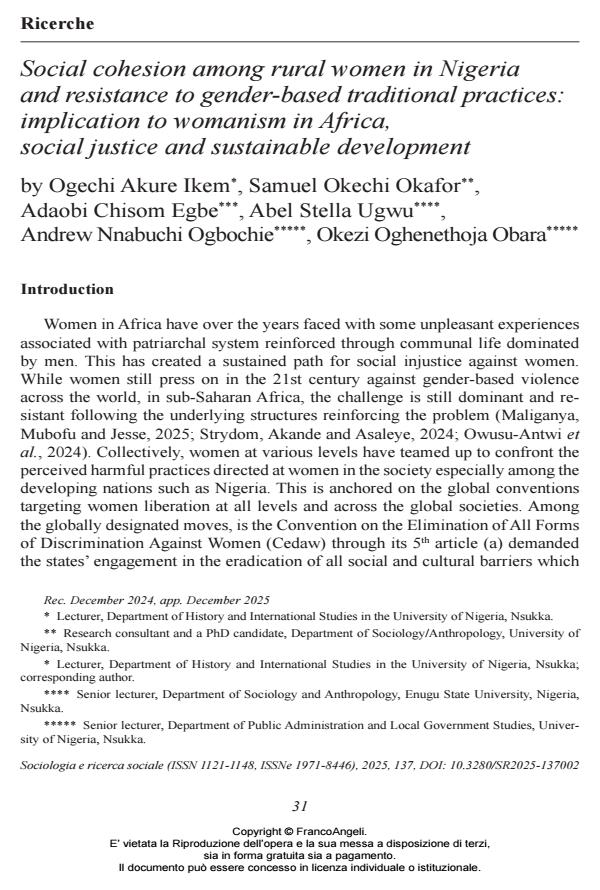
Anteprima articolo

FrancoAngeli è membro della Publishers International Linking Association, Inc (PILA), associazione indipendente e non profit per facilitare (attraverso i servizi tecnologici implementati da CrossRef.org) l’accesso degli studiosi ai contenuti digitali nelle pubblicazioni professionali e scientifiche.

Gender-based cultural practices against women are some of the enduring challenges with gender inequality and social justice implications in sub-Saharan Africa. Although womanism and feminism have penetrated sub-Saharan Africa, the polarisation between, and within the frameworks of womanism and feminism have prevailed against significant progress in women liberation in the region. This polarisation demonstrates the unseen disintegration within the women ranks mak-ing them vulnerable to cultural practices against women. As such, the present study examined the interaction between social cohesion and gender-based cultural practices against women in remote rural communities in southeast Nigeria. Sur-vey design was applied in the study, while questionnaire instrument (social cohe-sion scale) was used in collecting data from the respondents. The collected data was analysed using descriptive and inferential statistics. According to the findings from the study, there is a negative correlation between connection with social cohesion and vulnerability to Harmful traditional cultural practices (R -.680, P < .01), vulnerability to Harmful traditional cultural practices is predicted by socio-economic variables (R = 0.922, P < .05), while identification with social cohesion is predicted by socioeconomic variables (R = 0.965, P < .05).

  1. M.M. Abdul, O. Adeleke, O. Adeyeye, A. Babalola, E. Eyo, M.T. Ibrahim, M. Voke-Ighorodje,
  2. M. Onose (2011), Analysis of the History, Organisations and Challenges of Feminism in Nigeria Group: Work done in the Master on Empowerment and Leadership in Development Projects, within the project «Young Women, Empowerment and Development in Subsaha-ran Africa», Spanish Agency of International Cooperation for Develoment.
  3. H. Abebe, G.A. Beyene, B.S. Mulat (2021), «Harmful cultural practices during perinatal period and associated factors among women of childbearing age in Southern Ethiopia: Community based cross-sectional study», PloS One, 16, 7, e0254095,
  4. A. Adetunji, M. Silva, N.J. Tulsiani, M. Adediran (2023), «Like a broom tied together: A qual-itative exploration of social cohesion and its role in community capacity strengthening to support integrated health in Nigeria», PloS Global Public Health, 3, 10, e0002508, https:// doi.org/10.1371/journal.pgph.0002508.
  5. E.R. Agadullina, D.I. Lavelina (2023), «The Contribution of the System Justification to Social Cohesion», Social Psychology and Society, 14, 4, pp. 89-104,
  6. D.T. Agbalajobi (2017), «A Historical Perspective of Women Participation in Politics», Ife So-cial Sciences Review, 25, 2, pp. 33-47.
  7. N. Ahmad, G. Ghouse, M.I. Bhatti, A. Aslam (2023), «The Impact of Social Inclusion and Financial Development on CO2 Emissions: Panel Analysis from Developing Countries», Sustainability, 15, 14752,
  8. Y. Akinbobola (2020), «Defining African Feminism(s) While #BeingFemaleinNigeria», Afri-can Diaspora, 12, 1-2, pp. 64-88,
  9. C.O. Alordiah, F.C. Omumu, H.I. Owamah, O. Chenube, I.E. Okokoyo, M.A. Osagiede, H.T. Agbajor (2022), «Socio-cultural norms encouraging violence against women (Vaw) from a popular ethnic group in the Niger Delta region of Nigeria and the roles of schools in preventing Vaw», Cogent Social Sciences, 8, 1, 2102299, DOI: 10.1080/23311886.2022.2102299
  10. E.O. Amoo, A. Olawole-Isaac, M.P. Ajayi, O. Adekeye, O. Ogundipe, O. Olawande, A. Ogun-dipe (2019), «Are there traditional practices that affect men’s reproductive health in sub-Sa-haran Africa? A systematic review and meta-analysis approach», Cogent Social Sciences, 5, 1, DOI: 10.1080/23311886.2019.1677120
  11. K. Andrzejczak (2017), «Social cohesion in African countries. The role of remittances and the size of the welfare state», Problems of Social Policy, 38, pp. 13-34.
  12. J. Banda, P. Atansah (2016), An Agenda for Harmful Cultural Practices and Girls’ Empower-ment, Center for Global Development, http://www.jstor.org/stable/resrep39944.
  13. M. Bannò, G.M. D’Allura (2025), Feminist perspectives in business studies: A conceptual framework, in Feminist Perspectives in Business Studies, Cheltenham, Edward Elgar Pub-lishing, DOI: 10.4337/9781035336005.00009
  14. O. Bastug, L. Korkmaz, S. Korkut, H. Halis, T. Günes, S. Kurtoglu (2016), «A harmful tradition-al practice in newborns with adrenocorticotropic hormone resistance syndrome: branding», Turk pediatri arsivi, 51, 4, pp. 224-27,
  15. G. Bottoni, F. Addeo (2024), «The Effect of Social Cohesion on Subjective Individual Quality of Life in European Countries», Soc. Indic. Res., 171, pp. 1111-33,
  16. N. Bouchama, G. Ferrant, L. Fuiret, A. Meneses, A. Thim (2018), Gender Inequality in West African Social Institutions, West African Papers, No. 13, Paris, Oecd Publishing.
  17. Y. Bouka (2021), Women, Colonial Resistance, and Decolonization: Challenging African His-tories, in O. Yacob-Haliso, T. Falola (eds.), The Palgrave Handbook of African Women’s Studies, Cham, Palgrave Macmillan, DOI: 10.1007/978-3-030-28099-4_5
  18. F. Burchi, D. Loewe, D. Malerba, J. Leininger (2022), «Disentangling the Relationship Be-tween Social Protection and Social Cohesion: Introduction to the Special Issue», Eur. J. Dev. Res., 34, pp. 1195-215,
  19. P.J. Burke, J. Coffey, J. Parker, S. Hardacre, F. Cocuzzoli, J. Shaw, A. Haro (2023), «“It’s a lot of shame”: understanding the impact of gender-based violence on higher education access and participation», Teaching in Higher Education, 30, 1, pp. 116-131, DOI: 10.1080/13562517.2023.2243449
  20. J. Chan, H.-P. To, E. Chan (2006), «Reconsidering social cohesion: Developing a definition and analytical framework for empirical research», Social Indicators Research, 75, 2, pp. 273-302. Committee on the Elimination of Discrimination AgainstWomen (2015), General recommenda-tion onwomen’s access to justice, https://tbinternet.ohchr.org/Treaties/CEDAW/Shared%.
  21. A. Dagunduro, A. Adenugba (2020), «Failure to Meet up to Expectation: Examining Women’s Activist Groups in the Post-Colonial Period in Nigeria», Open Cultural Studies, 4, pp. 23-35,
  22. A. Daka, S. Tamira S. (2019), «Rural Communities, Development Policies and Social Sciences Practice: Advocacy for a Citizenship of Research in Sub-Saharan Africa», Open Journal of Social Sciences, 7, pp. 51-62,
  23. S.A.L. Dau (2024), «International human rights standards versus cultural practices: a case against harmful cultural practices in Sub-Saharan Africa, with a specific reference to Fgm», Discov. Glob. Soc., 2, 21,
  24. M.A. Djie (2025), Two Leading Female Figures of the Anti-Colonial Struggle in Africa, Mas-ter’s Theses, https://ecommons.luc.edu/luc_theses/4576.
  25. K. Elmusharaf, E. Byrne, D. O’Donovan (2017), «Social and traditional practices and their im-plications for family planning: a participatory ethnographic study in Renk, South Sudan», Reprod. Health, 14, 10,
  26. S.P. Emenogu (2025), «Promoting Gender Equality and Female Empowerment in Southeast Ni-geria: The Role of Television Amamihe», Journal of Applied Philosophy, 23, 1, pp. 24-45.
  27. C. Esse (2021), «Construction of Social Cohesion and Living Together in the Cameroonian Public Space: Differences of Opinion versus the Emergence of a Common Sense in Dis-course», Int. J. Communications, Network and System Sciences, 14, pp. 75-94, https://doi. org/10.4236/ijcns.2021.146006.
  28. M. Ette, P. Akpan-Obong (2023), «Negotiating Access and Privilege: Politics of Female Par-ticipation and Representation in Nigeria», Journal of Asian and African Studies, 58, 7, pp. 1291-1306, DOI: 10.1177/00219096221084253
  29. Z. Feng, J.M. Cramm, A.P. Nieboer (2021), «Associations of Social Cohesion and Socioec-onomic Status with Health Behaviours among Middle-Aged and Older Chinese People», International Journal of Environmental Research and Public Health, 18, 9, 4894, https:// doi.org/10.3390/ijerph18094894.
  30. N. Fraser (1997), Justice interruptus: Critical reflections on the «postsocialist» condition, New York, Routledge.
  31. A. Gasztold (2020), The Theoretical Framework of Feminism, in A. Gasztold, Feminist Per-spectives on Terrorism, Cham, Springer, DOI: 10.1007/978-3-030-37234-7_2
  32. T. Gebre, F. Hagos, G. Teklu, M. Fisseha, M. Abera (2020), «The Prevalence of Gender-based Violence and Harmful Traditional Practices against Women in the Tigray Re-gion, Ethiopia», Journal of Asian and African Studies, 55, 1, pp. 58-75, DOI: 10.1177/0021909619867110
  33. J. Glover, H. Liebling, H. Barrett (2018), «Persistence and resistance of Harmful Traditional Practices (HTPs) perpetuated against girls in Africa and Asia», Journal of International Women’s Studies, 19, 2, pp. 44-64, http://vc.bridgew.edu/jiws/vol19/iss2/4/.
  34. N.C. Ikeaba, M.R. Balogun, T. Olubodun, I. Okafor (2022), «Harmful traditional practices among market women in ojuwoye market mushin, South West, Nigeria», Annals of African Medicine, 21, 3, pp. 208-16,
  35. L.A. Kagher, L. Otaye-Ebede, B. Metcalfe (2021), «Black lives and bodywork matters: A post-colonial critique of gender and embodiment in Nigeria», Gender, Work & Organization, 28, 5, pp. 1787-804,
  36. S. Lai, Y. Zhou, Y. Yuan (2021), «Associations between Community Cohesion and Subjec-tive Wellbeing of the Elderly in Guangzhou, China-A Cross-Sectional Study Based on the Structural Equation Model», International Journal of Environmental Research and Public Health, 18, 3, 953,
  37. A. Laifa, F. Bendjeroudib (2022), The Effects of the American Revolution on Feminism in America, A Dissertation submitted to the Department of Letters and English Language in Partial Fulfillment of the Requirements for the Degree of Master in Literature and Civiliza-tion Candidates, Larbi Tebessi University, Tébessa.
  38. W. Maliganya, C. Mubofu, A.M. Jesse (2025), «The implications of gender-based violence on access to land for rural women’s empowerment in patrilineal societies in Tanzania», Cogent Social Sciences, 11, 1, DOI: 10.1080/23311886.2025.2516077
  39. A. Mama (1995), «Feminism or Femocracy? State Feminism and Democratisation in Nigeria», Africa Development/Afrique et Développement, 20, 1, pp. 37-58.
  40. J.M. Mauwa, S.B. Kaye, D. Mukengere (2022), Protecting and Nurturing Children Born from Rape in South Kivu Communities: A Challenge for Civil Society, in J.C.K. Kiyala, G.T. Harris (eds.), Civil Society and Peacebuilding in Sub-Saharan Africa in the Anthropocene, Cham, Springer, DOI: 10.1007/978-3-030-95179-5_17
  41. D.W. McMillan, D.M. Chavis (1986), «Sense of community: A definition and theory», Jour-nal of Community Psychology, 14, 1, pp. 6-23,
  42. H. Melber (2021), «One Namibia, One Nation? Social Cohesion under a Liberation Move-ment as Government in Decline», Vienna Journal of African Studies, 21, pp. 129-158,
  43. H.K. Mohajan (2022), «An Overview on the Feminism and Its Categories», Research and Ad-vances in Education, 1, 3, pp. 11-26, DOI: 10.56397/RAE.2022.09.02
  44. L. Moustakas (2023), «Social Cohesion: Definitions, Causes and Consequences», Encyclope-dia, 3, pp. 1028-1037,
  45. N.H. Msuya (2019), «Concept of Culture Relativism and Women’s Rights in Sub-SaharanAfrica», Journal of Asian and African Studies, 54, 8, pp. 1145-58, DOI: 10.1177/0021909619863085
  46. N.V. Nayana, V. Ashakumari (2024), «Africana Womanism as a Vehicle of Women Empower-ment and Influence», Educational Administration: Theory and Practice, 30, 1, pp. 7315-7,
  47. N. Nkealah (2016), «(West) African Feminisms and Their Challenges», Jls/Tlw, 32, 2, pp. 61-74, DOI: 10.1080/02564718.2016.12065
  48. E.N. Nwagu, S.I.C. Dibia, A.N. Odo (2017), «Socio-cultural norms and roles in the use and abuse of alcohol among members of a rural community in Southeast Nigeria», Health Edu-cation Research, 32, 5, pp. 423-36,
  49. O. Obianwu, A. Adetunji, O. Dirisu (2018), Understanding medicalisation of female genital muti-lation/cutting (Fgm/C): A qualitative study of parents and health workers in Nigeria, Evidence to End Fgm/C: Research to Help Girls and Women Thrive, New York, Population Council.
  50. A.N. Odo, S.I.C. Dibia, E.N. Nwagu, M.J. Umoke, P.C.I. Umoke (2020), «Towards charac-terization of Female Genital Mutilation (Fgm) in rural Nigeria», Afr. Health Sc., 20, 4, pp. 1968-78, https://dx.doi.org/10.4314/ahs.v20i4.55.
  51. I.J. Oguadimma, E.O. Nwakalor, B.A. Ejinkeonye (2021), «Factors That Militate Against Women Participation in Politics in Enugu State», Open Political Science, 4, pp. 68-73.
  52. S.O. Okafor (2020), «Patriarchy and women plight in Africa: The consequences of living in passivity», Bangladesh e-Journal of Sociology, 17, 2, pp. 57-74.
  53. I.N. Okedo-Alex, I.C. Akamike, C.J. Uneke, D.D. Abateneh (2021), «Community Attitudes to-wards Violence against Women, and Lived Experiences of Family Violence and Abuse during Childhood in Rural Eastern Nigeria: Implications for Policy and Programming», Risk Man-agement and Healthcare Policy, 14, pp. 4983-90, DOI: 10.2147/RMHP.S342584
  54. O.O. Olusegun, O.S. Oyelade (2022), «Access to justice for Nigerian women: A veritable tool to achieving sustainable development», International Journal of Discrimination and the Law, 22, 1, pp. 4-29, DOI: 10.1177/13582291211043418
  55. C.K. Onah, E.N. Ossai, O.M. Nwachukwu, G.E. Nwankwo, H.O. Mbam, B.N. Azuogu (2023), «Factors associated with the practice of and intention to perform female genital mutilation on a female child among married women in Abakaliki Nigeria», Bmc Women’s Health, 23, 376,
  56. C. Onyemelukwe (2016), «Intersections of Violence Against Women and Health: Implications for Health Law and Policy in Nigeria», 22 Wm. & Mary J. Women & L. 609, https://schol-arship.law.wm.edu/wmjowl/vol22/iss3/6.
  57. N. Orazani, D. Cárdenas, K.J. Reynolds, R. Mendoza-Denton (2023), «Editorial: “Divided or united”: strengthening social cohesion for well-being and prosperity», Frontiers in Psy-chology, 14, 1278832,
  58. R. Owusu-Antwi, L. Fedina, M.J.B. Robba, K. Khatibi, D. Bosomtwe, E. Nsereko, O. Shadare, S. Compton, A. Akinyemi, M.B. Randa, A.A. Afolabi, M.L. Munro-Kramer (2024), «Prev-alence of gender-based violence and factors associated with help-seeking among university students in sub-Saharan Africa», Women’s Health, 20, 17455057241307519, https://doi. org/10.1177/17455057241307519.
  59. G.P. Panthi (2020), Midwifery Asia Pacific 2020, World Congress on Midwifery, Maternal Health and Gynecology, webinar August 19-20, https://midwifery-gynecology.insightcon-ferences.com/.
  60. N. Perrin, M. Marsh, A. Clough, A. Desgroppes, C.Y. Phanuel, A. Abdi, F. Kaburu, S. Heit-mann, M. Yamashina, B. Ross, S. Read-Hamilton, R. Turner, L. Heise, N. Glass (2019), «Social norms and beliefs about gender based violence scale: a measure for use with gender based violence prevention programs in low-resource and humanitarian settings», Confl. Health, 13, 6,
  61. Z. Pervaiz, S. Akram, S. Ahmad Jan, A.R. Chaudhary (2023), «Is gender equality conducive to economic growth of developing countries?», Cogent Social Sciences, 9, 2,
  62. A.N. Peterson, J. Hughey (2004), «Social cohesion and intrapersonal empowerment: gender as moderator», Health Education Research, 19, 5, pp. 533-42,
  63. S. Poix, N. Ibrahim, S. Scriver, S. Raghavendra, N. Duvvury, K. Elmusharaf (2022), «Com-munity cohesion and violence against women in Ghana, Pakistan, and South Sudan: A sec-ondary data analysis», Women’s Health, 18, 17455057221123998, DOI: 10.1177/17455057221123998
  64. M. Powers, R. Faden (2006), Social justice: The moral foundations of public health and health policy, Oxford, Oxford University Press.
  65. M. Powers, R. Faden (2019), Structural injustice: Power, advantage, and human rights, Ox-ford, Oxford University Press.
  66. B. Pratt (2023), «A multidimensionalaccount of social justice for global health research», Bio-ethics, 37, pp. 624-36,
  67. L. Puigvert, R. Valls, C. Garcia Yeste, C. Aguilar, B. Merrill (2019), «Resistance to and Trans-formations of Gender-Based Violence in Spanish Universities: A Communicative Evalua-tion of Social Impact», Journal of Mixed Methods Research, 13, 3, pp. 361-80, https://doi. org/10.1177/1558689817731170.
  68. J. Quicke, C. Winter (1994), «Education, Cooperation and the Cultural Practices of Assertive Girls», International Studies in Sociology of Education, 4, 2, pp. 173-90, DOI: 10.1080/0962021940040203
  69. C. Sommer (2019), Social cohesion and economic development: Unpacking the relationship, Briefing Paper, No. 16/2019, DeutschesInstitutfürEntwicklungspolitik (Die), Bonn, https:// doi.org/10.23661/bp16.2019.
  70. P.W. Speer, N.A. Peterson (2001), «Psychometric properties of an empowerment scale: Testing cognitive, motional, and behavioural domains», Social Work Research, 24, 2, pp. 109-18, http://www.jstor.org/stable/42659424.
  71. K. Strydom, J.O. Akande, A.J. Asaleye. (2024), «The Quest for Female Economic Empower-ment in Sub-Saharan African Countries: Implications on Gender-Based Violence», Journal of Risk and Financial Management, 17, 2, 51,
  72. S. Tamale (2020), Decolonization and Afro-Feminism, Ottawa, Daraja Press.
  73. H. Toker, A. Yildiz (eds.) (2022), Gender Equality and Social Cohesion in Iraq, Izmir, Yasar University Publications.
  74. N. Toyo, O.T. Adegbeye (2021), Are Different Generations of Nigerian Feminists Ready to Join Forces?, in M. Judge (ed.), African Feminisms Across Generations, Berlin, Heinrich-Böll-Stiftung.
  75. O.D. Udoh, S.F. Folarin, V.A. Isumonah, E.O. Amoo (2020), «The influence of religion and culture on women’s rights to property in Nigeria», Cogent Arts & Humanities, 7, 1, https:// doi.org/10.1080/23311983.2020.1750244.
  76. Unicef (2022), Harmful practices: Child marriage and female genital mutilation are interna-tionally recognized human rights violations, Geneva, United Nations Publications.
  77. United Nations (2019), UN Women Annual Report 2018-2019, Geneva, United Nations Publications.
  78. L. Villardón-Gallego, A. García-Cid, A. Estévez, R. García-Carrión (2023), «Early Educational Interventions to Prevent Gender-Based Violence: A Systematic Review», Healthcare (Ba-sel, Switzerland), 11, 1, 142,
  79. A.J. Williams, K. Maguire, K. Morrissey, T. Taylor, K. Wyatt (2020), «Social cohesion, mental wellbeing and health-related quality of life among a cohort of social housing residents in Cornwall: a cross sectional study», Bmc Public Health, 20, 985,
  80. O. Yacob-Haliso (2025), «African Intersectionalities and Decolonisation of African Women’s and Gender Studies», History Compass, 23, 3, https://compass.onlinelibrary.wiley.com/doi/10. 1111/hic3.70008.
  81. I.M. Young (2000), Inclusion and democracy, Oxford, Oxford University Press.
  82. A.N. Zadawa, A. Omran (2020), Rural Development in Africa: Challenges and Opportunities, in A. Omran, O. Schwarz-Herion (eds.), Sustaining our Environment for Better Future, Singapore, Springer, DOI: 10.1007/978-981-13-7158-5_3

Ogechi Akure Ikem, Samuel Okechi Okafor, Adaobi Chisom Egbe, Abel Stella Ugwu, Andrew Nnabuchi Ogbochie, Okezi Oghenethoja Obara, Social cohesion among rural women in Nigeria and resistance to gender-based traditional practices: implication to womanism in Africa, social justice and sustainable development in "SOCIOLOGIA E RICERCA SOCIALE " 137/2025, pp 31-50, DOI: 10.3280/SR2025-137002