Intrecci emotivi della cura. Il caso delle reti informali di medici nell’emergenza pandemica
Titolo Rivista SALUTE E SOCIETÀ
Autori/Curatori Flavia Atzori, Rosario Aprile
Anno di pubblicazione 2026 Fascicolo 2026/3
Lingua Italiano Numero pagine 17 P. 61-77 Dimensione file 344 KB
DOI 10.3280/SES2026-003005
Il DOI è il codice a barre della proprietà intellettuale: per saperne di più
clicca qui
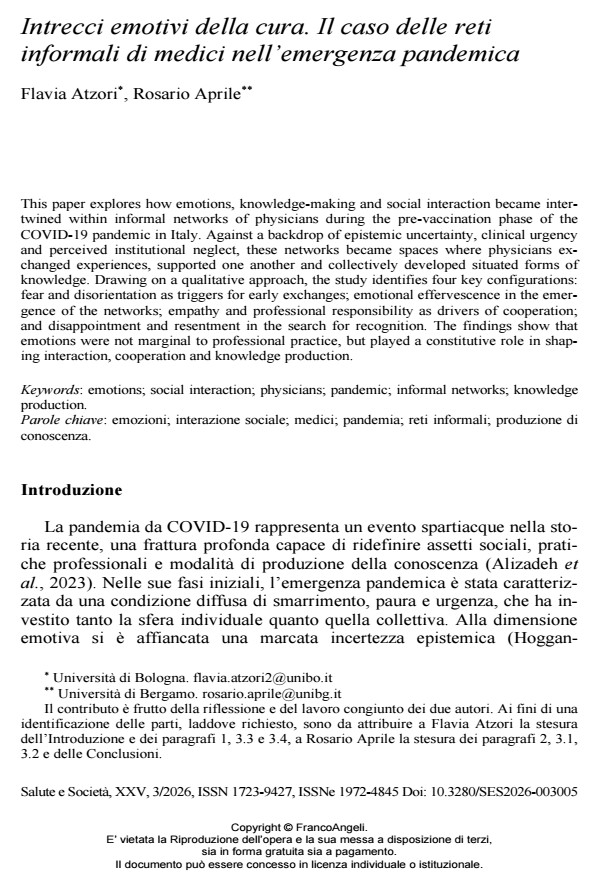
Qui sotto puoi vedere in anteprima la prima pagina di questo articolo.
Se questo articolo ti interessa, lo puoi acquistare (e scaricare in formato pdf) seguendo le facili indicazioni per acquistare il download credit. Acquista Download Credits per scaricare questo Articolo in formato PDF
FrancoAngeli è membro della Publishers International Linking Association, Inc (PILA), associazione indipendente e non profit per facilitare (attraverso i servizi tecnologici implementati da CrossRef.org) l’accesso degli studiosi ai contenuti digitali nelle pubblicazioni professionali e scientifiche.
This paper explores how emotions, knowledge-making and social interaction became intertwined within informal networks of physicians during the pre-vaccination phase of the COVID-19 pandemic in Italy. Against a backdrop of epistemic uncertainty, clinical urgency and perceived institutional neglect, these networks became spaces where physicians exchanged experiences, supported one another and collectively developed situated forms of knowledge. Drawing on a qualitative approach, the study identifies four key configurations: fear and disorientation as triggers for early exchanges; emotional effervescence in the emergence of the networks; empathy and professional responsibility as drivers of cooperation; and disappointment and resentment in the search for recognition. The findings show that emotions were not marginal to professional practice, but played a constitutive role in shaping interaction, cooperation and knowledge production.
Parole chiave:emozioni; interazione sociale; medici; pandemia; reti informali; produzione di conoscenza.
- Alberoni F. (1977). Movimento e istituzione. Bologna: Il Mulino.
- Alizadeh H., Sharifi A., Damanbagh S., Nazarnia H., et al. (2023). Impacts of the COVID-19 pandemic on the social sphere and lessons for crisis management: a literature review. Natural Hazards, 117(3): 2139-2164.
- Baehr P. (2005). Social extremity, communities of fate, and the sociology of SARS. European Journal of Sociology, 46(2): 179-211. DOI: 10.1017/S000397560500007
- Battistelli F., Galantino M.G. (2020). Sociologia e politica del coronavirus: Tra opinioni e paure. Milano: FrancoAngeli.
- Bianco A. (2016). La concezione di mutamento sociale in Georg Simmel. B@belonline, 1/2: 234-245. DOI: 10.13134/2531-8624/1-2-2016/1
- Bifulco L. (2019). Conflitto e solidarietà sociale. Il ruolo delle emozioni e della morale nell’impianto teorico di Randall Collins. Culture e Studi del Sociale, 4(2): 161-176.
- Blumer H. (1969). Symbolic Interactionism. Perspective and Method. Englewood Cliffs, NJ: Prentice-Hall.
- Braun V., Clarke V. (2022). Thematic analysis: a practical guide. London: Sage.
- Charmaz K. (2006). Constructing grounded theory: a practical guide through qualitative analysis. Los Angeles: Sage.
- Collins R. (2004). Interaction ritual chains. Princeton Studies in Cultural Socio-logy. Princeton: Princeton University Press.
- Fox R.C. (1957). Training for Uncertainty. In: Kendall P.L., Merton R.K., Reader G.G., eds., The Student-Physician: Introductory Studies in the Sociology of Medical Education. Cambridge, MA: Har-vard University Press.
- Gengler A.M. (2020). Emotions and Medical Decision-Making. Social Psychology Quarterly, 83(2): 174-194. DOI: 10.1177/019027251987693
- Ghosh R., Biswas P., Chatterjee S., Sengupta S., et al. (2021). Love and emotions at the time of COVID-19. Minerva Psychiatry, 62(3): 156-163. DOI: 10.23736/S2724-6612.21.02143-
- Gieryn T.F. (1983). Boundary-Work and the Demarcation of Science from Non-Science: Strains and Interests in Professional Ideologies of Scientists. American Sociological Review, 48(6): 781-795. DOI: 10.2307/209532
- Goffman E. (1967). Interaction Ritual. Essays on Face-to-Face Behavior. New York: Pantheon Books.
- Goffman E. (1969). Strategic Interaction. Philadelphia: University of Pennsylva-nia Press.
- Hochschild A.R. (1975). The Sociology of Feeling and Emotion: Selected Possibilities. Sociological Inquiry, 45(2-3): 280-307.
- Hochschild A.R. (1979). Emotion Work, Feeling Rules, and Social Structure. American Journal of Sociology, 85(3): 551-575. DOI: 10.1086/22704
- Hochschild A.R. (1983). The Managed Heart: Commercialization of Human Fee-ling. University of California Press.
- Hoggan-Kloubert T., Hoggan C. (2023). Post-Truth as an Epistemic Crisis: The Need for Rationality, Autonomy, and Pluralism. Adult Education Quarterly, 73(1): 3-20. DOI: 10.1177/0741713622108042
- Iagulli P. (2019). Interactionism and the Sociology of Emotions. Italian Sociological Review, 9(2): 195-208. DOI: 10.13136/ISR.V9I2.27
- Illouz E. (2025). Modernità esplosiva. Il disagio della civiltà delle emozioni. Einaudi: Torino.
- Jasper J.M. (1997). Art of Moral Protest: Culture, Biography, and Creativity in Social Movements. Chicago and London: University of Chicago Press.
- Kuckartz U., Rädiker S. (2019). Analyzing qualitative data with MAXQDA. Cham, Switzerland: Springer.
- Lamont M., Molnár V. (2002). The Study of Boundaries in the Social Sciences. Annual Review of Sociology, 28(1): 167-95.
- Lusardi R., Bronzini M., Piras E.M. (2023). Low-intensity epistemic war. Medical communities and the development of legitimate knowledge in times of radical uncertainty. Rassegna Italiana di Sociologia, (4): 643-74. DOI: 10.1423/11240
- Mazzeo R. (2021). Pandemia: tra la paura e Mister Hyde. Sicurezza e scienze sociali, 9(1): 39-49. DOI: 10.3280/SISS2021-00100
- Mora E. (1993). Il contributo di Georg Simmel ad un approccio comunicativo della teoria sociologica. Studi di Sociologia, 31(1): 5-28.
- Pugh A.J. (2013). What good are interviews for thinking about culture? Demystifying interpretive analysis. American Journal of Cultural Sociology, 1(1): 42-68.
- Rivera L.A. (2015). Go with Your Gut: Emotion and Evaluation in Job Interviews. American Journal of Sociology, 120(5): 1339-1389. DOI: 10.1086/68121
- Simmel G. (1908). Soziologie. Leipzig: Duncker & Humblot.
- Sinsky C.A., Trockel M., Carlasare L.E., West C.P., et al. (2023). Politicization of Medical Care, Burnout, and Professionally Conflicting Emotions Among Physicians During COVID-19. Mayo Clinic Proceedings, 98(11): 1613-1628.
- Špecián P. (2022). Epistemology and the Pandemic: Lessons from an Epistemic Crisis. Social Epistemology, 36(2): 167-179. DOI: 10.1080/02691728.2021.200993
- Thoits P.A. (1989). The Sociology of Emotions. Annual Review of Sociology, 15(1): 317-342.
- Tomelleri S. (2010). Una sociologia delle emozioni: il risentimento. Studi di Sociologia, 48(1): 3-15.
- Villa F. (1993). Sociologia e metasociologia in Georg Simmel. Studi di Sociologia, 31(1): 29-63.
- Weber M. (1922). Wirtschaft und Gesellschaft. Tübingen: Mohr.
- Wenger É. (1998). Communities of practice: learning, meaning, and identity. Cambridge: Cambridge University Press.
Flavia Atzori, Rosario Aprile, Intrecci emotivi della cura. Il caso delle reti informali di medici nell’emergenza pandemica in "SALUTE E SOCIETÀ" 3/2026, pp 61-77, DOI: 10.3280/SES2026-003005