Verso la qualità della vita lavorativa: dalla prevenzione del rischio alla promozione del benessere
Titolo Rivista RICERCHE DI PSICOLOGIA
Autori/Curatori Silvia Sumbula
Anno di pubblicazione 2015 Fascicolo 2015/1
Lingua Italiano Numero pagine 11 P. 225-235 Dimensione file 177 KB
DOI 10.3280/RIP2015-001014
Il DOI è il codice a barre della proprietà intellettuale: per saperne di più
clicca qui
Qui sotto puoi vedere in anteprima la prima pagina di questo articolo.
Se questo articolo ti interessa, lo puoi acquistare (e scaricare in formato pdf) seguendo le facili indicazioni per acquistare il download credit. Acquista Download Credits per scaricare questo Articolo in formato PDF
FrancoAngeli è membro della Publishers International Linking Association, Inc (PILA), associazione indipendente e non profit per facilitare (attraverso i servizi tecnologici implementati da CrossRef.org) l’accesso degli studiosi ai contenuti digitali nelle pubblicazioni professionali e scientifiche.
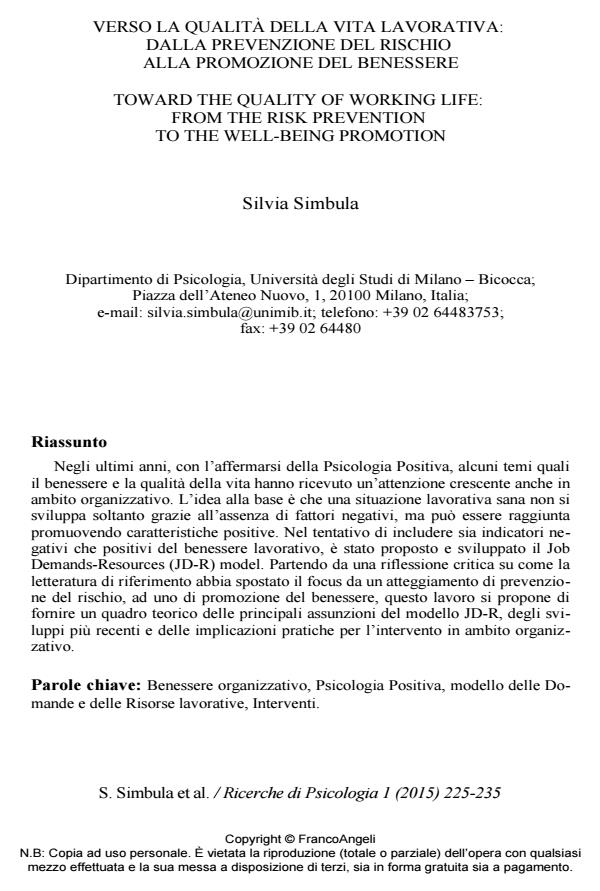
Negli ultimi anni, con l’affermarsi della Psicologia Positiva, alcuni temi quali il benessere e la qualita della vita hanno ricevuto un’attenzione crescente anche in ambito organizzativo. L’idea alla base e che una situazione lavorativa sana non si sviluppa soltanto grazie all’assenza di fattori negativi, ma puo essere raggiunta promuovendo caratteristiche positive. Nel tentativo di includere sia indicatori negativi che positivi del benessere lavorativo, e stato proposto e sviluppato il Job Demands-Resources (JD-R) model. Partendo da una riflessione critica su come la letteratura di riferimento abbia spostato il focus da un atteggiamento di prevenzione del rischio, ad uno di promozione del benessere, questo lavoro si propone di fornire un quadro teorico delle principali assunzioni del modello JD-R, degli sviluppi piu recenti e delle implicazioni pratiche per l’intervento in ambito organizzativo.
Parole chiave:Benessere organizzativo, Psicologia Positiva, modello delle Domande e delle Risorse lavorative, Interventi
- Bakker, A.B., & Demerouti, E. (2007). The Job Demands-Resources model: state of the art. Journal of Managerial Psychology, 22(3), 309-328. DOI: 10.1108/02683940710733115
- Bakker, A.B., & Demerouti, E. (2013). La teoria de las demandas y los recursos laborales. Journal of Work and Organizational Psychology, 29, 107-115. DOI: 10.5093/tr2013a16
- Bandura, A. (2000). Cultivate self-efficacy for personal and organizational effectiveness. In E.A. Locke (Ed.), Handbook of principles of organizational behavior (pp. 120-136). Oxford, United Kingdom: Blackwell.
- Cameron, K.S., Dutton, J.E., & Quinn, R.E. (Eds.) (2003). Positive organizational scholarship. San Francisco: Berrett-Koehler.
- Demerouti, E., Le Blanc, P.M., Bakker, A.B., Schaufeli, W.B., & Hox, J. (2009). Present but sick: A three-wave study on job demands, presenteeism and burnout. Career Development International, 14, 50-68. DOI: 10.1108/13620430910933574
- Demerouti, E., Bakker, A.B., Nachreiner, F., & Schaufeli, W.B. (2001). The Job Demands-Resources Model of burnout. Journal of Applied Psychology, 86, 499-512. DOI: 10.1037/0021-9010.86.3.499
- Engel, G.L. (1977). The need for a new medical model: A challenge for biomedicine. Science, 196, 129-136. DOI: 10.1521/pdps.2012.40.3.377
- Fraccaroli, F., & Balducci, C. (2011). Stress e rischi psicosociali nelle organizzazioni. Bologna: il Mulino.
- Hakanen, J.J., Bakker, A.B., & Schaufeli, W.B. (2006). Burnout and work engagement among teachers. The Journal of School Psychology, 43, 495-513. DOI: 10.1016/j.jsp.2005.11.001
- Hakanen, J.J., Schaufeli, W.B., & Ahola, K. (2008). The job demands-resources model: A three year cross-lagged study of burnout, depression, commitment, and work engagement. Work & Stress, 22, 224-241. DOI: 10.1080/02678370802379432
- Hobfoll, S.E. & Shirom, A. (2000). Conservation of resources theory: Applications to stress and management in the workplace. In R.T. Golembiewski (Ed.), Handbook of Organization Behavior, 2nd ed. (pp. 57-81). New York: Dekker.
- Hobfoll, S.E., Johnson, R.J., Ennis, N., & Jackson, A.P. (2003). Resource loss, resource gain and emotional outcomes among inner city women. Journal of Personality and Social Psychology, 84, 632-643. DOI: 10.1037//0022-3514.84.3.632
- Hu, Q., Schaufeli, W.B., & Taris, T.W. (2011). The job demands-resources model: An analysis of additive and joint effects of demands and resources. Journal of Vocational Behavior, 79, 181-190. DOI: 10.1016/j.jvb.2010.12.009
- Judge, T.A., Locke E.A., & Durham, C.C. (1997). The dispositional causes of job satisfaction: A core evaluations approach. Research in Organizational Behavior, 19, 151-188. DOI: 10.1177/0149206313515524.Karasek,R.A.(1979).Jobdemands,jobdecisionlatitude,andmentalstrain:Implicationsforjobredesign.AdministrativeScienceQuarterly,24,285-308
- Luthans, F. (2002). The need for and meaning of positive organizational behavior. Journal of Organizational Behavior, 23, 695-706. DOI: 10.1002/job.165
- Luthans, F., & Youssef, C.M. (2007). Emerging positive organizational behaviour. Journal of Organizational Behavior, 33, 321-349. DOI: 10.1177/0149206307300814
- Peterson, S.J., Luthans, F., Avolio, B.J., Walumbwa, F.O., & Zhang, Z. (2011). Psychological capital and employee performance: A latent growth modeling approach. Personnel Psychology, 64, 427-450. DOI: 10.1111/j.1744-6570.2011.01215.x
- Sarchielli, G. (2003). Psicologia del lavoro. Bologna: il Mulino.
- Schaufeli, W.B., & Bakker, A.B. (2004). Job demands, job resources, and their relationship with burnout and engagement: A multi-sample study. Journal of Organizational Behavior, 25, 293-315. DOI: 10.1002/job.248
- Schaufeli, W.B., & Taris, T.W. (2014). A critical review of the Job Demands-Resources Model: Implications for improving work and health. In G. Bauer & O.
- Hammig (Eds.), Bridging occupational, organizational and public health (pp. 43-68). Dordrecht: Springer.
- Schaufeli, W.B., Bakker, A.B., & van Rhenen, W. (2009). How changes in job demands and resources predict burnout, work engagement, and sickness absenteeism. Journal of Organizational Behavior, 30, 893-917. DOI: 10.1002/job.595
- Schaufeli, W.B., Salanova, M., Gonzales-Roma, V., & Bakker, A.B. (2002). The measurement of engagement and burnout: A two sample confirmatory factor analytic approach. Journal of Happiness Studies, 3, 71-92. DOI: 10.1023/A:1015630930326
- Seligman, M.E.P., e Csikszentmihalyi, M. (2000). Positive Psychology: An Introduction. American Psychologist, 55, 5-14. DOI: 10.1037//0003-066X.55.1.5
- Seligman, M.E.P., Steen, T.A., Park, N., & Peterson, C. (2005). Positive psychology progress: Empirical validation of interventions. American Psychologist, 60, 410-421. DOI: 10.1037/t03521-000
- Sheldon, K.M., & King, L. (2001). Why positive psychology is necessary. American Psychologist, 56, 216-217. DOI: 10.1037/0003-066X.56.3.216
- Siegrist, J. (1996). Adverse health effects of high-effort/low reward conditions at work. Journal of Occupational Health Psychology, 1, 27-43. DOI: 10.1037/1076-8998.1.1.27
- Simbula, S., Guglielmi, D., & Schaufeli, W.B. (2011). A three wave study on job resources, self-efficacy and work engagement among Italian school teachers. European Journal of Work and Organizational Psychology, 20, 285-305. DOI: 10.1080/13594320903513916
- Tims, M., & Bakker, A.B. (2010). Job crafting: Towards a new model of individual job redesign. South African Journal of Industrial Psychology, 36, 1-9.
- DOI: 10.4102/sajip.v36i2.841.VandenHeuvel,M.,Demerouti,E.,&Bakker,A.B.(2014).Howpsychologicalresourcesfacilitateadaptationtoorganizationalchange.EuropeanJournalofWorkandOrganizationalPsychology,23,847-858.DOI:10.1080/1359432X.2013.817057
- Wright, T.A., Cropanzano, R., & Meyer, D.G. (2004). State and trait correlates of job performance: A tale of two perspectives. Journal of Business and Psychology, 18, 365-383. DOI: 10.1023/B:JOBU.0000016708.22925.72
- Wrzesniewski, A., & Dutton, J.E. (2001). Crafting a job: Revisioning employees as active crafters of their work. Academy of Management Review, 26, 179-201. DOI: 10.5465/AMR.2001.4378011
- Xanthopoulou, D., Bakker, A.B., Demerouti, E., & Schaufeli, W.B. (2009a). Reciprocal relationships between job resources, personal resources, and work engagement. Journal of Vocational Behavior, 74, 235-244. DOI: 10.1016/j.jvb.2008.11.003
- Xanthopoulou, D., Bakker, A.B., Demerouti, E., & Schaufeli, W.B. (2009b). Work engagement and financial returns: A diary study on the role of job and personal resources. Journal of Organizational and Occupational Psychology, 82(1), 183-200.
- Sono presente qui e ora, e sto bene! ? Il ruolo della mindfulness nel Job Demands - Resources Model Michela Vignoli, Gerardo Petruzziello, Dina Guglielmi, in PSICOLOGIA DELLA SALUTE 2/2016 pp.106
DOI: 10.3280/PDS2016-002006
Silvia Sumbula, Verso la qualità della vita lavorativa: dalla prevenzione del rischio alla promozione del benessere in "RICERCHE DI PSICOLOGIA " 1/2015, pp 225-235, DOI: 10.3280/RIP2015-001014