La sfida delle coppie a doppia carriera tra strategie di coping e nodi conflittuali. Un contributo di ricerca

Journal title TERAPIA FAMILIARE
Author/s Paola Miano, Alessandra Salerno, Alessandra Ciulla, Aluette Merenda, Angela Maria Di Vita
Publishing Year 2015 Issue 2015/108
Language Italian Pages 30 P. 29-58 File size 213 KB
DOI 10.3280/TF2015-108002
DOI is like a bar code for intellectual property: to have more infomation click here

Below, you can see the article first page

If you want to buy this article in PDF format, you can do it, following the instructions to buy download credits
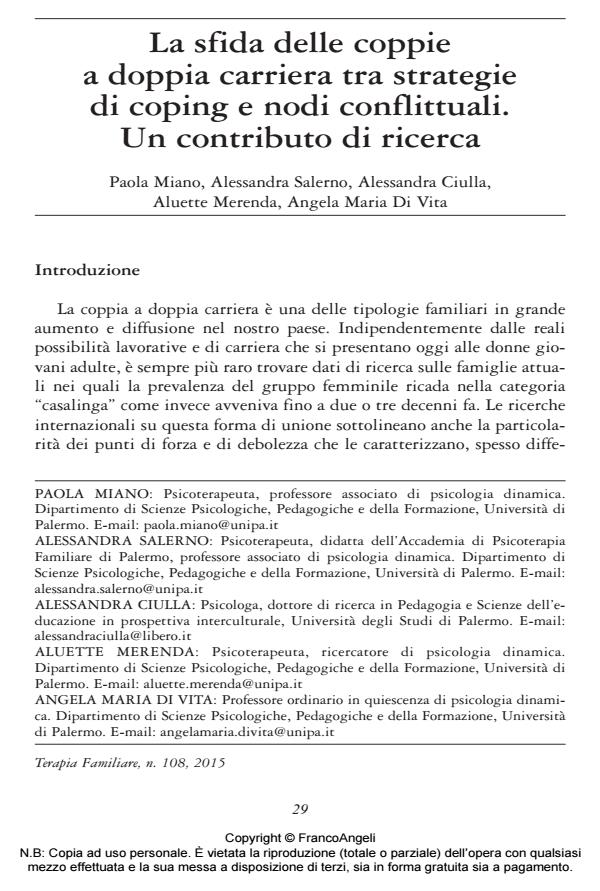
Article preview

FrancoAngeli is member of Publishers International Linking Association, Inc (PILA), a not-for-profit association which run the CrossRef service enabling links to and from online scholarly content.

Parenthood and the work-family balance, at both the private and social level, lead to an overload of responsibility and to disparity in work to the detriment of women. In dual-career families the work/family conflict affects various aspects; in our research we examined WIF conflict (work to family) and FIW conflict (family to work) in a sample of 483 dual-earner parents. Results from this study underline that the increase of family tasks concerning birth and child care is associated with a traditional work-family balance strategy, that reflects traditional roles differences between public-male-breadwinner and private-feminine-homemaker.

Keywords: Dual-earner families, work to family conflict, family to work conflict, gender, parenthood; couple

  1. Derogatis, L.R. (1994). Symptom Checklist 90–R: Administration, scoring, and procedures manual (3rd ed.). Minneapolis, MN: National Computer Systems.
  2. Emiliani F. (2008). La realtà delle piccole cose. Psicologia del quotidiano. Bologna: Il Mulino.
  3. FamWork Research Consortium (2005). Family life and professional work: Conflict and synergy (final report).
  4. Forsberg L. (2009). Managing time and childcare in dual-earner families. Unforeseen consequences of household strategies. Acta sociologica, 52(2): 152-175. DOI: 10.1177/000169930910400
  5. Gatrell C.J., Burnett S.B., Cooper C.L., Sparrow P. (2013). Work-Life balance and parenthood: a comparative review of definitions, equity and enrichment. International Journal of Management reviews, 15 (3): 300-316. DOI: 10.1111/j.1468-2370.2012.00341
  6. Giuliani C.R. Iafrate R. (2006). L’enrichment familiare. Roma: Carocci.
  7. Greenhaus J.H., Powell G.H. (2006). When work and family are allies: A theory of work-family enrichment. Academy of Management Review, 31 (4): 72-92. DOI: 10.5465/amr.2006.1937962
  8. Haddock S.A., Bowling S.W. (2001). Therapists’ approaches to the normative challenges of dual-earner couples: Negotiating outdated societal ideologies. Journal of Feminist Family Therapy, 13: 91-120. DOI: 10.1300/j086v13n02_0
  9. Haddock S.A., Schindler Zimmerman T., Ziemba S.J., Lyness K.P. (2006). Practices of Dual Earner Couples Successfully Balancing Work and Family. Journal of Family and Economic Issues, 27 (2): 207-234. DOI: 10.1007/s10834-006-9014-
  10. Higgins C.A., Duxbury L.E., Lyons S.T. (2010). Coping with overload and stress: Men and women in dual-earner families. Journal of Marriage and Family, 72: 847-859. DOI: 10.1111/j.1741-3737.2010.00734
  11. Hill E.J., Timmons Mead N., Dean L.R., Hafen D.M., Gadd R., Palmer A.A., Ferris M.S. (2006). Researching the 60-hour dual-earner workweek. An alternative to the “opt-out revolution”. American Behavioral Scientist, 49(9): 1184-1203.
  12. DOI: 10.1177/0002764206286385Knudson-Martin,C.,Huenergardt,D.(2010).Asocio-emotionalapproachtocoupletherapy:Linkingsocialcontextandcoupleinteraction.FamilyProcess,49:369-386.DOI:10.1111/j.1545-5300.2010.01328
  13. Knudson-Martin C. (2013). Why Power Matters: Creating a Foundation of Mutual Support in Couple Relationships. Family Process, 52: 5-18. DOI: 10.1111/famp.1201
  14. Lamb M.E., Pleck J.H., Charnov E.L., Levine J.A. (1987). A biosocial perspective on paternal behavior and involvement. In: Lancaster J.B., Altmann J., Rossi A.S., Sherrod L.R., editors, Parenting across the lifespan: Biosocial dimensions. Hawthorn, NY: Aldine, pp. 111-142.
  15. Lovejoy M.C., Graczyk P.A., O’Hare E., Neuman G. (2000). Maternal depression and parenting behavior: A meta-analytic review. Clinical Psychology Review, 20: 561-592.
  16. DOI: 10.1016/s0272-7358(98)00100-
  17. McCrae R.R., Costa P.T., Jr. (1987). Validation of the five-factor model of personality across instruments and observers. Journal of Personality and Social Psychology, 52: 81-90.
  18. DOI: 10.1037//0022-3514.52.1.8
  19. Mencarini L., Tanturri M.L. (2003). Donne e uomini fra tempo e figli. In: Livi Bacci M., Breschi M., a cura di, La bassa fecondità italiana tra costrizioni economiche e cambio di valori, Presentazione delle indagini e dei risultati. Udine: Casa Ed. Forum, 169-188.
  20. Merenda A., Salerno A. (2005). Gli scenari delle famiglie a doppia carriera in Italia e in Europa. Una ricerca transculturale. In: Di Vita A.M., Giambalvo E., a cura di, Figure della differenza. Corpi, generi, culture. Roma: CISU, 201-212.
  21. Mencarini L., Tanturri M.L. (2003). Donne e uomini fra tempo e figli. In: Livi Bacci M., Breschi M., a cura di, La bassa fecondità italiana tra costrizioni economiche e cambio di valori, Presentazione delle indagini e dei risultati. Udine: Casa Ed. Forum, pp. 169-188.
  22. Merenda A., Salerno A. (2005). Gli scenari delle famiglie a doppia carriera in Italia e in Europa. Una ricerca transculturale. In: Di Vita A.M., Giambalvo E., a cura di, Figure della differenza. Corpi, generi, culture. Roma: CISU, pp. 201-212.
  23. Mikula G., Schoebi D., Jagoditsch S., Macher S. (2009). Roots and correlates of perceived injustice in the division of family work. Personal Relationships, 16 (4): 553-574. DOI: 10.1111/j.1475-6811.2009.01239.x
  24. Mikula G., Riederer B., Bodi O. (2011). Perceived justice in the division of domestic labor: Actor and partner effects. Personal Relationships, 19 (4): 680-695. DOI: 10.1111/j.1475-6811.2011.01385.x
  25. Motherwell L., Prudent S. (1998). Childlessness and Group Psychotherapy: Psychological and Sociological Perspectives. Group, 3: 145-157. DOI: 10.1023/a:102308542432
  26. Nangle S.M., Kelley M.L., Fals-Stewart W., Levant R.F. (2003). Work and family variables as related to paternal engagement, responsibility and accessibility in dual-earner couples with young children. Fathering, 1: 71-90. DOI: 10.3149/fth.0101.7
  27. Nomaguchi K.M., Milkie M.A., Bianchi S.M. (2005). Time strains and psychological well-being. Do dual-earner mothers and fathers differ? Journal of Family Issues, 26 (6): 756-792. DOI: 10.1177/0192513x0527752
  28. Parker L. (2009). Disrupting power and privilege in couples therapy. Clinical Social Work Journal, 37: 248-255. DOI: 10.1007/s10615-009-0211-
  29. Rovi S.L.D. (1994). Taking “NO” for an Answer: Using Negative Reproductive Intentions to Study the Childless/Childfree. Population and Policy Review, 13: 343-65. DOI: 10.1007/bf0108411
  30. Salerno A. (2010). Vivere insieme. Tendenze e trasformazioni della coppia moderna. Bologna: Il Mulino.
  31. Skinner D.A., McCubbin H.I. (1987). DECS: Dual-employed coping scales. In: McCubbin H.I., Thompson A., editors, Family assessment inventories for research and practice. Madison: University of Wisconsin-Madison.
  32. Snyder K.A (2007). A vocabulary of motives: Understanding how parents define quality time. Journal of Marriage and Family, 69: 320-340. DOI: 10.1111/j.1741-3737.2007.00368
  33. Strazdins L., Clements M.S., Korda R.J., Broom D.H., D’Souza R.M. (2006).
  34. Unsociable work? Nonstandard work schedules, family relationships, and children’s well-being. Journal of Marriage and Family, 68: 394-410. DOI: 10.1111/j.1741-3737.2006.00260
  35. Tanturri M.L. (2007). Le funambole tra lavoro e famiglia. Golem l’Indispensabile.
  36. Tatman A.W., Hovestadt A.J., Yelsma P., Fenell D.L., Canfield B.S. (2006). Work and family conflict: an often overlooked issue in couple and family. Contemporary Family Therapy, 28 (1): 39-51. DOI: 10.1007/s10591-006-9693-4
  37. Utley J.L., Robertson A.R. (2012). Strategies for Working with Dual-Career Couples in the Hope Focused Couples Approach.
  38. Viers D., Prouty A.M. (2002). We’ve Come a Long Way? An Overview of Research of Dual-Career Couples’ Stressors and Strengths. Journal of Feminist Family Therapy, 13 (2/3): 169-190.
  39. DOI: 10.1300/J086v13n02_0
  40. Wayne J.H., Musisca N., Fleeson W. (2004). Considering the role of personality in the work-family experience: Relationships of the big five to work-family conflict and facilitation. Journal of Vocational Behavior, 64 (1): 108-130. DOI: 10.1016/S0001-8791(03)00035-
  41. Ababkov V., Merenda A., Miano, P., Perrez M. (2003). Dinamiche relazionali nelle famiglie a doppia scarriera, Abstract del V Congresso Nazionale della Sezione di Psicologia Clinica dell’AIP (Associazione Italiana di Psicologia), Bari, 26-27 Settembre 2003, 58-60.
  42. Athenstaedt U. (2000). Normative Geschlechtsrollenorientierung: Entwicklung und Validierung eines Fragebogens. Zeitschrift für Differentielle und Diagnostische Psychologie, 21: 91-104. DOI: 10.1024//0170-1789.21.1.9
  43. Atwood J.A. (2012). Couples and Money: The Last Taboo. The American Journal of Family Therapy, 40 (1): 1-19. DOI: 10.1080/01926187.201
  44. Barnett K.A., Del Campo R.L., Del Campo D.S., Steiner R.L. (2003). Work and family balance among dual-earner working class Mexican-Americans: Implications for therapists. Contemporary Family Therapy, 25 (4): 353-366. DOI: 10.1023/A:102739590128
  45. Baron R. M., Kenny D. A. (1986). The moderator-mediator variable distinction in social psychological research: conceptual, strategic, and statistical considerations. Journal of Personality and Social Psychology, 51: 1173-1182. DOI: 10.1037/0022-3514.51.6.117
  46. Burgoyne C. (2004). Heart-strings and purse-strings: money in heterosexual marriage. Feminism and Psychology, 14 (1): 165-172. DOI: 10.1177/095935350404031
  47. Buckley C.K., Schoppe-Sullivan S.J. (2010). Father involvement and coparenting behavior: Parents’ nontraditional beliefs and family earner status as moderators. Personal Relationships, 17: 413-431. DOI: 10.1111/j.1475-6811.2010.01287
  48. Campbell C.S. (2001). Work Cultures and Work/FamilyBalance. Journal of Vocational Behavior, 58: 348-365. DOI: 10.1006/jvbe.2000.175
  49. Ciabattari T. (2004). Cohabitation and Housework: The Effects of Marital Intention. Journal of Marriage and the Family, 66 (1): 118-125.
  50. DOI: 10.1111/j.0022-2445.2004.00008.x-i1CraigL.(2007).Istherereallyasecondshift,andifso,whodoesit?Atime-diaryinvestigation.FeministReview,86:149-170.DOI:10.1057/palgrave.fr.940033
  51. Current L.R., Haddock S.A., Ziemba S., Zimmermann T.S. (2003). Intimate partnership: foundation to the successful balance of family and work. The American Journal of Family Therapy, 31: 107-124. DOI: 10.1080/0192618030112
  52. De Grazia G., Merenda A., Miano P. (2006). Psicodinamica della famiglia a doppia carriera: un modello di ricerca crossculturale. In: Di Vita A.M., Garro M., Il fascino discreto della famiglia. Milano: FrancoAngeli, 48-72.
  53. Mikula G., Schoebi D., Jagoditsch S., Macher S. (2009). Roots and correlates of perceived injustice in the division of family work. Personal Relationships, 16 (4): 553-574.
  54. DOI: 10.1111/j.1475-6811.2009.01239.x
  55. Mikula G., Riederer B., Bodi O. (2011). Perceived justice in the division of domestic labor: Actor and partner effects. Personal Relationships, 19(4), 680-695. DOI: 10.1111/j.1475-6811.2011.01385.x
  56. Motherwell L., Prudent S. (1998). Childlessness and Group Psychotherapy: Psychological and Sociological Perspectives. Group, 3: 145-157. DOI: 10.1023/a:102308542432
  57. Nangle S.M., Kelley M.L., Fals-Stewart W., Levant R.F. (2003). Work and family variables as related to paternal engagement, responsibility and accessibility in dual-earner couples with young children. Fathering, 1: 71-90. DOI: 10.3149/fth.0101.7
  58. Nomaguchi K.M., Milkie M.A., Bianchi S.M. (2005). Time strains and psychological well-being. Do dual-earner mothers and fathers differ? Journal of Family Issues, 26 (6): 756-792.
  59. DOI: 10.1177/0192513x05277524ParkerL.(2009).Disruptingpowerandprivilegeincouplestherapy.ClinicalSocialWorkJournal,37:248-255.DOI:10.1007/s10615-009-0211-
  60. Rovi S.L.D. (1994). Taking “NO” for an Answer: Using Negative Reproductive Intentions to Study the Childless/Childfree. Population and Policy Review, 13: 343-65. DOI: 10.1007/bf0108411
  61. Salerno A. (2010). Vivere insieme. Tendenze e trasformazioni della coppia moderna. Bologna: Il Mulino.
  62. Skinner D.A., McCubbin H.I. (1987). DECS: Dual-employed coping scales. In: McCubbin H.I., Thompson A., editors, Family assessment inventories for research and practice. Madison: University of Wisconsin-Madison.
  63. Snyder K.A (2007). A vocabulary of motives: Understanding how parents define quality time. Journal of Marriage and Family, 69: 320-340. DOI: 10.1111/j.1741-3737.2007.00368
  64. Strazdins L., Clements M.S., Korda R.J., Broom D.H., D’Souza R.M. (2006). UJournal of Marriage and Family, 72: 847-859. DOI: 10.1111/j.1741-3737.2010.00734
  65. Hill E.J., Timmons Mead N., Dean L.R., Hafen D.M., Gadd R., Palmer A.A., Ferris
  66. M.S. (2006). Researching the 60-hour dual-earner workweek. An alternative to the “opt-out revolution”. American Behavioral Scientist, 49 (9): 1184-1203. DOI: 10.1177/000276420628638
  67. Knudson-Martin C., Huenergardt D. (2010). A socio-emotional approach to couple therapy: Linking social context and couple interaction. Family Process, 49: 369-386. DOI: 10.1111/j.1545-5300.2010.01328
  68. Knudson-Martin C. (2013). Why Power Matters: Creating a Foundation of Mutual Support in Couple Relationships. Family Process, 52: 5-18. DOI: 10.1111/famp.1201
  69. Lamb M.E., Pleck J.H., Charnov E.L., Levine J.A. (1987). A biosocial perspective on paternal behavior and involvement. In: Lancaster J.B., Altmann J., Rossi A.S., Sherrod L.R., editors, Parenting across the lifespan: Biosocial dimensions. Hawthorn, NY: Aldine, pp. 111-142.
  70. Lovejoy M.C., Graczyk P.A., O’Hare E., Neuman G. (2000). Maternal depression and
  71. parenting behavior: A meta-analytic review. Clinical Psychology Review, 20: 561-592. DOI: 10.1016/s0272-7358(98)00100-
  72. McCrae R.R., Costa, P.T., Jr. (1987). Validation of the five-factor model of personality across instruments and observers. Journal of Personality and Social Psychology, 52: 81-90.
  73. DOI: 10.1037//0022-3514.52.1.8
  74. Weston R., Qu L. (2001). Men’s and women’s reason for not having children. Family Matters, 58: 10-15.

Paola Miano, Alessandra Salerno, Alessandra Ciulla, Aluette Merenda, Angela Maria Di Vita, La sfida delle coppie a doppia carriera tra strategie di coping e nodi conflittuali. Un contributo di ricerca in "TERAPIA FAMILIARE" 108/2015, pp 29-58, DOI: 10.3280/TF2015-108002