The conceptualization of «families» within social sciences

Journal title SOCIOLOGIA E RICERCA SOCIALE
Author/s Matteo Zani
Publishing Year 2026 Issue 2025/137
Language English Pages 25 P. 5-29 File size 215 KB
DOI 10.3280/SR2025-137001
DOI is like a bar code for intellectual property: to have more infomation click here

Below, you can see the article first page

If you want to buy this article in PDF format, you can do it, following the instructions to buy download credits
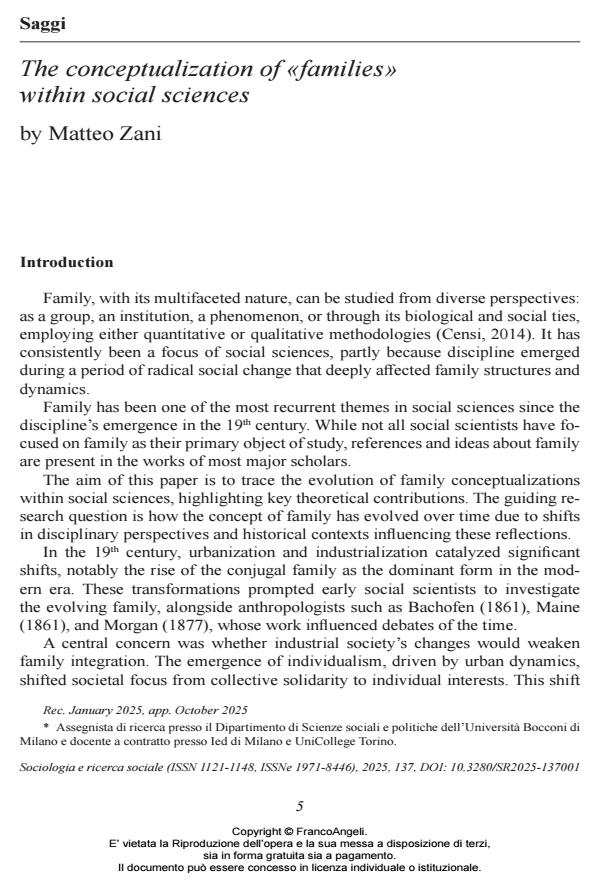
Article preview

FrancoAngeli is member of Publishers International Linking Association, Inc (PILA), a not-for-profit association which run the CrossRef service enabling links to and from online scholarly content.

This article examines the evolving conceptualization of family within social sciences, tracing its historical, theoretical, and empirical developments. Begin-ning with foundational contributions from Tönnies, Durkheim, Engels, Simmel and Weber, the paper explores how industrialization, urbanization, and individu-alism reshaped family structures from communal and extended forms to the nu-clear family. It highlights feminist critiques of patriarchal family models and the rise of new paradigm such as family practices. By integrating historical analyses, feminist critiques, and radical theories advocating for family abolition, this ar-ticle under-scores the shifting boundaries of what constitutes family in modern societies, including queer and blended families, and the increasing recognition of non-traditional kinship systems. It concludes by calling for an inclusive and dynamic understanding of family that reflects diverse lived experiences and chal-lenges the constraints of traditional paradigms.

  1. A. Ardigò (1965), «La disintegrazione della famiglia nella sociologia dell’800», Studi di Socio-logia, 3, 3, pp. 215-231, https://www.jstor.org/stable/1868698.
  2. P. Ariès (1965), Centuries of Childhood. A social history of family life, Taylorsville, Vintage Editions.
  3. J.J. Bachofen (1861), Das Mutterrecht. Eine Untersuchung über die Gynaikokratie der alten Welt nach ihrer religiösen und rechtlichen Natur, Stuttgart, Verlag von Krais ft Hoffmann.
  4. M. Barbagli (1985), Sotto lo stesso tetto: mutamenti della famiglia in Italia dal 15mo al 20mo secolo, Bologna, il Mulino.
  5. M. Barbagli (2009), «Peter Laslett e la conoscenza delle società del passato», Contemporanea, 12, 4, pp. 767-70, https://www.jstor.org/stable/24653246.
  6. L.K. Berkner (1972), «The Stem Family and the Developmental Cycle of the Peasant House-hold: An Eighteenth-Century Austrian Example», The American Historical Review, 77, 2, pp. 398-418, https://www.jstor.org/stable/1868698.
  7. C. Bertone (2024), Il familiare è politico Attrezzi di ricerca per uno sguardo posizionato, Mi-lano, Meltemi.
  8. E. Brake (2012), Special Treatment for Lovers: Marriage, Care, and Amatonormativity, in Min-imizing Marriage: Marriage, Morality, and the Law, Oxford, Oxford University Press.
  9. J. Butler (2004), Undoing Gender, New York, Routledge.
  10. J. Carsten (2004), After Kinship, Cambridge, Cambridge University Press.
  11. A. Censi (2014), Famiglia e sociologia. Dai classici al pensiero contemporaneo, Milano, Pear-son Italia.
  12. W.G. Clingempeel, E. Brand, S. Segal (1987), A multilevel-multivariable-developmental per-spective for future research on stepfamilies, in K. Pasley, M. Ihinger-Tallma (eds.), Re-marriage and stepparenting: Current research and theory, New York, The Guilford Press.
  13. R. Collins (2011), Weber’s theory of the family, in Weberian Sociological Theory, Cambridge, Cambridge University Press, https://doi.org/10.1017/cbo9780511557682.012.
  14. K. Crenshaw (1989), «Demarginalizing the intersection of race and sex: A black feminist critique of antidiscrimination doctrine, feminist theory and antiracist politics», University of Chicago Legal Forum, 1, article 8, http://chicagounbound.uchicago.edu/uclf/vol1989/iss1/8?utm_ source=chicagounbound.uchicago.edu%2Fuclf%2Fvol1989%2Fiss1%2F8&utm_medi-um=PDF&utm_campaign=PDFCoverPages.
  15. M. Dalla Costa, S. James (1975), The Power of Women and the Subversion of the Community, Bristol, The Falling Wall Press.
  16. A.Y. Davis (1981), Women, Race & Class, New York, Vintage Books Edition.
  17. P. Di Nicola (2016), «Intervista a Marzio Barbagli», Sociologia Italiana, 7, pp. 125-32.
  18. F. Engels (1884), Der Ursprung der Familie, des Privateigenthums und des Staats. Im An-schluss an Lewis H. Morgan’s Forschungen, Verlags-Magazin, Zürich.
  19. F. Engels (1988), «Engels on the Origin and Evolution of the Family», Population and Devel-opment Review, 14, 4, 705.
  20. J.N. Ferrer (2018), «Mononormativity, Polypride, and the “Mono-Poly Wars», Sexuality and Culture, 22, 3, pp. 817-36, https://doi.org/10.1007/s12119-017-9494-y.
  21. J. Gabb (2008), Researching Intimacy in Families, New York, Palgrave Macmillan.
  22. L. Ganong, M. Coleman (2017), Stepfamily Relationships Development, Dynamics, and Inter-ventions, Cham, Springer, 2nd ed.
  23. P.P. Gross (1987), «Defining post-divorce remarriage families. The Divorce Process: A Hand-book for Clinicians», Journal of Divorce, 10, 1-2, pp. 205-17, https://doi.org/10.1300/ J279v10n01_14.
  24. L. Guizzardi, T. Parsons (2012), Il sistema della parentela negli Stati Uniti contemporanei, Roma, Armando.
  25. S. Harding, M.B. Hintikka (eds.) (1983), Discovering Reality. Feminist Perspectives on Epis-temology, Metaphysics, Methodology and Philosophy of Science, Dordrecht, Kluwer Aca-demic Publishers.
  26. L. Jamieson (1998), Intimacy: Personal Relationships in Modern Societies, Cambridge, Polity.
  27. M.A. Lamanna (2002), Emile Durkheim on the Family, Thousand Oak, Sage.
  28. P. Laslett (1970), «The Comparative History of Household and Family», Journal of Social History, 4, 1, https://about.jstor.org/terms.
  29. P. Laslett, R. Wall (1972), Household and familyin past timeComparative studies in the size and structure of thedomestic group over the last three centuries inEngland, France, Serbia, Ja-pan and colonial NorthAmerica, with further materials from Western Europe, Cambridge, Cambridge University Press.
  30. P.M. Lengermann, G. Niebrugge (2007), The Women Founders: Sociology and Social Theory 1830-1930, Long Grove, Waveland Pr Inc.
  31. I. Levin (2004), «Living Apart Together: A New Family Form», Current Sociology, 52, 2, pp. 223-40, https://doi.org/10.1177/0011392104041809.
  32. S. Lewis (2022), Abolish the Family. A Manifesto for Care and Liberation, London, Verso Books.
  33. H.S. Maine (1861), Ancient Law: Its Connection with the Early History of Society, and Its Re-lation to Modern Ideas, London, John Murray.
  34. L. Merla, B. Nobels (2019), Children Negotiating their Place through Space in Multi-local, Joint Physical Custody Arrangements, in L. Murray, L. McDonnell, T. Hinton-Smith, N. Ferreira, K. Walsh, Families in Motion: Ebbing and Flowing through Space and Time, Leeds, Emerald Publishing Limited, https://doi.org/10.1108/978-1-78769-415-620191005.
  35. D. Morgan (1975), Social Theory and the Family (RLE Social Theory), London, Routledge Library Editions: Social theory.
  36. D. Morgan (1996), Family Connections. An Introduction to Family Studies, New York, Polity Press.
  37. D. Morgan (2011), Rethinking Family Practices, London, Palgrave Macmillan UK.
  38. L.H.M. Morgan (1877), Ancient Society, New York, Henry Holt and Company.
  39. M. Naldini (2017), The sociology of families, in The Cambridge Handbook of Sociology, Cam-bridge, Cambridge University Press, vol. 1, https://doi.org/10.1017/9781316418376.029.
  40. M. Pallotta-Chiarolli, E. Sheff, R. Mountford (2020), Lgbtq-Parent Families: Innovations in Research and Implications for Practice, Cham, Springer, https://doi.org/10.1007/978-3-030-35610-1.
  41. T. Parsons, R. Bales (1955), Family, Socialization and Interaction Process, New York, The Free Press.
  42. T. Portrie, N.R. Hill (2005), «Blended Families: A Critical Review of the Current Research», The Family Journal, 13, 4, pp. 445-51, https://doi.org/10.1177/1066480705279014.
  43. C. Ramazanoglu, J. Holland (2002), Feminist Methodology. Challenges and Choices, London, Sage Publications.
  44. C. Saraceno, M. Naldini (2021), Sociologia della famiglia, Bologna, il Mulino, 4a ed.
  45. G. Simmel (1998), «On the sociology of family», Theory, Culture and Society, 15, 3-4, pp. 283-93.
  46. P.G. Spagnoli, M. Winock (1981), «Philippe Ariès, historian of the family», Journal of Family History, 6, 4, pp. 434–41.
  47. D.B. Targ (1989), «Feminist Family Sociology: Some Reflections», Sociological Focus, 22, 3, pp. 151-60, https://www.jstor.org/stable/20831512?seq=1.
  48. B. Thorne, M. Yalom (eds.) (1982), Rethinking the Family. Some Feminist Questions, New York, Longman.
  49. F. Tönnies, M. Hollis (2001), Ferdinand Tönnies: Community and Civil Society, in J. Har-ris, Ferdinand Tönnies: Community and Civil Society, Cambridge, Cambridge University Press, https://doi.org/10.1017/cbo9780511816260.
  50. R.T. Vann (1974), «Review Reviewed Work(s): Household and Family in Past Time by Peter Laslett», Journal of Social History, 8, 1, pp. 105-18, https://about.jstor.org/terms.

Matteo Zani, The conceptualization of «families» within social sciences in "SOCIOLOGIA E RICERCA SOCIALE " 137/2025, pp 5-29, DOI: 10.3280/SR2025-137001