“Once upon a time”, faire tales and psychoanalytic listening
Journal title PSICOTERAPIA PSICOANALITICA
Author/s Alessandra Dore
Publishing Year 2026 Issue 2026/1
Language Italian Pages 11 P. 114-124 File size 62 KB
DOI 10.3280/PSP2026-001007
DOI is like a bar code for intellectual property: to have more infomation
click here
Below, you can see the article first page
If you want to buy this article in PDF format, you can do it, following the instructions to buy download credits
FrancoAngeli is member of Publishers International Linking Association, Inc (PILA), a not-for-profit association which run the CrossRef service enabling links to and from online scholarly content.
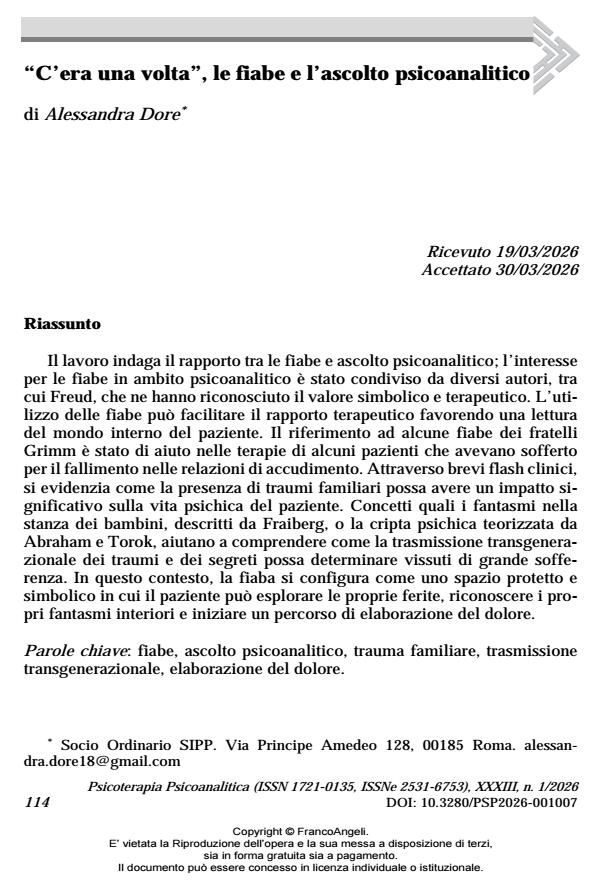
This paper investigates the relationship between fairy tales and psychoanalytic listening. Interest in fairy tales within the psychoanalytic field has been shared by several authors, including Freud, who have recognized their symbolic and therapeutic value. The use of fairy tales can facilitate the therapeutic relationship by promoting an understanding of the patient’s inner world. The reference to certain fairy tales by the Brothers Grimm has been helpful in the therapy of some patients who had suffered from failures in caregiving relationships. Through brief clinical vignettes, the study highlights how the presence of familial trauma can have a significant impact on the patient’s psychic life. Concepts such as the ghosts in the nursery, described by Fraiberg, and the inner crypt theorized by Abraham and Torok, help to explain how the transgenerational transmission of trauma and secrets can give rise to profound suffering. In this context, the fairy tale emerges as a protected and symbolic space in which the patient can explore their wounds, recognize their inner ghosts, and begin a process of working through pain.
Keywords: fairy tales, psychoanalytic listening, family trauma, transgenerational transmission, working through pain.
Alessandra Dore, “C’era una volta”, le fiabe e l’ascolto psicoanalitico in "PSICOTERAPIA PSICOANALITICA" 1/2026, pp 114-124, DOI: 10.3280/PSP2026-001007