The psychoanalytic narration between trauma and subjectivation
Journal title PSICOTERAPIA PSICOANALITICA
Author/s Saveria Toscano
Publishing Year 2026 Issue 2026/1
Language Italian Pages 9 P. 134-142 File size 54 KB
DOI 10.3280/PSP2026-001009
DOI is like a bar code for intellectual property: to have more infomation
click here
Below, you can see the article first page
If you want to buy this article in PDF format, you can do it, following the instructions to buy download credits
FrancoAngeli is member of Publishers International Linking Association, Inc (PILA), a not-for-profit association which run the CrossRef service enabling links to and from online scholarly content.
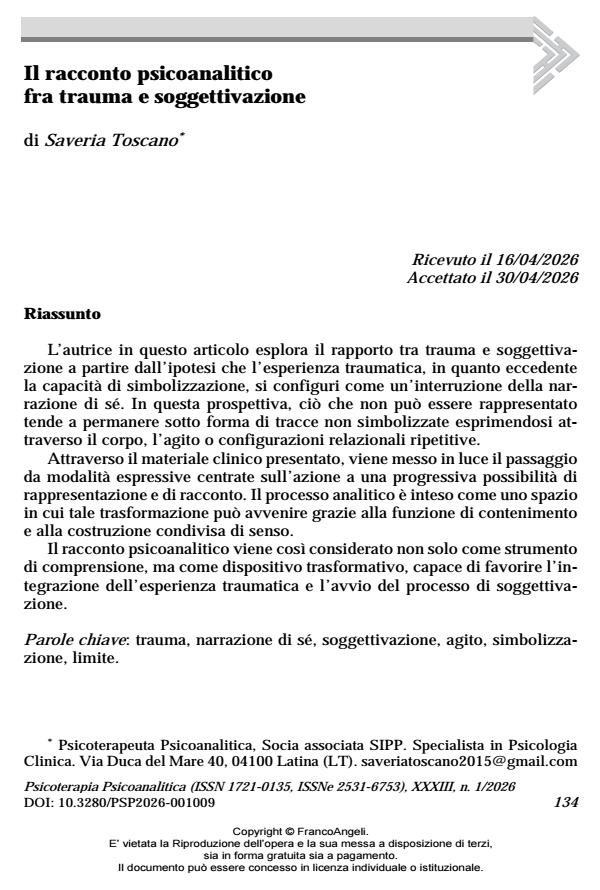
The author, in this article, explores the relationship between trauma and subjectivation starting from the hypothesis that traumatic experience, as it exceeds the capacity for symbolization, is configured as an interruption of self-narration. From this perspective, what cannot be represented tends to persist in the form of unsymbolized traces expressed through the body, the acting out, or repetitive relational configurations. Through clinical material presented, the transition from action-centered expressive modalities to a progressive possibility of representation and storytelling is highlighted. The analytical process is understood as a space in which such transformation can occur thanks to the function of containment and the shared construction of meaning. The psychoanalytic narrative is thus considered not only as a tool for understanding, but as a transformative device, capable of promoting the integration of traumatic experience and the initiation of the process of subjectivation.
Keywords: trauma, self-narration, subjectivation, acting out, symbolization, limit.
- Aulagnier P. (1975), La violenza dell’interpretazione. Dal pittogramma all’enunciato. Roma: Mimesis, 1994.
- Dolto F. (1981), Il gioco del desiderio. Saggi clinici. SEI, 1987.
- Freud S. (1920), Al di là del principio di piacere. OSF, IX.
- Freud, S. (1905), Tre saggi sulla teoria sessuale. OSF, IV.
- Green A. (1993), Il lavoro del negativo. Roma: Borla, 1996.
- Laplanche J. (1970), Nuovi fondamenti per la psicoanalisi. Roma: Borla, 1989.
- McDougall J. (1989), Eros. Le deviazioni del desiderio. Milano: Raffaello Cortina, 1997.
- McDougall J. (1989), Teatri del corpo. Milano: Raffaello Cortina, 1990.
- Parat H. (1999), L’erotico materno. Roma: Borla, 2000.
Saveria Toscano, Il racconto psicoanalitico fra trauma e soggettivazione in "PSICOTERAPIA PSICOANALITICA" 1/2026, pp 134-142, DOI: 10.3280/PSP2026-001009