Assertiveness and effective communication in healthcare professionals: a state of art perspective through a narrative review
Journal title PSICOLOGIA DELLA SALUTE
Author/s Danilo Atripaldi, Sonia Ambrogi, Ilaria Nicandra Capuano, Marina Ferrillo, Federica Osso, Francesca Baggio, Teresa Cosentino
Publishing Year 2026 Issue 2026/2
Language Italian Pages 13 P. 36-48 File size 210 KB
DOI 10.3280/PDS2026-002003
DOI is like a bar code for intellectual property: to have more infomation
click here
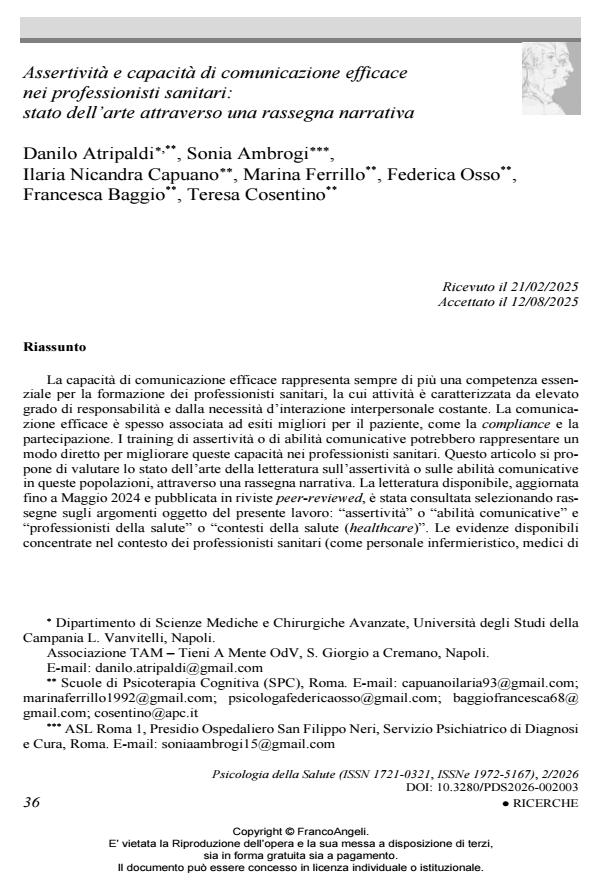
Below, you can see the article first page
If you want to buy this article in PDF format, you can do it, following the instructions to buy download credits
FrancoAngeli is member of Publishers International Linking Association, Inc (PILA), a not-for-profit association which run the CrossRef service enabling links to and from online scholarly content.
Effective communication skills increasingly represent an essential skill in the training of health professionals, whose work is characterized by a high degree of responsibility and the need for constant interpersonal interaction. Effective communication is often associated with better patient-related outcomes, such as compliance and participation. Assertiveness or communication skills training could represent a direct way to improve these abilities in healthcare professionals. This paper aims to assess the state of the art of the literature on assertiveness or communication skills in these populations, through a narrative review. Available literature, updated until May 2024 and published in peer-reviewed journals, was consulted, selecting reviews on the topics covered in this paper: “assertiveness” or “communication skills” and “health professionals” or “health (healthcare) contexts.” The available evidence concentrated in the context of healthcare professionals (such as nursing staff, general practitioners, specialized physicians, and related students) aimed at promoting communication skills has shown a good degree of effectiveness, despite heterogeneous conducting methodologies. Studies that have explored the effectiveness of programs geared toward promoting communication skills and assertiveness have shown increased involvement in care by health care users, associated with an improvement in the quality of information received in the absence of impact on access time. Promoting research by including studies with diverse clinical populations would explore possible barriers to improving the quality of health care services.
Keywords: Professional education, healthcare, communication skills training, healthcare professionals, assertiveness.
- Ammentorp, J., Bigi, S., Silverman, J., Sator, M., Gillen, P., Ryan, W., ... and Martin, P. (2021). Upscaling communication skills training–lessons learned from international initiatives. Patient Education and Counseling, 104(2): 352-359.
- Ardenghi, S., Russo, S., Rampoldi, G., Bani, M., and Strepparava, M. G. (2024). Medical students’ attitude toward patient-centeredness: a longitudinal study. Patient Education and Counseling, 108003.
- Belasen, A., and Belasen, A. T. (2018). Doctor-patient communication: a review and a rationale for using an assessment framework. Journal of Health Organization and Management, 32(7): 891-907. DOI: 10.1108/JHOM-10-2017-026
- Calhoun, A., Boone, M. C., Porter, M. B., and Miller, K. (2014). Using simulation to address hierarchy-related errors in medical practice. The Permanente Journal, 18(2): 14–20. DOI: 10.7812/TPP/13-124
- Gilligan, C., Powell, M., Lynagh, M. C., Ward, B. M., Lonsdale, C., Harvey, P., ... and Silverman, J. (2021). Interventions for improving medical students’ interpersonal communication in medical consultations. Cochrane Database of Systematic Reviews, (2).
- Grady, A., Carey, M., Bryant, J., Sanson-Fisher, R., and Hobden, B. (2017). A systematic review of patient-practitioner communication interventions involving treatment decisions. Patient Education and Counseling, 100(2): 199-211.
- Greenberg, C. C., Regenbogen, S. E., Studdert, D. M., Lipsitz, S. R., Rogers, S. O., Zinner, M. J., and Gawande, A. A. (2007). Patterns of communication breakdowns resulting in injury to surgical patients. Journal of the American College of Surgeons, 204(4): 533-540.
- Gutgeld-Dror, M., Laor, N., and Karnieli-Miller, O. (2024). Assertiveness in physicians’ interpersonal professional encounters: A scoping review. Medical Education, 58(4): 392-404.
- Jones, A., Blake, J., Adams, M., Kelly, D., Mannion, R., and Maben, J. (2021). Interventions promoting employee “speaking-up” within healthcare workplaces: A systematic narrative review of the international literature. Health Policy.
- Kim, S., Appelbaum, N. P., Baker, N., Bajwa, N. M., Chu, F., Pal, J. D., Cochran, N. E., and Bochatay, N. (2020). Patient safety over power hierarchy: A scoping review of healthcare professionals’ speaking-up skills training. Journal for Healthcare Quality: Official Publication of the National Association for Healthcare Quality, 42(5): 249–263. DOI: 10.1097/JHQ.000000000000025
- Kwame, A., and Petrucka, P. M. (2021). A literature-based study of patient-centered care and communication in nurse-patient interactions: barriers, facilitators, and the way forward. BMC nursing, 20(1): 158.
- Lee, S. E., Choi, J., Lee, H., Sang, S., Lee, H., and Hong, H. C. (2021). Factors influencing nurses’ willingness to speak up regarding patient safety in East Asia: A systematic review. Risk management and healthcare policy, 1053-1063. DOI: 10.2147/RMHP.S29734
- Lee, E., De Gagne, J. C., Randall, P. S., Kim, H., and Tuttle, B. (2022a). Effectiveness of speak-up training programs for clinical nurses: A scoping review. International Journal of Nursing Studies, 104375.
- Lee, S. E., Kim, E., Lee, J. Y., and Morse, B. L. (2022b). Assertiveness educational interventions for nursing students and nurses: A systematic review. Nurse Education Today, 105655.
- Leonard, M., Graham, S., and Bonacum, D. (2004). The human factor: the critical importance of effective teamwork and communication in providing safe care. BMJ Quality and Safety, 13(suppl 1): i85-i90.
- Liaw, S. Y., Ooi, S. W., Rusli, K. D. B., Lau, T. C., Tam, W. W. S., and Chua, W. L. (2020). Nurse-physician communication team training in virtual reality versus live simulations: randomized controlled trial on team communication and teamwork attitudes. Journal of medical Internet research, 22(4): e17279. DOI: 10.2196/1727
- Lyndon, A., Zlatnik, M. G., and Wachter, R. M. (2011). Effective physician-nurse communication: a patient safety essential for labor and delivery. American journal of obstetrics and gynecology, 205(2): 91-96.
- Morrow, K. J., Gustavson, A. M., and Jones, J. (2016). Speaking up behaviours (safety voices) of healthcare workers: A metasynthesis of qualitative research studies. International Journal of Nursing Studies, 64: 42–51.
- O’Donovan, R., and McAuliffe, E. (2020). A systematic review exploring the content and outcomes of interventions to improve psychological safety, speaking up and voice behaviour. BMC Health Services Research, 20(1): 101.
- Okuyama, A., Wagner, C., and Bijnen, B. (2014). Speaking up for patient safety by hospital-based health care professionals: A literature review. BMC Health Services Research, 14(61): 1–8. DOI: 10.1186/1472-6963-14-6
- Omura, M., Maguire, J., Levett-Jones, T., and Stone, T. E. (2017). The effectiveness of assertiveness communication training programs for healthcare professionals and students: A systematic review. International journal of nursing studies, 76: 120-128.
- Rabøl, L. I., Andersen, M. L., Østergaard, D., Bjørn, B., Lilja, B., and Mogensen, T. (2011). Descriptions of verbal communication errors between staff. An analysis of 84 root cause analysis-reports from Danish hospitals. BMJ quality and safety, 20(3): 268-274.
- Schwappach, D. L., and Gehring, K. (2014). Silence that can be dangerous: a vignette study to assess healthcare professionals’ likelihood of speaking up about safety concerns. PLoS one, 9(8): e104720.
- Schwappach, D. L., and Niederhauser, A. (2019). Speaking up about patient safety in psychiatric hospitals–a cross-sectional survey study among healthcare staff. International Journal of Mental Health Nursing, 28(6): 1363-1373.
- Schwappach, D., and Sendlhofer, G. (2020). Speaking up about patient safety in perioperative care: differences between academic and nonacademic hospitals in Austria and Switzerland. Journal of Investigative Surgery, 33(8): 730-738. DOI: 10.1080/08941939.2018.155401
- Smith, R. C., Fortin, A. H., Dwamena, F., and Frankel, R. M. (2013). An evidence-based patient-centered method makes the biopsychosocial model scientific. Patient education and counseling, 91(3): 265-270.
- Sutcliffe, K. M., Lewton, E., and Rosenthal, M. M. (2004). Communication failures: an insidious contributor to medical mishaps. Academic medicine, 79(2): 186-194. DOI: 10.1097/00001888-200402000-0001
- Thompson, L., and McCabe, R. (2012). The effect of clinician-patient alliance and communication on treatment adherence in mental health care: a systematic review. BMC psychiatry, 12: 1-12. DOI: 10.1186/1471-244X-12-8
- Zill, J. M., Christalle, E., Müller, E., Härter, M., Dirmaier, J., and Scholl, I. (2014). Measurement of physician-patient communication—a systematic review. PLoS one, 9(12): e112637.
Danilo Atripaldi, Sonia Ambrogi, Ilaria Nicandra Capuano, Marina Ferrillo, Federica Osso, Francesca Baggio, Teresa Cosentino, Assertività e capacità di comunicazione efficace nei professionisti sanitari: stato dell’arte attraverso una rassegna narrativa in "PSICOLOGIA DELLA SALUTE" 2/2026, pp 36-48, DOI: 10.3280/PDS2026-002003